
Z. ai has released GLM-5.4, a 750-billion-parameter model that matches systems with 2 to 3 trillion parameters by running part of its network twice. The Chinese lab, also known as Zhipu AI, described the design in a technical blog on 23 November. For business users the point is direct: more reasoning depth without a larger parameter count.
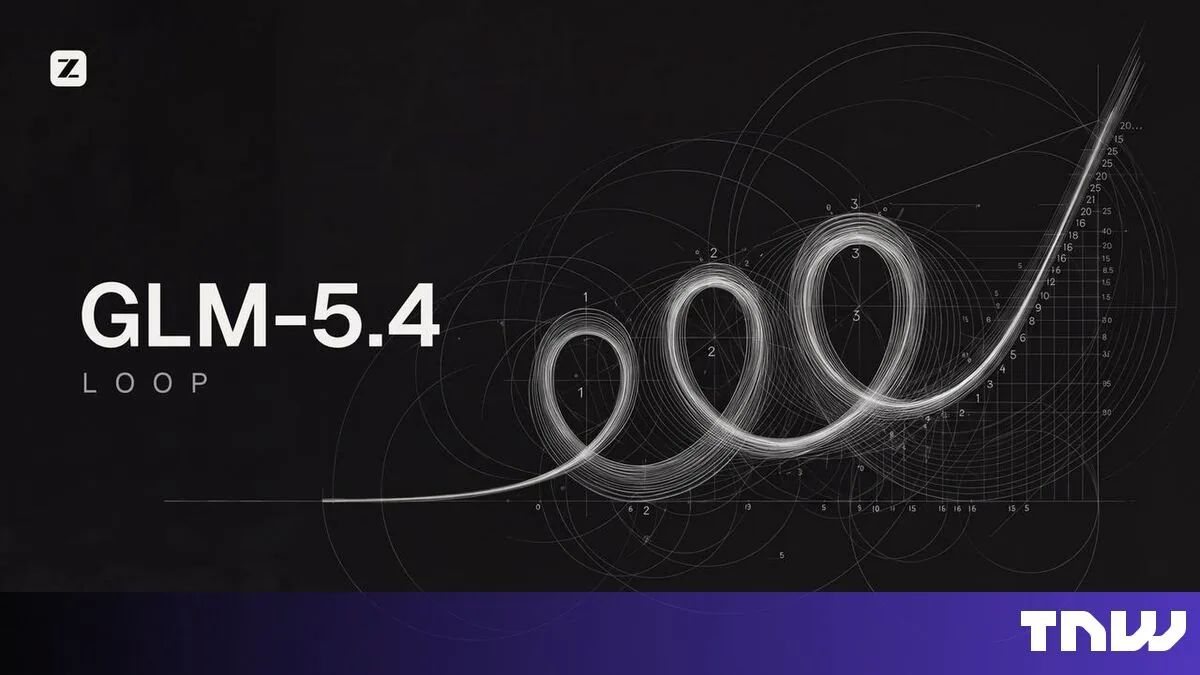
How GLM-5.4 reuses its base layers
The model is the first flagship built on a Loop Transformer and is available now to GLM Coding Plan subscribers, inside the ZCode tool and Z. ai Chat. API access will open after a safety evaluation, while open weights will follow safety hardening. Users with weekly quotas receive 50% more quota for GLM-5.4 than for GLM-5.3. A significantly larger model is coming soon, according to the company.
In a standard Transformer each layer runs once per pass, but GLM-5.4 runs 28 layers of the GLM-5 base model twice. That creates a deeper network with no extra parameters. The idea goes back to the 2018 Universal Transformer, Z. ai said. Thinking Machines released a looped model for laptops last week.
Z. ai did not train the looped design from scratch because such models still trail standard ones on the same compute budget. Instead it adapted the already trained base model through continued training. To control cost, the second pass reuses the cache and attention indices from the first pass and adds only a small sliding window of its own. Tests on 1B, 4B, 30B and 750B base models confirmed the approach.
On the 30B model, looping required about 10% more training compute and delivered the largest gains in maths, scientific reasoning and long-context tasks. Average output length on benchmarks such as GPQA-Diamond and MMLU-Pro fell by 10% to 14%. Z. ai published no benchmark scores for GLM-5.4 itself, but cited speed of up to 200 tokens a second off-peak and 70 to 80 at peak load. The prior GLM-5.3 focused on coding and cybersecurity, with Anthropic saying in October that it nearly matched Mythos at cyber exploits.
What Generalized Coding means for business
Z. ai positions the release as the start of Generalized Coding, where code becomes the basis for video, games, 3D shaders and CAD modeling. Demos include a self-narrated music video, a complete game, a 3D scene with custom shaders and a 6-axis robotic arm modeled in FreeCAD, plus vision capabilities for visual coding. For product teams this widens one coding subscription into prototyping for media, design and engineering tasks. Small firms gain access to formats that previously needed separate specialists.
The stated limitation is a tendency toward overly long marathon thinking loops, although Z. ai says extra self-correction still improves accuracy. Buyers should verify latency under peak load, where throughput drops to 70 to 80 tokens per second, and check weekly quota terms against GLM-5.3. Questions to ask cover API timing after safety evaluation, open-weight release conditions, and the six risk-management stages proposed with Concordia AI. The news alone does not prove benchmark leadership.
The marker to watch is the opening of API access and the release of open weights after safety work. If third-party developers reproduce the video, game and CAD results outside ZCode and Z. ai Chat, looped scaling will look like a practical path. The next large model from Z. ai will show whether the method holds at bigger scale.
