
XPENG presented its IRON humanoid at Tech Day on November 25, 2026 as a "qualified work partner" for commercial service, showing seven robots together with multilingual interaction. The machine stands 170 cm tall, weighs 62 kg and offers 76 whole-body degrees of freedom. The company pairs the hardware pitch with purchase and partnership inquiries, which matters because XPENG is testing whether a carmaker can sell labor hours rather than vehicles.
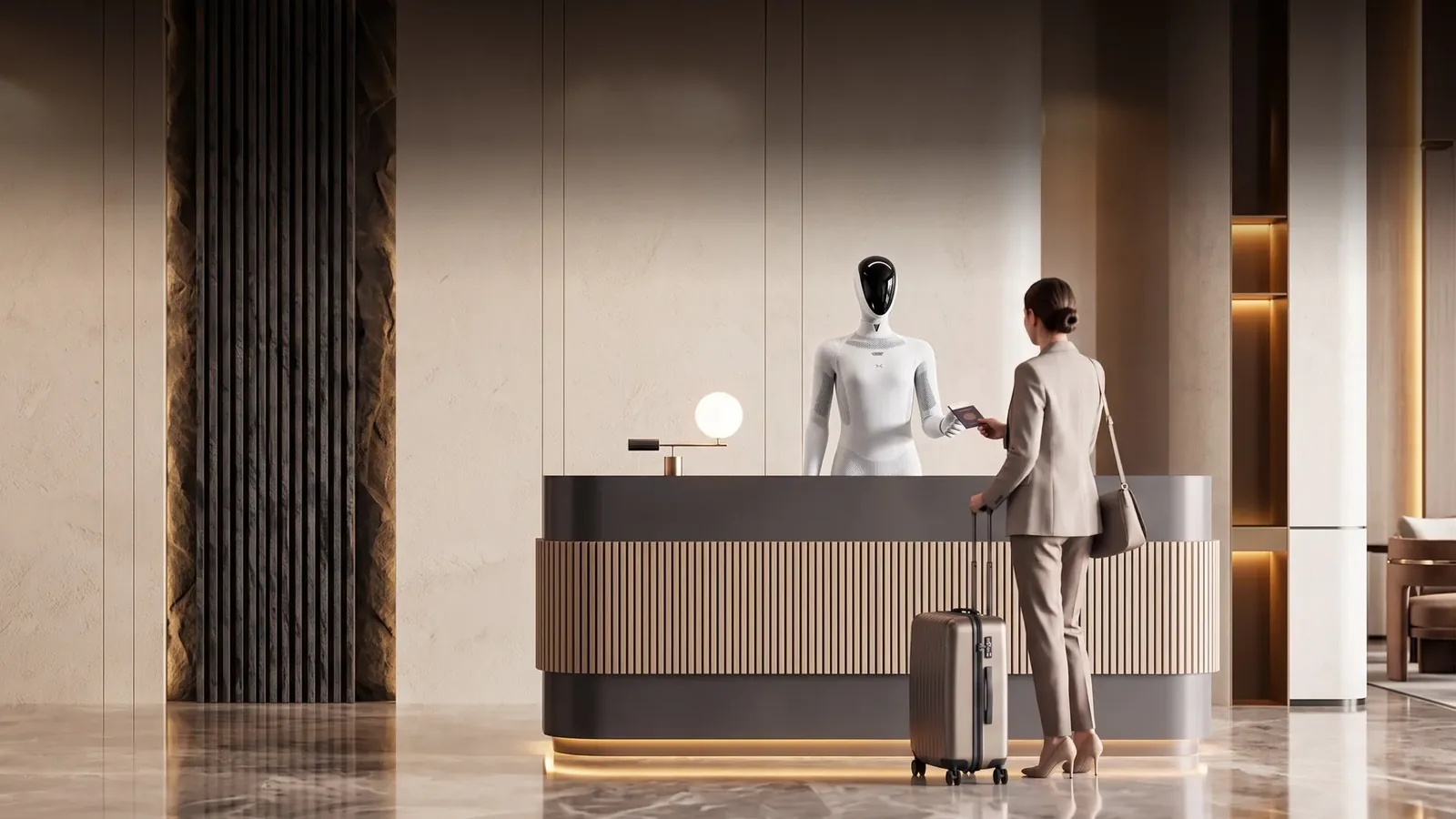
IRON work model, hardware and safety design
XPENG describes a work-service model built on schedule management, autonomous task planning, downloadable skill packages, whole-machine over-the-air updates and knowledge accumulation. Initial roles cover shopping guidance and tours, with wider commercial settings planned. The robot is designed for 24/7 service and manages charging itself, where a 20-minute charge supports 1.5 hours of work. Self-managed power thus becomes central to the offer, since IRON must move between assignments without staff help.
Local autonomy is handled by three in-house Turing chips rated at 2,250 TOPS of effective computing, with full-stack models running on the robot for millisecond-level responses and offline reasoning. After one walkthrough of an unfamiliar site, IRON can generate a local map, navigate without a network connection, accept visual calibration through a phone app and share maps with other robots. Sensitive face and voice data remain isolated on-device, while the communications system uses dual-channel redundancy. The architecture therefore reduces dependence on connectivity during a shift.
Physical interaction rests on more than 1,500 tactile contact points across the body, with over 80 percent tactile coverage in core areas. Each hand provides 21 degrees of freedom, 375 tactile sensors and support for 33 categories of everyday manipulation. The body uses full-coverage bionic skin and flexible muscles over magnesium-aluminum alloy and high-strength steel. For balance loss, the robot is designed to recover or bend its knees and select a fall direction, supported by a solid-state battery with cell energy density of at least 300 Wh/kg.
What IRON means for commercial AI adoption
For service businesses, the proposition is a programmable floor employee for guidance, tours and customer assistance that updates skills by download and shares site maps across a fleet. A retail chain or campus operator could deploy one mapped unit and replicate navigation to others, cutting setup time for new locations. Larger operators gain more from fleet mapping and centralized updates, while a small store faces a different calculation around utilization, floor space and supervision of a 170 cm machine.
The limits center on endurance and production readiness. A ratio of 20 minutes of charging to 90 minutes of work implies frequent power breaks inside any 24/7 schedule, so buyers need shift plans, charging points and task queues. XPENG itself cautions that displayed performance, functions and appearance may differ from the final mass-production product. Questions to the vendor should cover guaranteed uptime, offline skill limits, service terms and price of updates.
The marker to watch is the production timeline set on September 9, 2026: scale production by end of 2026, deployment in XPENG stores and campuses first, then launch and delivery in China and overseas in 2027. Backing that plan are more than 80 percent automated core processes, over 1,000 automotive-grade tests and a 50,000-square-metre data factory with 250 scenarios. If store deployments hold daily routines, the work-partner claim gains commercial weight.
