
Claude can now generate fully functional desktop applications for Windows and Mac from a single prompt, Anthropic said on November 24. Users can turn artifacts into standalone apps through a new Install as App feature, available in beta on Windows and macOS. The apps open in a dedicated window, carry their own icons, and can send notifications. For business users this matters because routine internal tools may soon be created without traditional software development.
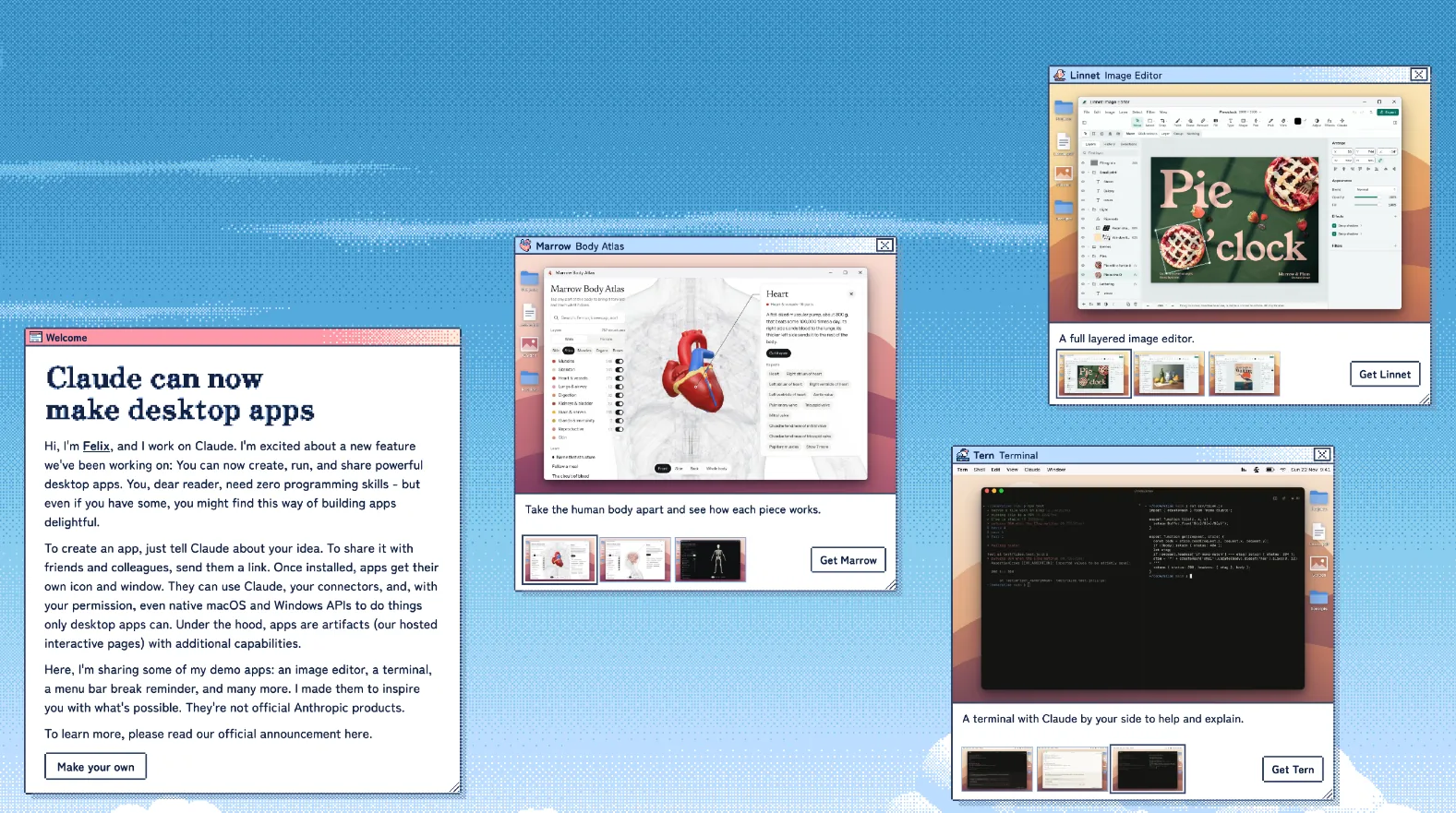
How Install as App changes artifacts
Artifacts have existed in Claude as objects such as an order tracker or a meeting dashboard that pulls data from calendar and email. Until now they lived only inside Claude, so a user had to open the chatbot, sign in, and locate the original conversation. Anthropic said people use artifacts for everyday tasks and argued that a work tool should open like other apps and remind users when attention is needed. The new feature removes that extra path and places the artifact on the desktop.
Creation follows a short sequence shown by Anthropic in a video on X. A user describes the desired tool, confirms the request, and Claude assembles the code within seconds. After clicking Install as app, the artifact opens like any other program instead of running inside the Claude interface. Converted apps can use Claude and third-party connectors, allowing AI agents to interact with them autonomously. Requests made by an app to Claude count toward monthly credit usage.
Anthropic illustrated the approach with tools built by its internal teams. The examples include Linnet, a featured image editing app, Phosphor, a file manager with cinematic design, and Tern, a terminal application integrated with Claude. The beta is open to all Claude subscribers except HIPAA-compliant organizations and hybrid Claude deployments. Team plans receive the feature by default, while Enterprise customers require administrator activation.
What this means for corporate software
For companies that adopt AI, the change lowers the cost of small operational utilities such as trackers, dashboards, and file helpers. A department could describe a workflow aid and receive a desktop program with notifications or a menu bar item, without commissioning desktop development. Small firms gain access to custom tools that previously required a contractor, while large firms can prototype departmental apps faster. The trade-off is consumption-based: heavy automated requests through connectors will consume Claude credits.
Several limits deserve attention before wider rollout. Anthropic states that users need to be online and signed in to Claude to open an app, so offline work is not possible. That differs from traditional desktop software, much of which runs without an internet connection. Buyers should also verify connector permissions, notification behavior, and how agent access is controlled. This announcement alone does not mean generated apps match the stability, security review, or long-term support of conventional programs.
The marker to watch is whether Team and Enterprise customers move these apps from experiment to daily work. Continued beta expansion, administrator enablement in large accounts, and examples of durable departmental tools would signal confirmation. If usage stays limited to demonstrations such as Linnet, Phosphor, and Tern, the format will remain a fast prototyping path rather than a replacement for desktop software.
