
Robust AI has deployed Carter, a mobile warehouse robot built to work alongside people rather than replace them, in logistics warehouses and on factory floors. The machine looks like a utility cart on wheels, moves in any direction on holonomic wheels, and can be pushed, pulled, or cut off by workers without stopping operations. In large facilities, staff walk on average 30,000 steps a day moving goods between stations. That matters because most factories cannot afford full automation, so productivity depends on how well people, robots, and backend systems perform together.
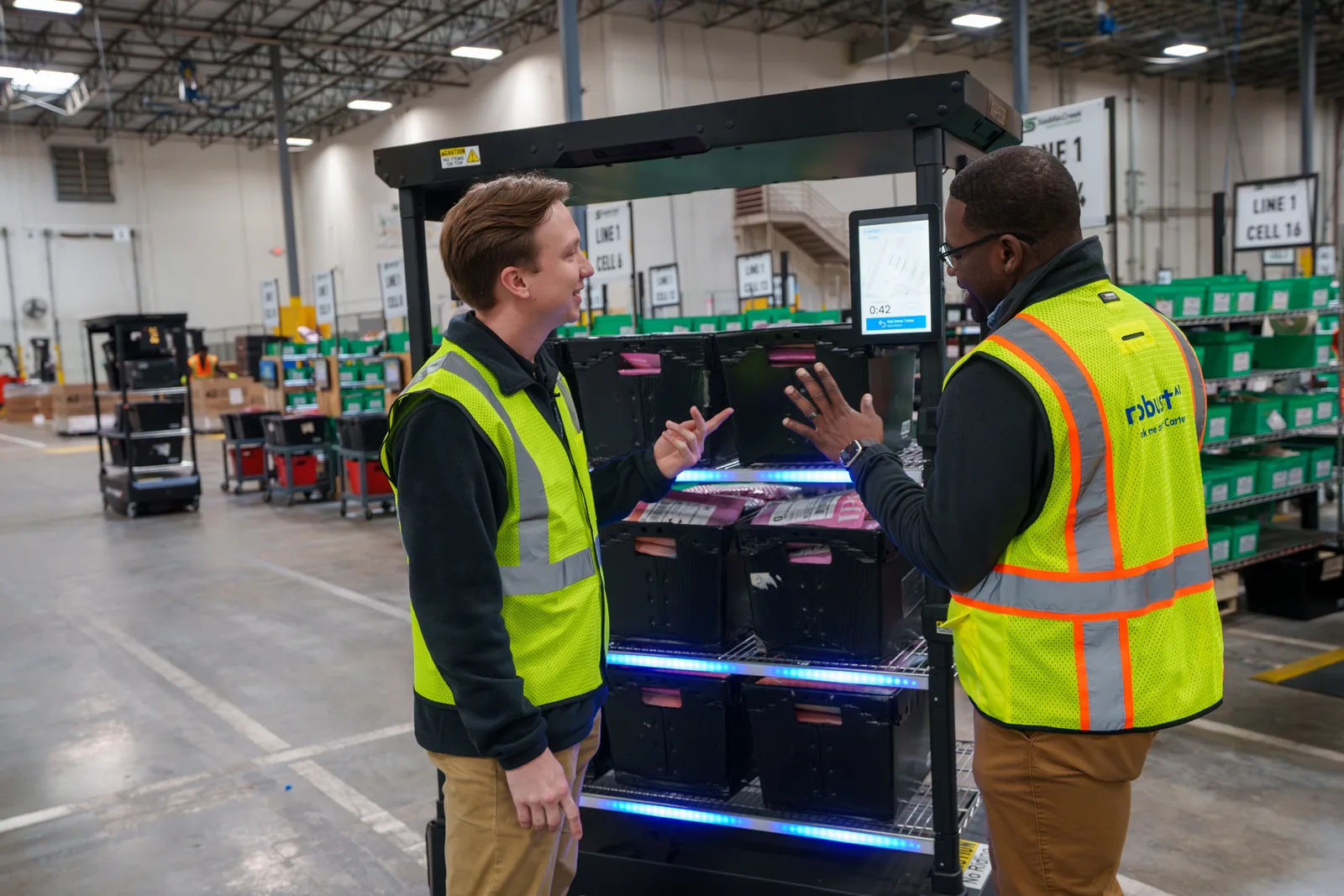
Carter design and early warehouse deployments
The company was co-founded in 2019 by MIT Professor Emeritus Rodney Brooks and Anthony Jules 92, SM 92, who now serve as chief technology officer and chief innovation officer. Brooks previously co-founded iRobot, maker of the Roomba vacuum that went public in 2005, and later Rethink Robotics, while Jules co-founded Sapient, acquired by Publicis in 2015. The pair met as members of CSAIL labs on the same floor in the 1990s and reconnected at a robotics conference in 2019. Their first plan was robotics software compared to a video game engine for training robots. The Covid-19 pandemic then pushed them toward disinfection robots, a direction abandoned once surface transmission was ruled out.
Carter is built around physical collaboration with workers in fast-changing environments. It carries a force-sensitive handlebar for guidance with one hand, an AI-powered vision system, and an onboard touch screen for commands and gestures. Holonomic wheels allow instant movement in any direction, so a person can redirect the machine or walk into its path without causing a fault. The robot can guide workers to specific locations for picking, follow them for loading, or carry items autonomously across a facility. In one cited case, a worker loads Carter and sends it 400 feet to another station with a simple done command.
The focus on warehouses and manufacturing follows years of customer interviews through several pivots. Jules contrasts the 5 percent of factories shown in photos with 50 to 200 million dollar fully automated systems against the majority that lack even a conveyor belt. Those plants will not tear out existing layouts for a 200 million dollar installation. Robust AI therefore offers robots that can be phased into operations as needed, with workflows selected by the customer. Leila Takayama, vice president of human robot interaction, supports that approach with research on why rigid automation fails. The company positions Carter for sites that need gradual improvement rather than replacement of the whole system.
What Carter changes for warehouse operations
For operators, the practical effect is less walking and fewer interruptions during picking, stocking, and transfer tasks. Instead of carrying goods across huge spaces, a worker loads the robot and returns to value work while Carter travels to the next station. The integration pattern is set by the customer, from robot-led guidance to human-led loading and autonomous transport. That flexibility helps small and mid-size sites that run manual processes without conveyors. For larger warehouses, the gain comes from keeping existing staff, layouts, and backend systems while adding mobile capacity step by step.
The design also addresses a common failure mode where robots block primary work. Brooks cites a peer-reviewed hospital study in which transport robots stopped dead in hallways when nurses rushed past with a gurney, leaving machines parked and switched off against walls. Carter is meant to avoid that outcome by yielding to people and accepting pushes, pulls, and gesture commands. Buyers should still verify navigation behavior in narrow aisles, peak-hour traffic, and mixed fleets. The source does not provide pricing, fleet size, deployment numbers, or measured throughput gains, so return calculations need pilot data from a comparable facility.
The marker to watch is whether Carter units stay active in daily shifts months after installation rather than being parked at the walls. Continued use across picking, replenishment, and long-distance transfers would confirm that phased collaborative robots suit non-automated plants. New customer names, repeat orders, and published workflow results would extend that signal. If adoption stalls, attention will return to fixed automation for the small share of sites that can fund it.
