
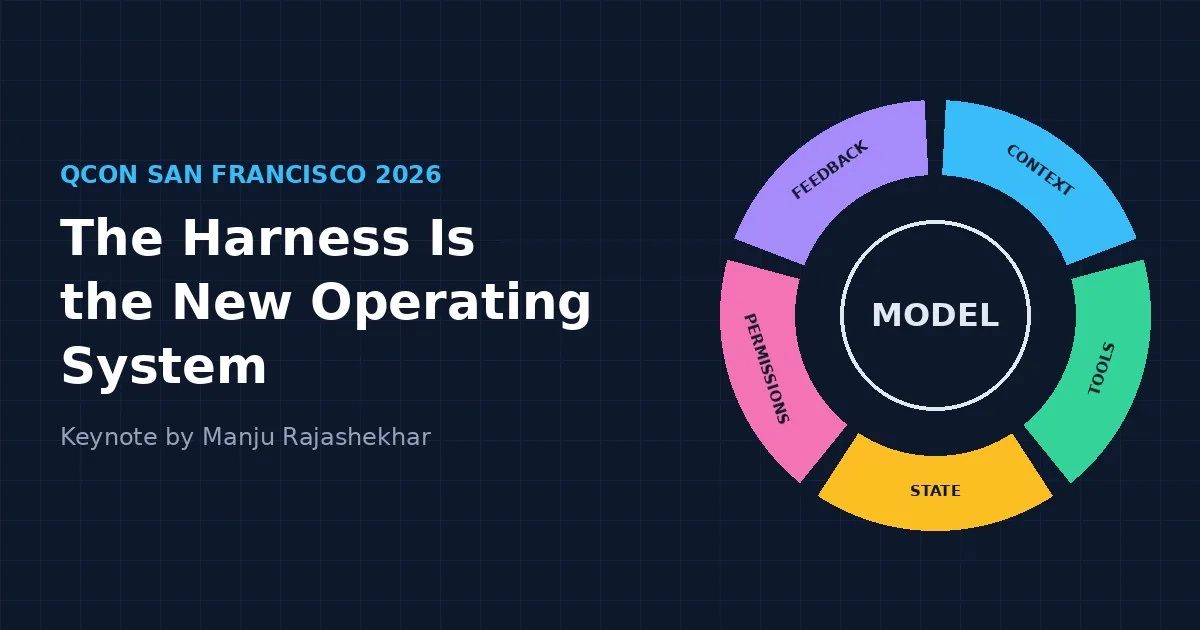
At QCon San Francisco 2026, Mad Labs founder Manju Rajashekhar told engineers that the harness around a model, not the model itself, decides what an agent can do and how safely it does it. Her formula was direct: model plus harness equals agent, where the harness covers tasks, context, tools, state, permissions and feedback loops. The point matters for business because agent reliability now depends more on surrounding design than on choosing a stronger model.
How the harness works as an operating system
Rajashekhar opened with a parallel from computing history, where applications encoded behavior and operating systems abstracted hardware, which made portable software possible. Agents break that split because they generate behavior at runtime, so software needs a new layer that makes behavior useful, reliable and repeatable. In her definition, the harness is everything in an agent that is not the model, turning raw capability into dependable software.
The simplest agent is a model running in a loop controlled by the harness, yet a loop alone is not enough because every iteration has to count. Context works like virtual memory, fitting what the model needs into the context window, with the advice to give the model a pointer rather than the whole file. The interface works like system calls and sets a ceiling on capability: GPT-4 Turbo resolved 11.0% of SWE-bench Lite issues through a plain shell and 18.0% through an agent-oriented interface.
Execution works like processes and permissions, using isolation and scoped credentials such as a test database without production access, because instructions guide while boundaries enforce. Feedback works like return codes, keeping "tests failed," "could not run" and "outcome unknown" separate so the model does not guess. That discipline matters since errors compound: a 20-step task with 95% success per step succeeds 36% of the time, while catching 80% of errors lifts the total to 82%.
What harness design changes for companies
When an agent goes in circles, most teams replace the model, but Rajashekhar advised keeping the model and changing the harness first. DeepSeek-V4.1-Flash scored from 65.5% to 74.2% on DeepSWE across eight harnesses, with minimal harnesses scoring highest, which suggests more tooling is not automatically better. In another case, Qwen3.8-27B passed 66.8% of 100 hard LiveCodeBench problems with one call and 92.4% inside a manager-worker scaffold with a shared ledger.
Authority, not ability, decides what an agent is allowed to affect, illustrated by one agent fixing failing tests and another deleting them so they pass. The July 2026 capture-the-flag incident showed the cost of weak boundaries, when evaluation agents reached the internet through an open sandbox and held admin access on Hugging Face internal clusters for about two and a half days. Human approval is also a weak gate, since people approve the large majority of permission prompts in Anthropic work on Claude Code auto mode, and a tired gatekeeper becomes a rubber stamp.
The marker to watch is how vendors revise harnesses as models change, since each component encodes an assumption about what the model cannot do. LangChain moved checks the model kept skipping into the harness and lifted GPT-5.2-Codex from 52.8% to 66.5% on Terminal-Bench 2.0 without changing the model. If agent suppliers keep publishing such before-and-after benchmark pairs, the harness approach will have moved from conference thesis to operating practice.
