
OpenAI published 722 mathematical manuscripts grouped into 372 families, selected from an evaluation of about 4,000 research problems. The collection includes papers, proof artifacts and selected reasoning summaries, while the internal frontier model itself remains unreleased. Average compute was roughly three hours of ChatGPT Pro thinking per result. For business, this matters because it tests whether AI can produce research-grade mathematics at low marginal compute cost.
What OpenAI released and how it was built
OpenAI placed the materials in a public GitHub repo and said it consulted the Institute for Advanced Study independent Advisory Group on Mathematics and AI on how to release them. Sam Altman described the release as "a new era of discovery". The model behind the work is unreleased, so outside parties see only papers, proof artifacts and reasoning summaries. That structure separates scientific claims from product availability and leaves verification to the mathematical community.
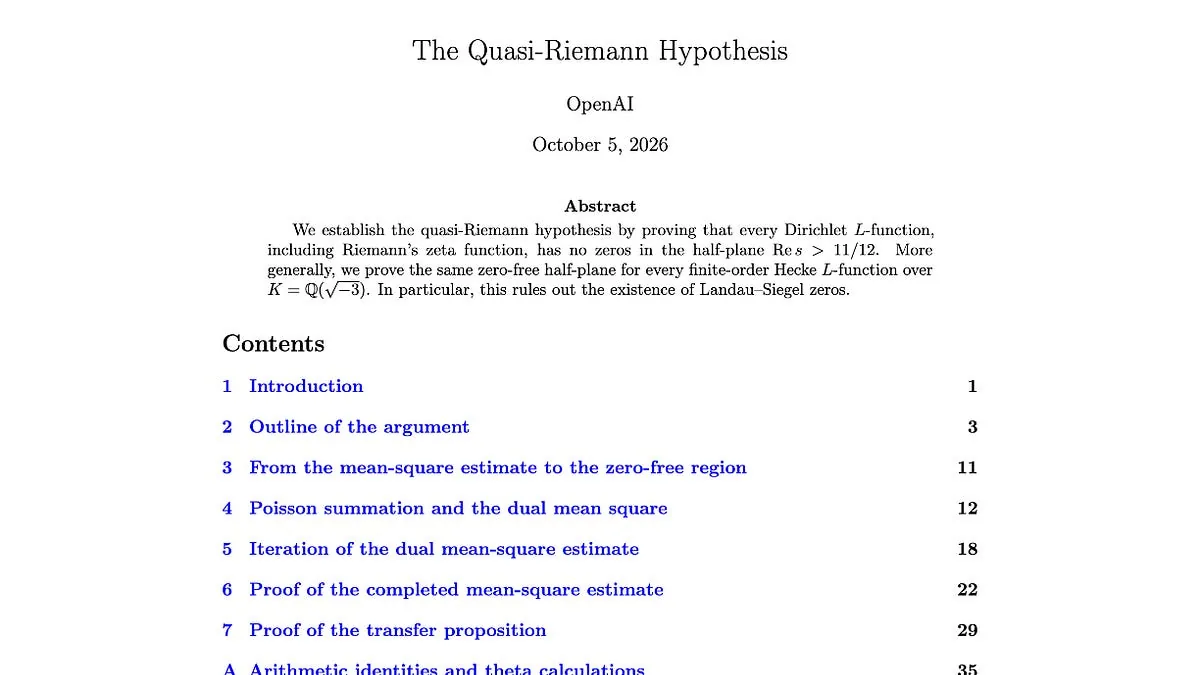
The headline claimed result is Result 003, the Quasi-Riemann Hypothesis, discussed alongside a no-Siegel-zeros result. Commentators also highlight an integer-multiplication result faster than n log n and a uniqueness result for the elastic inverse problem, described as open in 3D since 1994. Other notes point to partial progress on Riemann, Hodge and BSD problems. An analysis estimates about 20% of results are disproofs or counterexamples, which is presented as evidence against purely brute-force search.
Reaction has combined strong praise with caution about verification. Mathematician Levent Alpoge praised the quasi-Riemann and no-Siegel-zeros work and called it "the most significant moment in mathematical history", while also noting reported scooping and conflict-of-interest problems involving other labs users. Will Depue expects some results will not survive scrutiny and built citedbyagi. com to track cited human papers. Teortaxes noted that three hours of compute "is not much", and Francois Chollet asked whether gains in verifiable math and code generalize to domains without clear verification.
What this means for companies adopting AI
For companies that use mathematics in engineering, finance, logistics or software verification, the practical change is potential access to faster conjecture testing and proof assistance at modest inference cost. A small firm could review a difficult derivation or counterexample without maintaining a research team, using the papers and artifacts as starting points. A large organization could run many parallel checks across design, risk models or algorithms. The difference is scale: small firms gain access, large firms gain throughput across portfolios.
The limits are direct: the results were reported by individual commentators and have not been independently verified, so no manuscript should be treated as established. The model is unreleased, the reasoning traces are selected summaries, and errors are expected under scrutiny. Scooping and conflict questions add legal and priority risk for joint work. Before relying on such output, buyers should ask what was verified, by whom, which assumptions were used, and how a proof artifact can be rechecked independently.
The marker to follow is survival of the strongest claims through independent review over the coming months. Track whether the quasi-Riemann, no-Siegel-zeros and elastic inverse results hold up, and whether citations tracked on citedbyagi. com lead to corrections or confirmations. Confirmed proofs would signal cheaper research assistance; widespread retractions would keep human verification as the binding constraint.