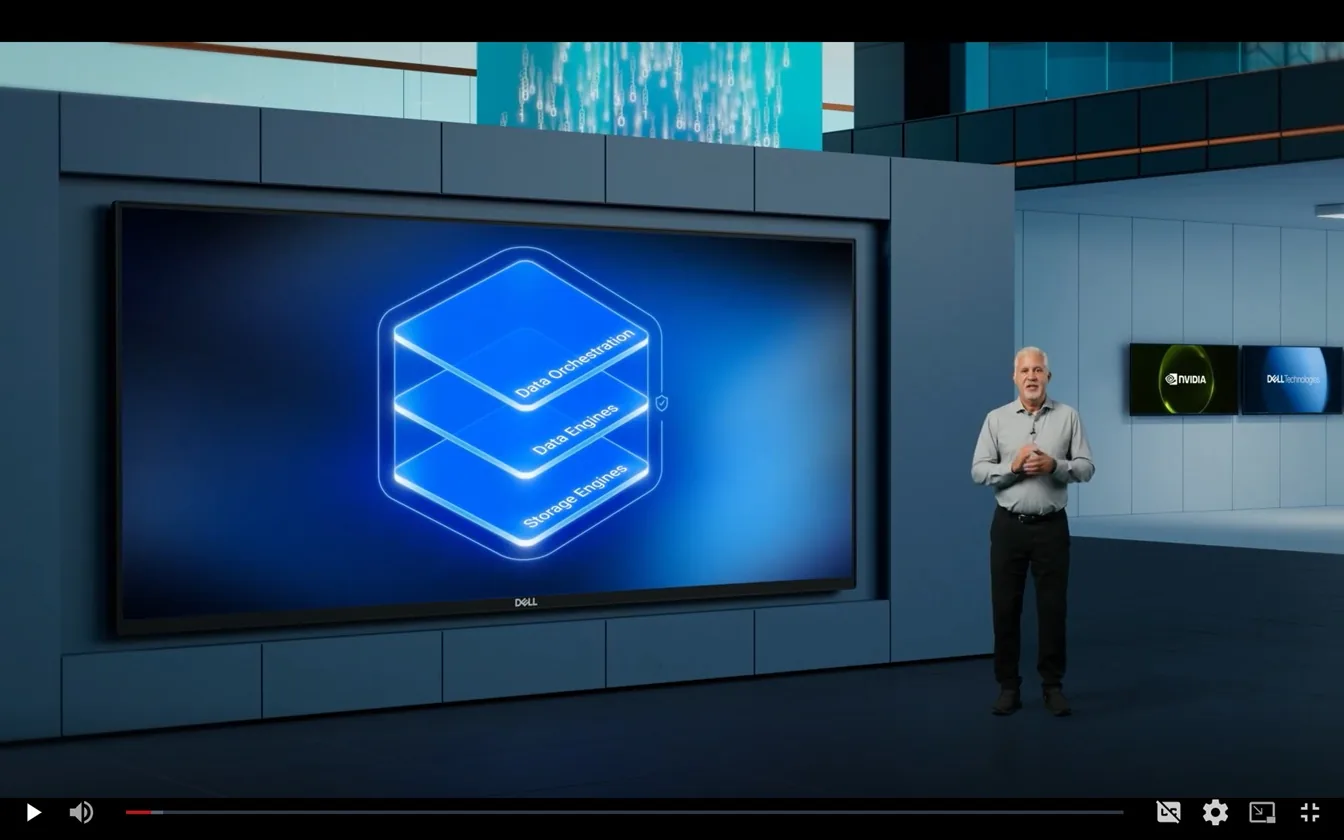
Dell Technologies has extended its AI Data Platform with new orchestration and processing capabilities aimed at agentic AI, including a Unified Semantic Layer, Enterprise Knowledge Graph and Knowledge Agents. The Data Processing Engine will now run on graphics processing units using Nvidia cuDF, while storage engines gain zero-copy access and memory-to-memory transfer. The move matters because Dell frames data, not models, as the next constraint on production AI.
What Dell added to orchestration and processing
At the center of the announcement is the Dell Data Orchestration Engine, which gains three additions that work together as one retrieval foundation. The Unified Semantic Layer gives structured and unstructured information consistent business meaning across sources, using open models with human-in-the-loop verification. The Enterprise Knowledge Graph connects entities and relationships from metadata, lineage, storage metadata and query history, then enriches each agent query with related tables, images, vector indexes and logs.
Knowledge Agents sit on top of those two layers as domain-focused assistants for parts of the graph. According to lead product manager Vrashank Jain, users can scope an agent to curated expertise, then set prompt-based guidance, data access permissions, quality guardrails and token cost thresholds. The agents remain model agnostic, which preserves choice of language models while standardizing how context is built. Jain described the result as trusted and accurate agentic retrieval.
The second change concerns the Data Processing Engine, redesigned to accelerate enterprise data preparation for AI directly on GPUs. Running with Nvidia cuDF, it moves closer to Dell storage through zero-copy data access, memory-to-memory transfer and distributed processing. Dell links this tighter path to PowerScale, ObjectScale and Lightning File System, each aimed at different performance, capacity and workload needs. The logic is straightforward: less unnecessary movement from raw information to AI-ready context.
What the agentic data center means for business
For companies deploying agents, the practical effect is faster access to harmonized context without rebuilding pipelines for every use case. A shared semantic definition means a term keeps the same meaning across reports, documents and databases, while the graph supplies related evidence automatically. Small teams gain a packaged route to governed retrieval, and large enterprises gain a way to serve many agents from one curated foundation at lower operational complexity.
The same design introduces controls that buyers should examine before committing. Permission models, verification workflows, graph tuning signals and token budgets will determine accuracy, cost and compliance in production. Dell positions the platform as model agnostic and continuously updated, yet customers still need to confirm how lineage is exposed, how unstructured sources are covered and how cyber resilience is enforced. This release alone does not prove sustained quality at scale.
The marker to watch is whether enterprises shift language from AI factories to agentic data centers in procurement and architecture decisions. Dell fellow Gaurav Chawla and theCUBE Research analysts frame that shift as agents becoming operators that call humans for review. If upcoming deployments show agents executing processes, learning over time and driving revenue per GPU, the data path will have become the core enterprise architecture.