
Moth announced Tessa on November 16, 2026, reporting encoding and recovery of 1,568 real values across all 120 qubits of IBM Phoenix Nighthawk r2 processor. The method targets loading classical data into fragile qubits on sparsely connected hardware, a persistent obstacle for quantum machine learning. This matters because data loading often limits practical use of quantum processors more than qubit counts alone.
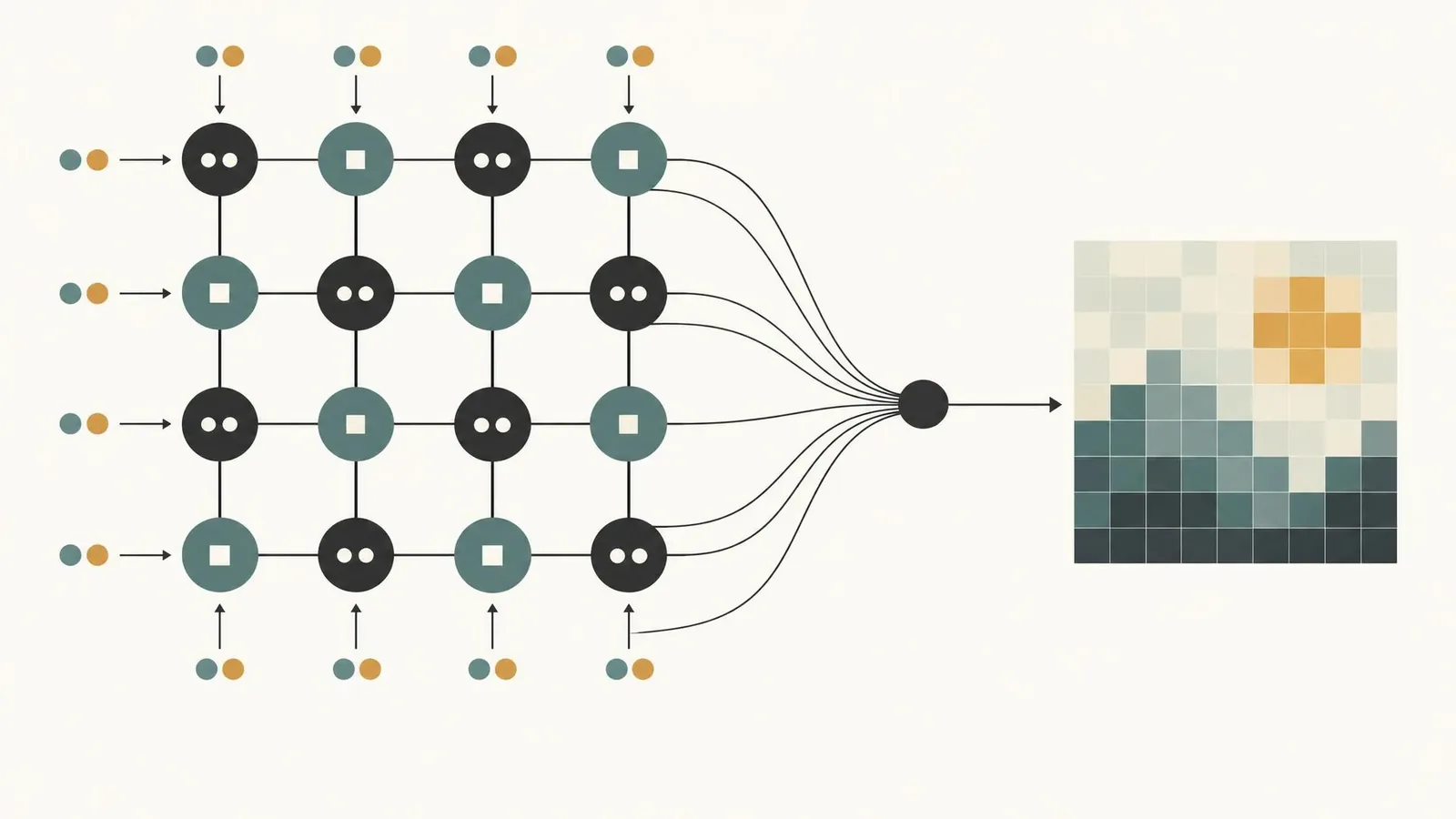
Tessellated encoding on physical coupling maps
Daniel Bultrini defines the claimed record narrowly: loading freely chosen numeric lists onto physical processors and retrieving individual values, excluding runs returning only a derived quantity. Under that definition, QCrank previously recovered 128 values from 12 trapped-ion qubits. A Fez experiment recovered 1,024 pixels from 13 qubits but used a trained tensor-network approximation rather than an arbitrary list, so it is not directly comparable. The paper therefore calls the Tessa run the largest reported under its definition.
Tessa, short for Tessellated QPIXL, alternates data and address qubits in a checkerboard laid over physical connections. Each data qubit is controlled only by neighbouring address qubits, which nearby data qubits can share. Every additional address neighbour doubles storage, so an interior qubit with four neighbours holds 16 values. The construction works on any bipartite coupling graph, where every coupler joins a data qubit to an address qubit.
Using the device layout avoids SWAP gates and routing and requires no ancilla qubits. The paper proves values on each data qubit remain independently recoverable despite shared controls. All values stored in a single basis decode from one round of computational-basis measurements across the chip. Tessa can also store a second number in each slot phase, and the Phoenix run used this pair mode for brightness and hue, placing two numbers in each of 784 used slots while spare slots held zeros.
What dense quantum data loading means for business
For companies tracking quantum machine learning, the practical change is a hardware-aware way to load and verify classical data across an entire processor. Single-basis tests used 8,192 shots per basis to recover a 28-by-28 QCAT image using 784 of 792 Phoenix slots and a 21-by-21 image using 441 of 448 Fez slots. Raw correlations reached 0.96 on Phoenix and 0.95 on Fez, with mean absolute errors of 0.130 and 0.131, reduced to 0.075 and 0.078 by dynamic-range recovery. Small exploratory teams and large R and D units get the same verification path through raw counts and notebooks.
Density carries costs that buyers should weigh before treating the record as production readiness. Pair mode adds measurement bases and doubles circuit depth, with 1,456 two-qubit CZ gates versus 728 for the single-basis Phoenix run. The 1,568-value run showed value correlation of 0.69, value error of 0.152 and hue error of 0.092. Shots divide among local address configurations, so requirements for equal accuracy grow exponentially with local coupling degree, and no error mitigation was used.
Beyond images, tests covered audio, MIDI, DNA and protein sequences including p53, chosen for length or names rather than biology. At 32,768 shots per measurement, Phoenix recovered the 784-nucleotide MT-CO3 sequence with 92.1 percent exactly correct, or 92.3 percent with recovery selected using the true sequence. Moth offers Tessa for image-processing experiments on its Atlas platform, with library, job records and notebooks available. The open question is whether later computations can use the encoded state without full reconstruction.
