
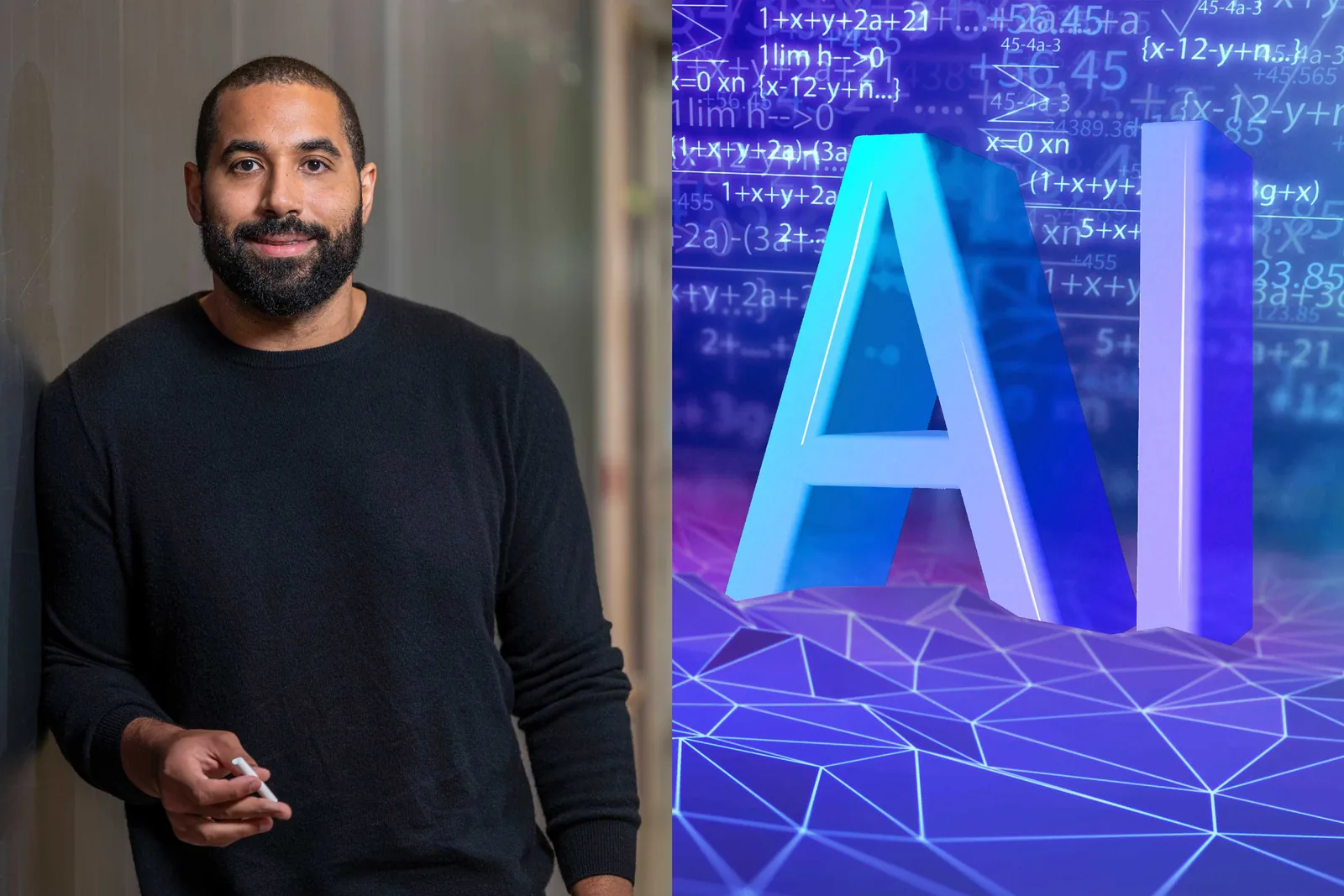
MIT mathematician John Urschel used AI tools to complete two proofs that had stumped mathematicians for decades, then argued that human problem-solving muscles matter more, not less. Urschel, the Class of 1956 Career Development Assistant Professor in the MIT Department of Mathematics and a former Baltimore Ravens lineman, described AI as a collaborator with seemingly unlimited resources that handles certain mathematics far faster than people. The lesson he draws for business is direct: value comes when a person understands how the machine combined ideas and can explain it to others.
Two proofs solved with human insight plus AI
Urschel recently published two preprints on arXiv, one on the growth factor of random matrices and the other on worst-case behavior in Gaussian elimination. Both combined human insight with AI tools to close problems that had resisted solution for decades. He said these were the first two papers in which he had ever used the machine in this way. The experience felt different from solo work, closer to working with a collaborator that executes specific operations at far greater speed. For MIT, the cases became material for a wider conversation about education, AI, and mathematics.
The workflow Urschel describes separates machine output from human assimilation. AI can produce calculations and certain types of mathematical reasoning much more efficiently than any person, in the same way computers long ago outpaced humans at arithmetic. Yet the proof itself gains value only when a human studies how the system combined mathematical ideas, internalizes that logic, and communicates it. He stresses understanding to students who use AI systems, while students who do not use them focus on classical problem-solving training. That division preserves curiosity and independent judgment alongside automation.
The interview follows a recent report from MIT's Ad Hoc Committee on AI Use in Teaching, Learning and Research Training, which stressed productive struggle and collaboration in learning. Urschel calls AI a giant win for education and for leveling playing fields because easily accessible tools provide vast knowledge to learners without academic family backgrounds. He recalls learning advanced concepts as a student through a laptop and Google, finding papers by leading experts freely available online. Current systems extend that access further, letting students learn faster than before.
What this means for training staff to work with AI
For companies adopting AI copilots and agents, the implication is to train staff for verification and reasoning rather than for memorized expertise. Urschel argues that knowing facts at one's fingertips matters less when a machine holds those resources, while the ability to think independently commands a premium. In practice this shows up in analysis, engineering, finance, and operations roles where employees must check machine-generated calculations, proofs, code, or forecasts. Large firms can formalize that review step, while small firms depend on each employee's quantitative discipline.
The risk is the illusion of competence created by one-click homework, essays, and solutions. Urschel warns that tired students can finish assignments with the push of a button and believe they understand material they have not actually learned. The same failure mode appears in business when teams accept AI drafts, models, or reports without working through assumptions. What remains unclear is how each organization will measure real understanding, which tasks may be delegated, and what questions vendors' claims must answer. This news alone does not prove a new pedagogy works at scale.
A marker to watch is how MIT and peer universities redesign in-person teaching over the next academic cycles: recitations, office hours, and assessments that require students to show reasoning and collaborate with peers. If attendance, completion of unassisted work, and demand for residential programs hold steady alongside AI use, the argument for struggle plus human connection will have institutional support. For employers, that outcome would signal a pipeline of graduates trained to direct machines rather than defer to them.
