
LangChain has raised $300 million at a $3 billion valuation, with Alphabet fund CapitalG leading the round alongside IVP, Sapphire Ventures, GIC and DFJ Growth. The San Francisco company supplies widely used open-source software for building AI agents plus the paid LangSmith platform for running them in production. The scale of the round matters because agent infrastructure has become a separate budget line for enterprises deploying automation beyond pilots.
How the $300M round is structured
The Wall Street Journal reported the financing details, placing LangChain at a $3 billion valuation after the new capital. CapitalG took the lead position, while IVP, Sapphire Ventures, GIC and DFJ Growth joined the round. LangChain said it plans to nearly double staff to 850 employees by the end of 2027. Hiring will cover infrastructure specialists, AI engineers, salespeople and marketers, a mix that points to parallel investment in product depth and enterprise distribution.
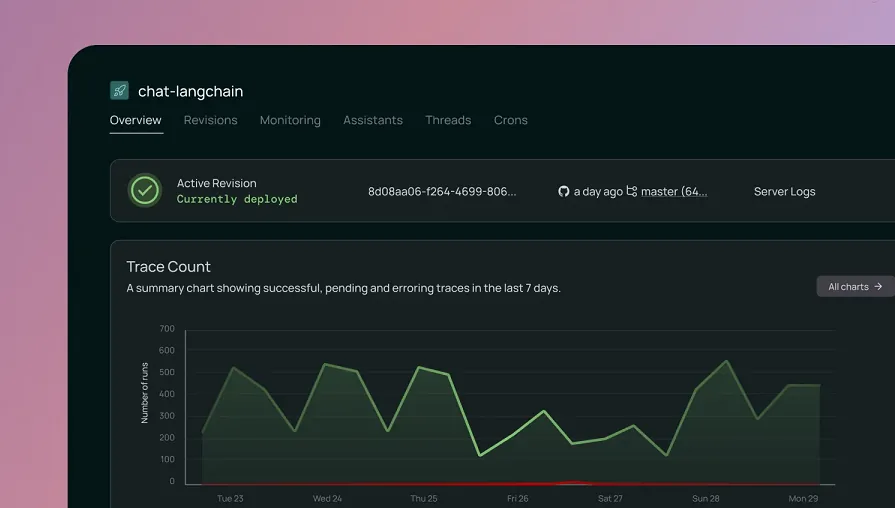
Revenue comes from LangSmith, a paid suite for building agents and maintaining them after release. Teams can store agent iterations in a central repository and roll back to an earlier version when an update introduces a bug. Version comparison helps select the build with better output quality for production deployment. LangSmith also produces traces that record every step of prompt processing, analyzes them for technical faults, ranks issues by severity and generates code fixes.
The open-source base consists of three components with distinct roles in agent projects. The original LangChain framework, released in 2022, connects an agent to a large language model, adds tool integrations and system prompts, and controls response formatting. LangGraph links several LangChain-based agents into one workflow and supports human approval for sensitive actions. Deep Agents adds a virtual file system for agent data, work planning functions and subagent generation for complex assignments.
What the funding means for enterprise AI
For companies building agents, a funded LangSmith roadmap lowers the cost of keeping automations stable after launch. Central version storage shortens recovery when a release fails, while trace analysis reduces manual debugging of multi-step workflows. Small teams gain access to testing and observability without building internal platforms, while large organizations can standardize agent maintenance across departments. Customers named in the source include Autodesk and Cisco Systems alongside other technology firms.
The main limitation is that financing does not remove integration and governance work inside the buyer organization. Multi-agent workflows still need clear approval rules, data access controls and ownership for production incidents. Download volume of about 90 million per month, disclosed after the previous round last year, signals popularity rather than production readiness of any specific project. Buyers should ask how LangSmith fits existing model contracts, logging policies and change management before committing.
The marker to watch is hiring progress toward 850 employees by the end of 2027 and the balance between engineering and sales roles. Steady growth of the infrastructure and AI engineering teams would confirm continued work on reliability and complex workflows. Faster expansion of enterprise customers on LangSmith would show that agent projects are moving from experiments to maintained services.
