
LangChain launched LangSmith Tool Gateway in public beta on November 19, 2026, giving enterprises a shared control layer for agent tool calls. The gateway routes requests to MCP tool servers, centralizing authentication, access rules and call records that teams otherwise build into each agent. Availability is limited to LangSmith Plus and Enterprise plans, which makes the release relevant mainly for organizations already running agents in production.
How Tool Gateway routes and checks tool calls
Administrators register a remote MCP server once or enable a LangSmith-hosted built-in server, then assemble selected tools into a kit exposed through one MCP URL. The kit defines which tools an agent can see, including tools taken from different servers. For large catalogs, search mode lets the agent query the kit and load only task-relevant tools instead of loading the full set. The source illustrates the scale with a large US retailer exposing over 1,000 tools across more than 50 MCP servers for store operations and inventory.
Identity handling separates employee-facing work from unattended work. In acting-as-user mode, the call uses the end user's credentials, with Okta or Entra ID identifying the person; an unconnected user gets a sign-in link and the call continues after authentication. In acting-as-agent mode, the call uses the agent's own credentials or a shared profile connected once by a workspace administrator. That split lets a store assistant act under each associate's rights across inventory, schedules and email, while a 3 a. m. stock reconciliation runs under service credentials.
Each request follows a fixed sequence described in the documentation. The gateway identifies the user, agent or profile, applies deny policies, attaches a stored credential or requests a connection, checks approval policies and forwards the call. Deny rules can target users, service keys or combinations at organization or workspace level, including rules for everyone with listed exceptions. Approval policies add a human checkpoint in the MCP client before execution, for example requiring confirmation of each attempted write by a warehouse-writing tool.
What centralized tool control means for business
For companies operating agents, the practical effect is fewer custom access mechanisms inside every agent. Authentication, permission checks and call records move into one layer, so a change in credentials, token refresh logic or tool allowlist does not require edits across many codebases. Small teams gain a ready kit-and-URL model plus managed sign-in integrations for Google, Microsoft, Salesforce, GitHub, Linear and LinkedIn. Larger estates benefit more, because kits, search mode and deny rules address catalogs that already count hundreds or thousands of tools.
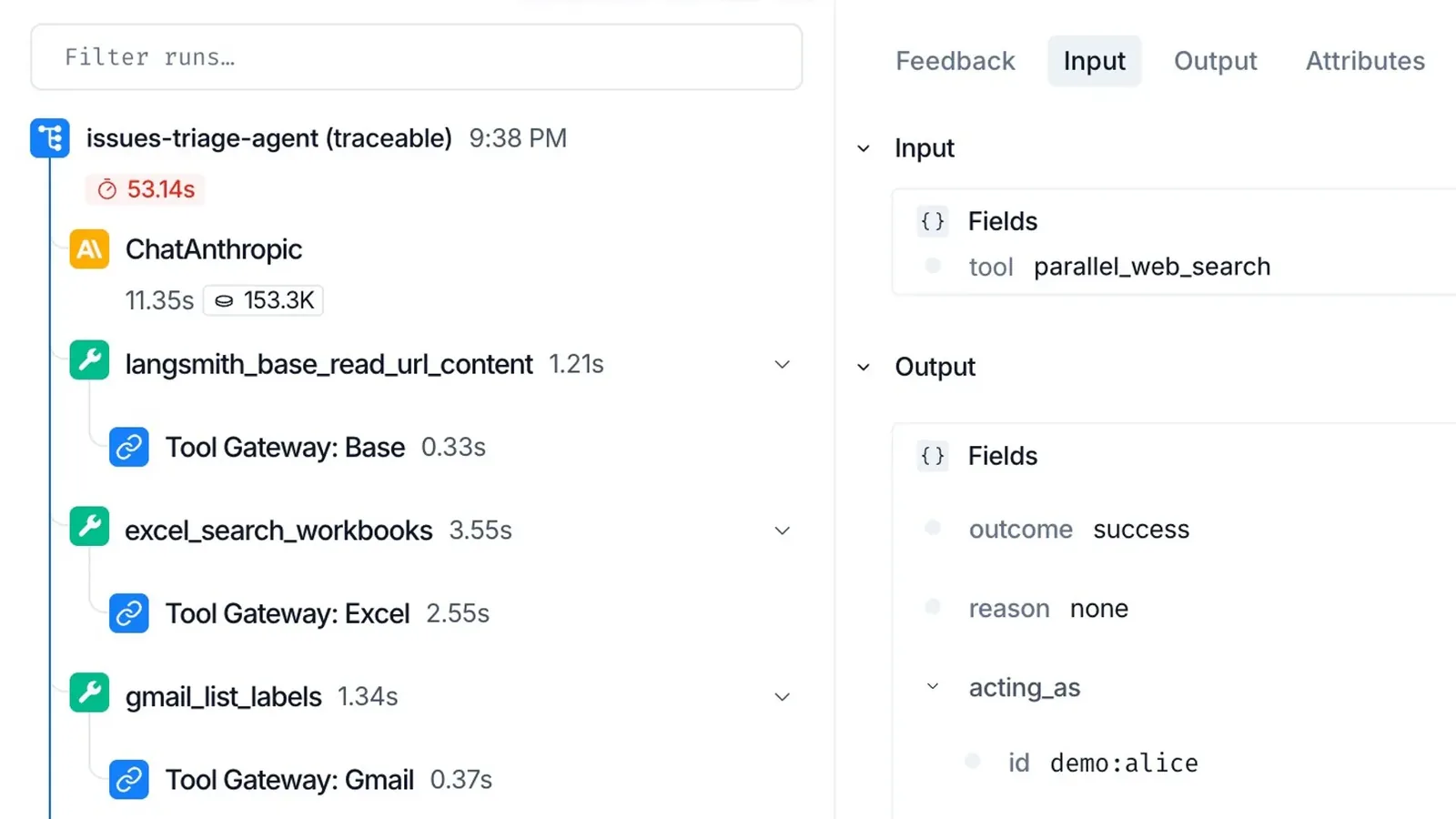
The release still leaves checks that buyers should perform before deployment. With tracing enabled, the record includes tool, server, user, outcome and duration, but not the data sent to or returned by the tool; the organization-wide audit log is reserved for Enterprise plans. Regional support on LangSmith Cloud covers GCP US, GCP EU, GCP APAC and AWS US, while Azure US is excluded. Compatibility should also be confirmed, with listed MCP clients including LangChain, Deep Agents, Managed Deep Agents, Claude Code and Cursor, plus API-key or public built-ins such as Parallel search, Exa, Tavily, Apollo, Ashby and Pylon.
A useful confirmation marker will be expansion beyond the current beta limits. Watch whether Azure US support appears, the audit log moves beyond Enterprise, and LangChain reports production use beyond the retailer example. Paired with LLM Gateway for model calls, Tool Gateway points toward one LangSmith control plane for models and tools, but its business value will depend on that wider rollout.
