
At the AI Engineer Code Summit, TypeSafe AI CEO Diogo Almeida presented Jev as "reliable intelligence" for automating everything, less than two months after its September release. Jev belongs to system one models that return structured choices, scores or probabilities and run faster and cheaper than reasoning LLMs. Engineers from Glean, UiPath and Workday showed early production prototypes built on it. The shift matters because unreliable outputs have limited direct automation with large language models.
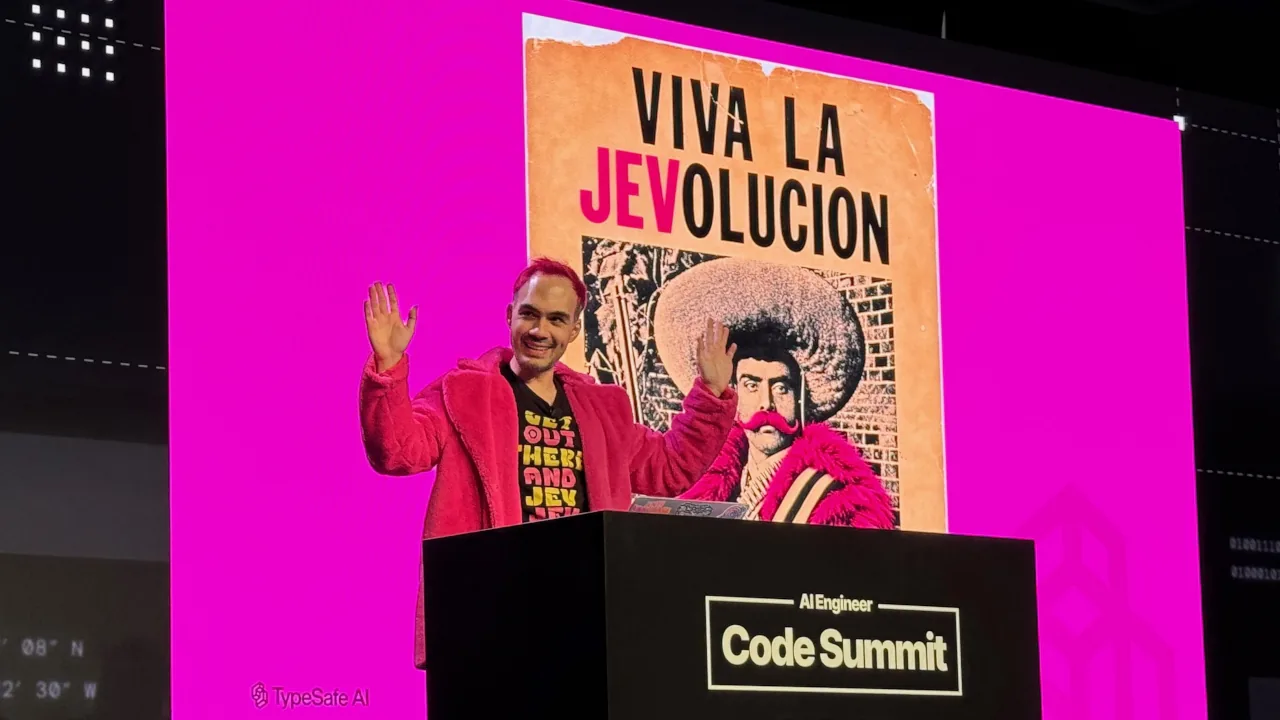
Jev presentations at AI Engineer Code Summit
Almeida, lead creator of Jev and co-founder of TypeSafe AI, delivered the keynote that framed the session. He argued that system one models should be integrated with code, saying code is the language of automation. Latent Space founder swyx described the idea as sprinkling System One calls inside application code instead of concatenating strings and hoping for the best. Almeida contrasted the approach with LLM-driven software that delivers Einstein 95% of the time and Mr. Bean 5% of the time, without a clear way to tell the difference.
Jev itself is positioned as a non-generative model for decisions rather than text generation. It produces structured outputs that software can act on directly, which reduces ambiguity in automated flows. Glean engineer Chinmay Goyal said his team uses system one models alongside LLMs and other classifiers. He singled out zero-shot flexibility: when the taxonomy of the decision space changes, the team does not need to fine-tune models again and again. Customers do not need to know which model type powers a flow, only that the product works.
The context is a search for reliability after rapid LLM adoption in software. A September Latent Space podcast with Almeida on Jev launch problems became the publication's most popular episode of the year, with reliability as the central theme. System two models, or reasoning LLMs, remain powerful but slower and more expensive for routine decisions. System one models address the gap where a fast scored choice is enough. Almeida closed by comparing current experimentation to the early internet and predicting an explosion in what software can do.
What System One means for automation projects
For companies building AI features, the practical change is embedding many small model calls directly into product logic. UiPath engineers Chibi Vikram and Kevin Bernstein tested Jev for ranking document chunks through a tournament, where winners from small groups advanced to further rounds. The process involved thousands of Jev calls and completed in under a second. Workday principal engineer Scott Roberts showed a time-off card that starts filling while the user is still typing, moving from predicting words to predicting actions. Such patterns suit classification, routing, ranking and form completion.
The approach has clear limits that buyers should verify before scaling. Goyal presented rules for when to use Jev, indicating it fits alongside LLMs rather than replacing them in all tasks. UiPath described Jev as a building block that looks less intelligent alone but gains power through strategies and patterns. Performance depends on correct integration, decision design and fallback handling for uncertain scores. Teams should ask vendors about accuracy on their own taxonomy, latency under load, cost per decision and retraining behavior when categories change.
A useful marker will be whether more enterprises report Jev powering a significant number of live flows without users noticing the model underneath. Glean already describes that pattern, with complexity hidden from customers. If UiPath and Workday move tournament ranking and predictive interfaces from prototypes to default features, the building-block method will be confirmed. That would signal a wider move from chat-centered AI to decision models wired into code.
