
Cerebras Systems said on November 17, 2026 that its production disaggregated inference deployment delivered five times the throughput per megawatt of a CS-3-only setup, with no loss in token-generation speed. The split assigns prompt processing to AMD Instinct GPUs and response generation to CS-3 systems inside Cerebras Inference Cloud. The gain matters because power-constrained data centers can serve more fast-inference demand from the same power budget.
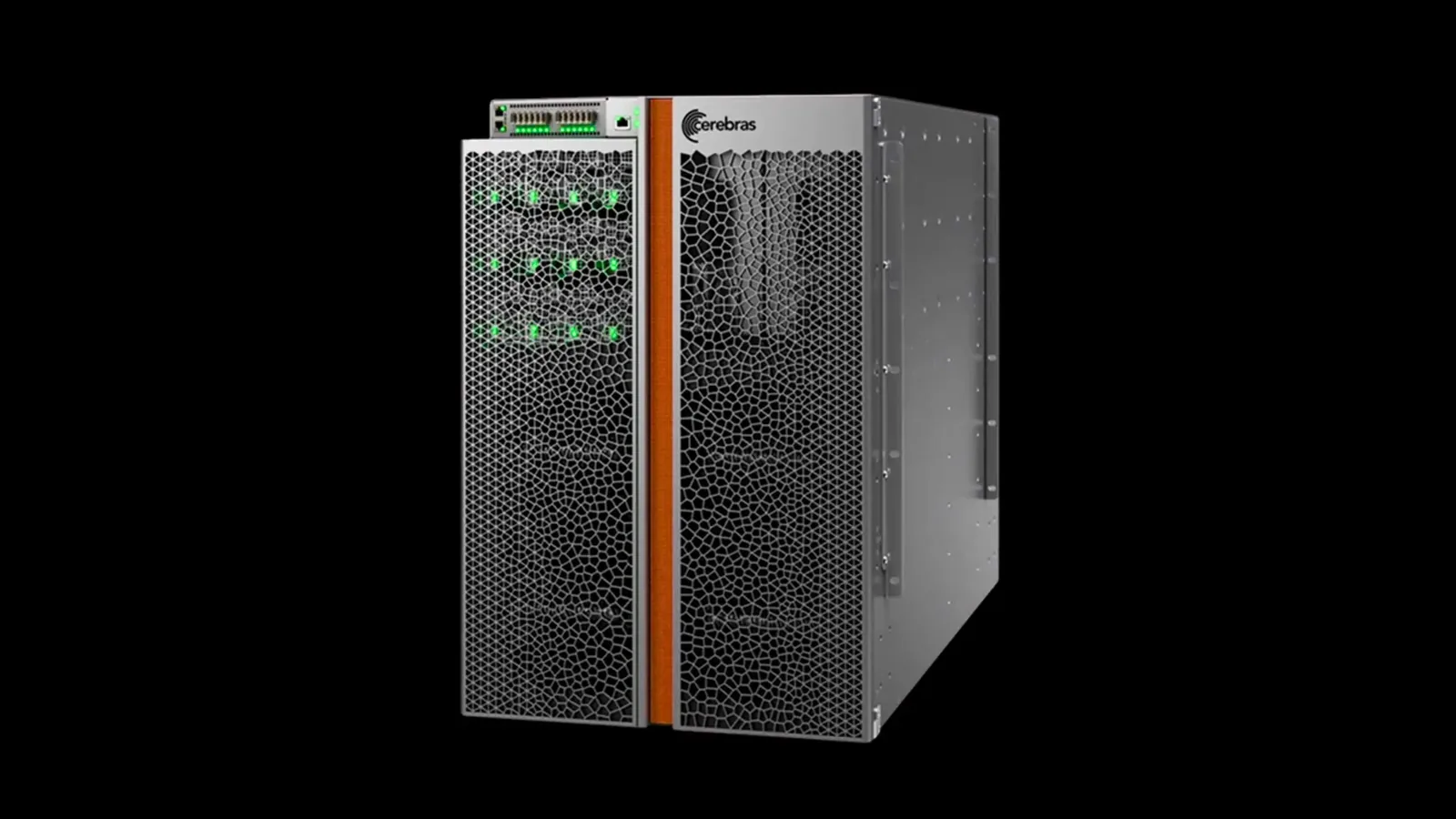
Production measurement and deployment package
The measured result came from a shared GPT-OSS-120B endpoint on November 14, 2026, comparing throughput per megawatt before and after disaggregation was enabled. Cerebras normalized the aggregated configuration to a 1x baseline, so the reported figure describes efficiency per megawatt rather than raw output. Moving prompt work to GPUs frees CS-3 serving capacity for generating responses, expanding the fast-inference capacity available through its cloud. The disclosure follows an October 1, 2026 explanation that cited a 5x gain in early tests with the same wafer-scale-engine footprint.
Each inference request has two stages with different hardware demands. Prefill processes the input prompt and creates intermediate model state, while decode uses that state to produce output tokens one at a time. Every decode step reads model data from memory again, which makes memory bandwidth central to interactive generation speed. Prefill performs more computation across the prompt in parallel, so it fits accelerators suited to that compute load. The split keeps speed-sensitive generation on wafer-scale systems while offloading the parallel prompt stage.
Cerebras places model data in on-chip SRAM rather than relying primarily on off-chip high-bandwidth memory. The company describes its wafer-scale chip as carrying tens of gigabytes of SRAM and tens of petabytes per second of memory bandwidth. Those figures are presented as 350x the SRAM capacity and 5,400x the memory bandwidth of a typical GB300 GPU. That on-chip capacity allows more concurrent requests and model layers to remain directly on the chip for rapid decode. The economic target is more customer-serving capacity and revenue potential from the same power budget.
What this means for AI infrastructure buyers
For companies running interactive workloads, the direct effect is access to more fast-generation capacity without a separate speed penalty. Cerebras cites Muse, Copilot and Codex as examples of rapidly scaling agentic applications that require highly interactive responses. A small company buying inference through the cloud would see this mainly as availability and responsiveness for coding assistants and agents. A large operator with power limits would see it as higher served demand per megawatt across hundreds of megawatts planned by the end of 2027.
Infrastructure partners can co-locate chosen prefill accelerators and Cerebras systems on a unified network using a Cerebras-provided reference architecture. Two integration routes are offered: an end-to-end software stack intended to shorten time to market, or a decode-only SDK for partners seeking more control. The full stack routes requests between prefill and decode pools and manages replica capacity and health, with support for vLLM or SGLang on prefill. KV Portal transfers intermediate state, including key-value caches, between engines over RDMA. Early-access partners named are Amazon Web Services, Fireworks AI, Gimlet Labs and General Compute.
The marker to watch is whether the 5x throughput-per-megawatt result repeats outside the single shared GPT-OSS-120B endpoint. Cerebras plans broad deployment across its own inference cloud and partner sites by the end of 2027, but that is a target rather than operating capacity. Reproduction across different prefill accelerators, frameworks and deployment sizes will show if the advantage holds in varied partner environments. Partner expansions and additional production measurements will provide that confirmation.
