
ATOM agreed borrowing limits totaling 4.5 billion yen with three Japanese banks to fund an on-premises GPU cluster and preparations for volume production of humanoid robots. The agreements, announced on November 24, 2026, involve Mizuho Bank, Sumitomo Mitsui Banking Corp. and Mitsubishi UFJ Bank. The amounts are maximum limits rather than disbursed loans, with drawdowns subject to contract terms. For businesses watching physical AI, the move links model training capacity directly to manufacturing scale-up.
Borrowing structure and production targets
Sumitomo Mitsui Banking Corp. provides the largest facility at 2 billion yen, followed by Mizuho Bank at 1.5 billion yen and Mitsubishi UFJ Bank at 1 billion yen. Each facility sits under a separate agreement, so funding will be drawn in stages as conditions are met. Mizuho financing replaces an August 2026 loan agreement of the same 1.5 billion yen size under revised terms. As a result, the headline total does not represent 4.5 billion yen of entirely new borrowing capacity.
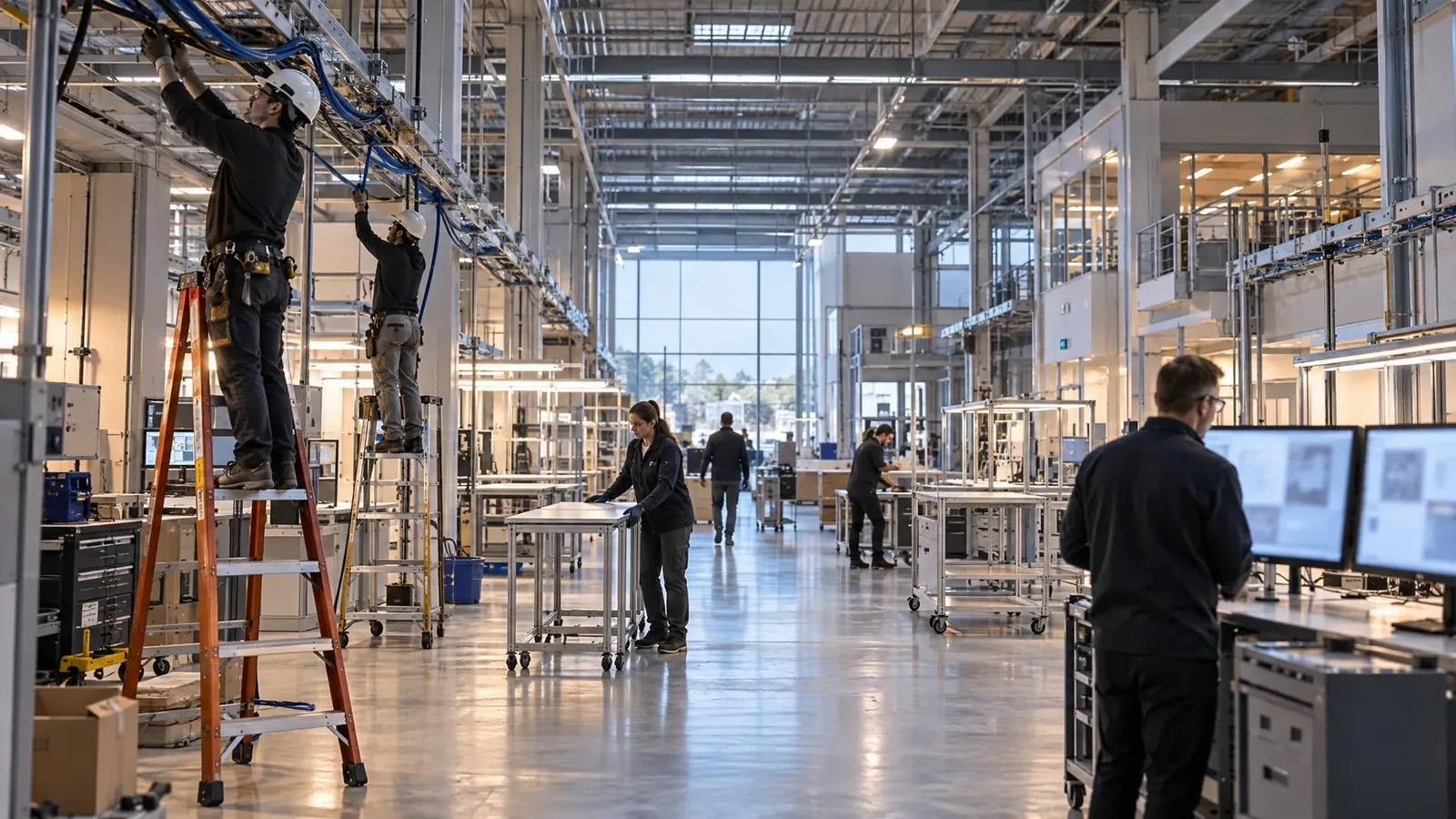
The GPU cluster will be built and operated on ATOM premises as a dedicated environment for training and validating physical AI models. Those models handle robot perception, decision-making and movement, and owning the infrastructure is intended to speed development and testing cycles. Manufacturing work will proceed in parallel through cooperation with component manufacturers and manufacturing partners. Their joint scope covers design, procurement, assembly and inspection, with output expanded in stages.
ATOM was founded on November 11, 2025 and operates from Tokyo Koto ward, developing a dual-arm bipedal humanoid alongside the physical AI foundation model meant to control it. Its profile describes vertical integration across hardware design and production, environmental recognition, decision-making and action generation. The Tokyo operation, called the Physical AI Foundry, collects and generates real-machine training data, trains and evaluates models, and refines robot hardware. The company previously raised 3 billion yen in a May 2026 seed round before the first Mizuho loan agreement in August 2026.
What this means for enterprise automation
For companies facing labor shortages, ATOM positions its robots as workplace systems tied to measurable customer outcomes rather than laboratory demonstrations. President Shunsuke Aoki connected the financing to Japanese component suppliers and experience built in manufacturing and logistics. Deliveries are planned to grow in stages while safety and quality requirements are checked at customer sites. The stated goal is continuing product supply instead of one-off shipments.
The delivery targets underline how early the program remains: 200 humanoid robots annually in 2027, rising to 10,000 in 2030. Those figures are company targets, not current output, so buyers should treat them as planning signals. The Toyosu foundry, opened in August 2026, covers about 1,700 square meters of development space. ATOM aims to operate 200 robots continuously there and accumulate 300,000 hours of training data by the end of 2027.
The marker to follow is conversion of borrowing capacity into repeatable deployments with verified safety and quality at customer sites. An August 2026 memorandum with NSK on joint validation of actuators and collection of physical AI data at manufacturing sites offers one check on partner traction. Growth in real-machine training hours and staged expansion of deliveries would confirm that computing investment supports production. Without that link, facilities remain financial headroom rather than operating capability.
