
ARCS-ai launched the ARPI Center for robotics and Physical AI in Yerevan on November 20, 2026, with a stated goal of graduating 50 specialized engineers annually. The center pools faculty, students and equipment from three Armenian universities under a shared national-lab model. For business, it signals a new regional pipeline of talent trained directly on hardware, simulation and deployment.
How the shared center and study programs work
The presentation took place at Digitec in Yerevan's Meridian Exhibition Center, with NVIDIA Vice President of physical AI simulation Rev Lebaredian, university representatives and live robot demonstrations. ARPI stands for Armenian Robotics and Physical Intelligence, focused on the convergence of robotics and artificial intelligence. The partners are the American University of Armenia, Yerevan State University and the National Polytechnic University of Armenia.
Thirty students are enrolled in the first semester of a three-semester Physical AI minor offered within AUA's Engineering program and YSU's Data Science program. Nine courses are being delivered across the two universities, covering robot mechanics, control and estimation, reinforcement learning, digital twins, and ethics and governance of Physical AI. A Physical AI master's program at AUA is scheduled to launch in 2027.
The curriculum links theory to hardware from the start. A course on dynamical systems, control and estimation combines modeling and controller design with experiments on single-degree-of-freedom mechanisms and multi-rotor aerial robots. A course on simulation, digital twins and differentiable physics requires prior study in deep learning, robot mechanics, and control and estimation. The planned capstone asks teams to move through simulation, data collection, policy training, transfer to real hardware, deployment and evaluation, including mechanical design, sensor suites and a safety envelope.
What this means for companies hiring robotics talent
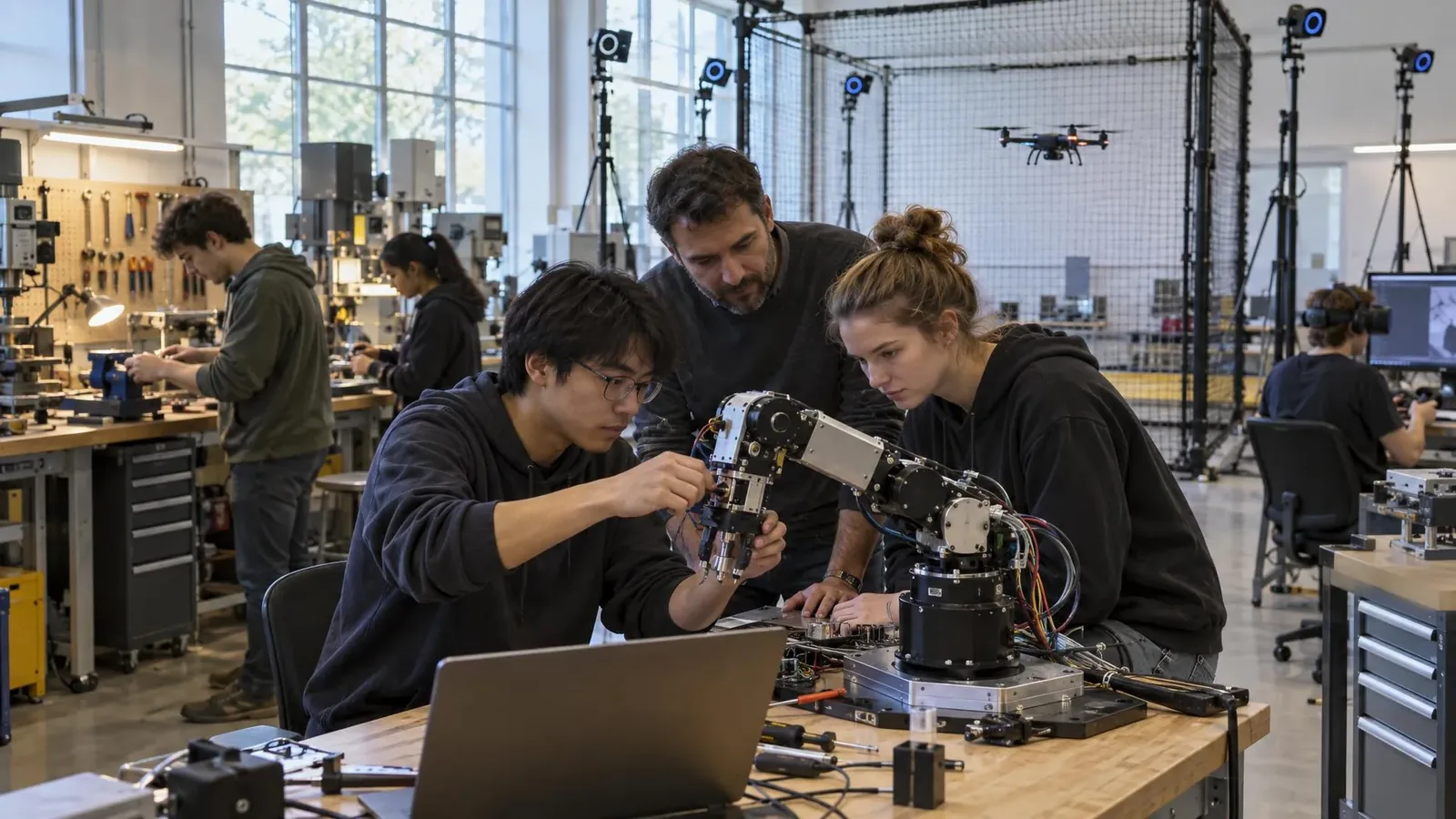
Fourteen faculty members are engaged, including eight recruited from institutions in the United States and Europe such as the University of Southern California, TU Delft and the Rutherford Appleton Laboratory. Astghik Hakobyan has become the first ARCS-ai Fellow under a three-year joint appointment between AUA and ARCS-ai. The physical base is a new robotics laboratory built with a $500,000 investment, with manipulator arms, ground robots, virtual-reality headsets, a machine shop and a large drone flight area with motion tracking.
Compute is provided on site through NVIDIA GPUs for AI training and robot simulation, plus access to the Firebird AI initiative's GPU cluster, described by ARCS-ai as one of Europe's five largest. AUA and ARCS-ai have signed a memorandum of understanding, while a similar YSU agreement remains in development. That split leaves one partnership formalized and another still under negotiation, which matters for scheduling staff and shared equipment.
External ties remain at an early stage and should be read accordingly. ARCS-ai is exploring collaborations with Agile Robots of Germany, FieldAI of the United States and KM-RoBoTa of Switzerland, alongside institutional discussions with University of Michigan-Dearborn, Caltech, ETH Zurich and EPFL. Existing work with YerevaNN on applied AI and robotics continues, and ARPI invites faculty and postdoctoral researchers for short visits, sabbaticals or longer appointments. The marker to watch is the 2027 master's launch and whether the YSU agreement is signed, confirming that the shared model can scale beyond the first 30-student cohort.
