
Apple has launched a dedicated app to study how people use AI for health questions, developed with healthcare AI company OpenEvidence. The study is open to US users over 21 with iPhone 15 or later, iOS 26 or later, and Apple Intelligence enabled, with enrollment of up to 200,000 participants for more than 12 months. Answers will be grounded in clinical sources rather than general chatbot output, which makes the project a test of trusted medical AI in everyday use.
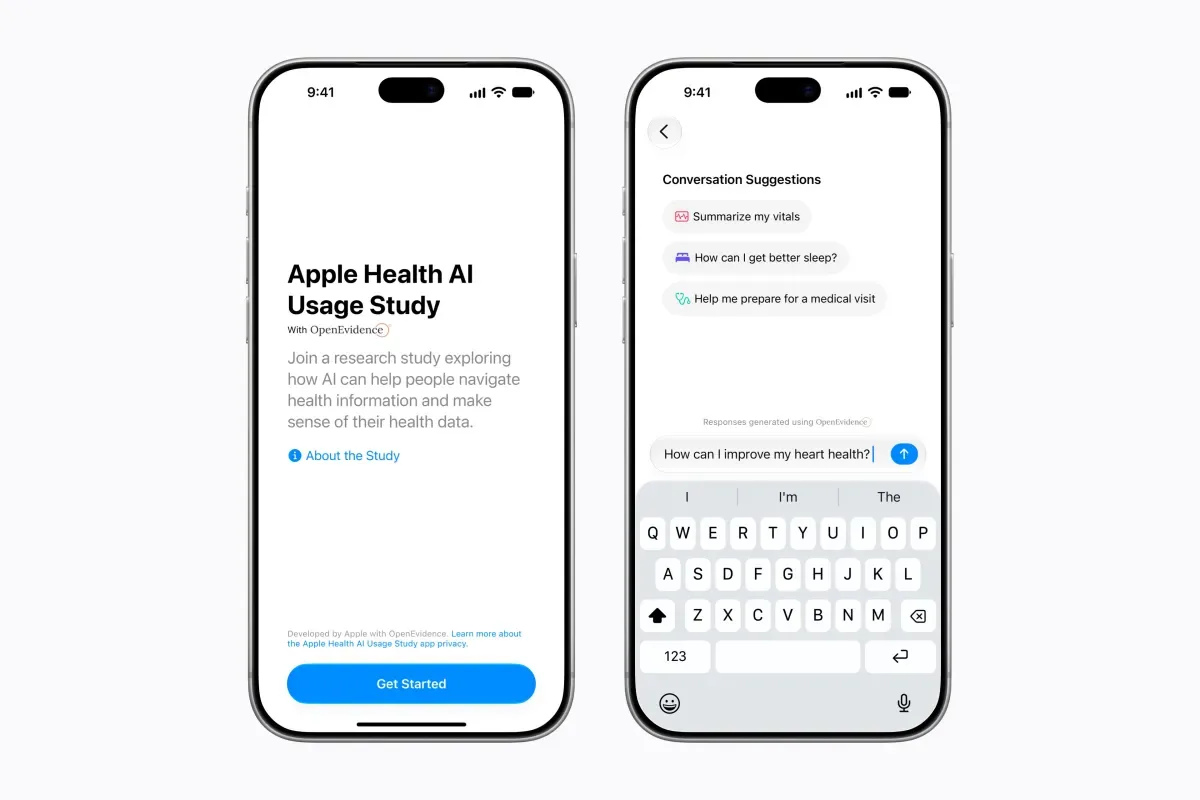
Study terms with OpenEvidence
The app works in a familiar format: users ask health-related questions as they do in ChatGPT or Claude and receive simplified answers to everyday medical questions. Apple names The New England Journal of Medicine, Journal of the American Medical Association, and Nature among the clinical sources behind the responses. Participants can rate answers, leave feedback on responses, and take part in monthly surveys about comprehension and usefulness.
Personalization is optional and built on HealthKit data that participants choose to share, including resting heart rate, activity, sleep, or lab results. The app uses this information to give more pointed suggestions and to help users prepare for a doctor visit. For concerning medical issues, it guides users toward specific providers instead of leaving the query inside the chat. Data handling is defined in advance: information is anonymized before transfer to a secure third-party cloud provider.
Apple states that the data will not be used to train AI models, while OpenEvidence deletes query and response data after 24 hours. Apple vice president of Health and Fitness Sumbul Desai described the study as a way to understand how people engage with, comprehend, and evaluate health AI in daily life. The app became available for download for US users on the day of the announcement. Apple has not said whether the capability will later appear in the Health app or Siri.
What this means for health AI adoption
For companies in healthcare, insurance, and corporate wellness, the study signals demand for answers with a traceable clinical basis rather than fluent general responses. If Apple validates the format, patient portals, triage assistants, and pre-visit preparation tools may shift toward cited sources and structured feedback. Small clinics could gain a safer way to answer routine questions, while large providers could standardize explanations across call centers and digital channels.
The limits are practical: participation requires recent hardware, current software, enabled Apple Intelligence, and US residence, so findings will not automatically transfer to other populations. Monthly surveys and ratings measure perception and comprehension, not clinical outcomes, and personalized suggestions depend on the quality of shared HealthKit data. Buyers should ask vendors which sources ground each answer, how updates are handled, where data is stored, and how escalation to a clinician is triggered.
The marker to watch is whether Apple moves from research to product after the 12-month period with 200,000 participants. Integration into the Health app or Siri, or publication of study insights, would confirm that clinically grounded AI is ready for wider business use. OpenAI already reports more than 300 million health-related queries each week, so the contest is about reliability, not traffic.
