
Anthropic has launched Claude Ship, a suite of AI agents that moves beyond code generation to review, fix and approve changes for production. The package includes the generally available Code Review tool plus two beta components, PR Steward and Claude Approvals. The latter can grant final approval under policies set by the development team, a capability not previously offered in this form. For companies already generating code with AI, this matters because the human sign-off step had become the main bottleneck.
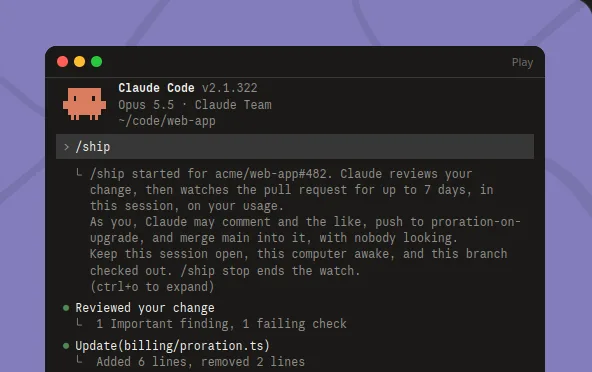
How Claude Ship handles review and sign-off
Claude Ship is positioned as the stage after the pull request, when generated code waits for checks and permission to merge. Anthropic said the problem is scale: teams once approved every change by hand because people wrote every line, while agent-assisted teams now produce far more code. On its own Claude Code team, Claude writes most of the code, and the company wanted post-pull-request work to move at the same pace. The launch therefore targets organizations where generation and initial checking are automated but final review still rests with humans.
PR Steward takes responsibility for the intermediate work between review and approval. It addresses failing continuous integration checks, merge conflicts and feedback left by Code Review. After each push it leaves comments describing what was changed and how to roll the change back if needed. Once that cleanup is complete, Claude Approvals takes over and applies the approval decision. The sequence keeps diagnosis, repair and sign-off in separate steps rather than combining them into one opaque action.
Approval itself works through a policy file stored in the code repository. Teams describe quality and security standards in natural language, and Claude Approvals evaluates the change against that policy. The assessment can incorporate Code Review findings and the organization own classifiers alongside other defined elements. Anthropic advises starting with one repository, running Claude Approvals in observe-only mode first, and setting monthly spending limits. Availability is limited to Claude Team and Enterprise subscribers with repositories on GitHub.
What automated approval means for business
For companies using AI coding tools, the direct effect is faster movement from finished code to production without adding reviewers. Development teams can define standards once in a policy file and let routine changes pass when those conditions are met. Small teams gain a way to process a larger volume of pull requests without hiring additional senior reviewers. Large organizations can spread a uniform quality and security baseline across repositories instead of relying on varied judgments by individual approvers.
The limits concern control, cost and readiness of the policy. The two newest components remain in beta, so behavior in observe-only mode needs comparison with human decisions before granting approval authority. A natural-language policy still requires precise wording, maintenance and ownership inside the team, plus clarity on classifiers and rollback procedures. This announcement does not mean unsupervised deployment: teams need to ask what categories of changes are eligible, how rejections are logged, and how spending limits interact with high-volume repositories.
The marker to watch is how quickly teams move Claude Approvals from observe-only mode to active approval in real repositories. Broader use across more than one repository, plus continued availability through GitHub for Team and Enterprise plans, would signal trust in policy-based sign-off. If that shift happens, final code approval will look less like manual inspection of every change and more like governance of the rules that agents enforce.
