
Serving deployed AI models at scale now drives electricity use, cooling water demand, hardware load and regional infrastructure strain. Unite. ai frames environmental cost of AI inference as the resources consumed each time models handle real workloads, not as a synonym for advanced AI. The distinction matters for business because inference runs continuously, while training happens once.
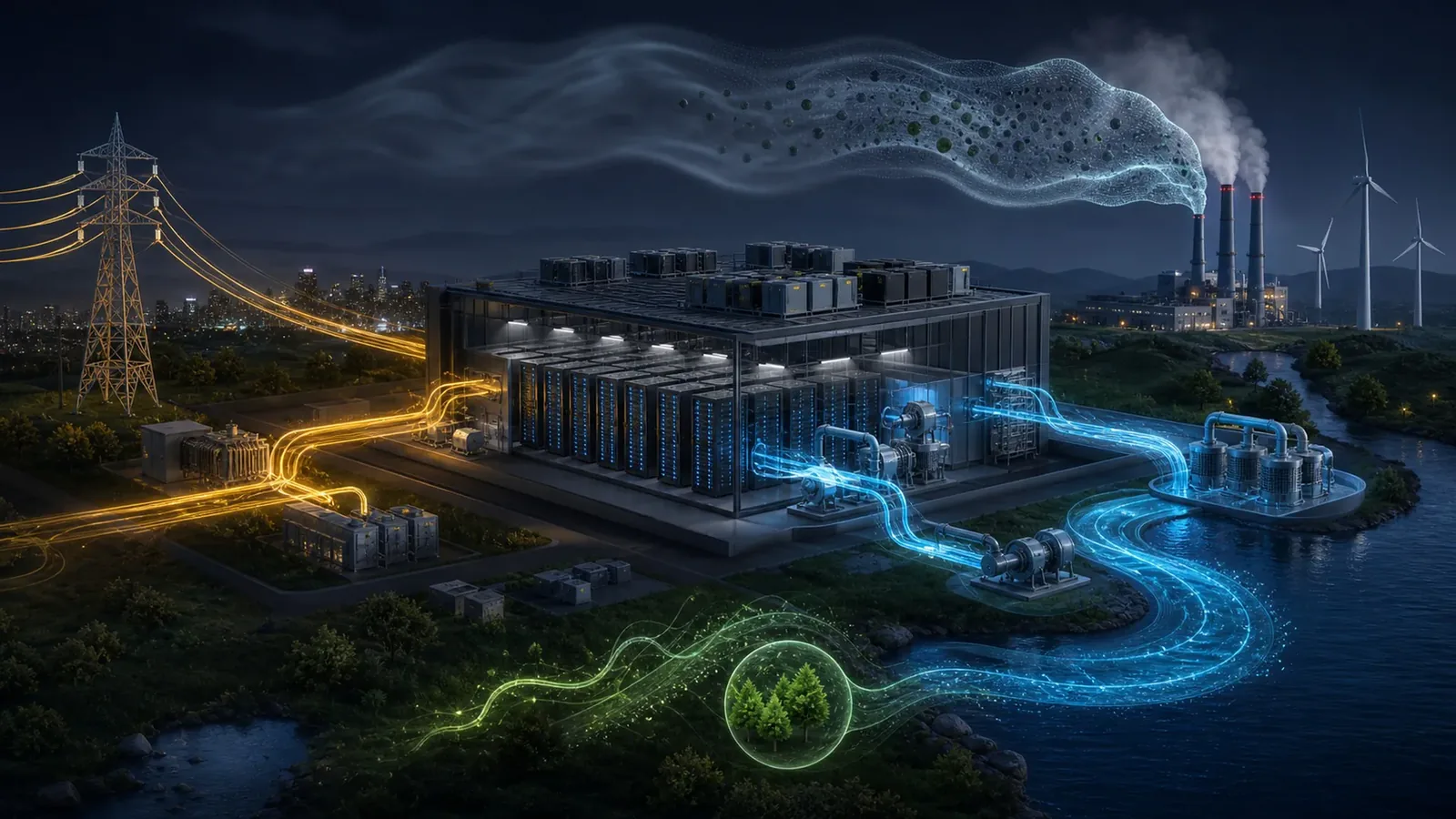
How inference costs accumulate in production
Measurement starts with requests, tokens and utilization. The guide presents this as the entry stage: stated objectives turn into countable workload units that later support energy attribution. Teams should record uncertainty, rejected alternatives, resource use and controls applied at the boundary. Such traceability helps detect when efficiency gains per request are outweighed by rapidly growing demand.
Attribution of facility and hardware energy forms the second stage. Inference performance depends on model architecture, numerical precision, memory movement, scheduling, networking, hardware and workload shape. The surrounding data, interfaces, permissions and people can determine performance even when the model itself is unchanged. Separating learned behavior from product decisions about when, where and with what authority it runs becomes central.
Cooling and water context, then grid carbon intensity and time, complete the physical picture. The system must account for cooling needs and water conditions tied to a specific facility, then consider carbon intensity of the grid at a given moment. One handoff leads to the next: energy attribution supports cooling analysis, which supports carbon analysis. Reading the map backward helps diagnose why an output proved costly, slow or unsafe.
What inference economics means for business
For companies operating AI products, the consequence is a shift from one-time training budgets to ongoing serving costs. Routing routine tasks to a smaller model and improving utilization can reduce energy per useful answer, according to the worked example in the guide. Small firms feel this as direct cloud bills tied to tokens and requests, while large operators face added pressure on data-center capacity, cooling and regional grids.
Procurement and governance need verification rather than polished demonstrations. The guide recommends testing ordinary, difficult and deliberately misleading cases, preserving a baseline without the technique, and recording average performance alongside severity of individual failures. Buyers should ask what inputs were measured, how energy was attributed, how water and grid timing were included, and what happens when inputs are removed, signals conflict or compute is limited. Reduction of waste should precede offsetting of residual impact.
The marker to watch is whether vendors report inference costs per useful workload with stated assumptions and reproducible method. If request counts, utilization, energy attribution, water context and grid timing appear in regular reporting, the operating view has taken hold. That discipline will define which AI deployments remain affordable under infrastructure constraints.
