
Skyways announced its production autonomous cargo aircraft Skyreach on November 9, 2026, and confirmed that manufacturing has started in Austin, Texas. Flights for existing defense and commercial customers are scheduled for December 2026. The aircraft is rated for more than 1,300 miles with 10 pounds of cargo, which matters because long-range uncrewed logistics is moving from prototypes to repeatable service.
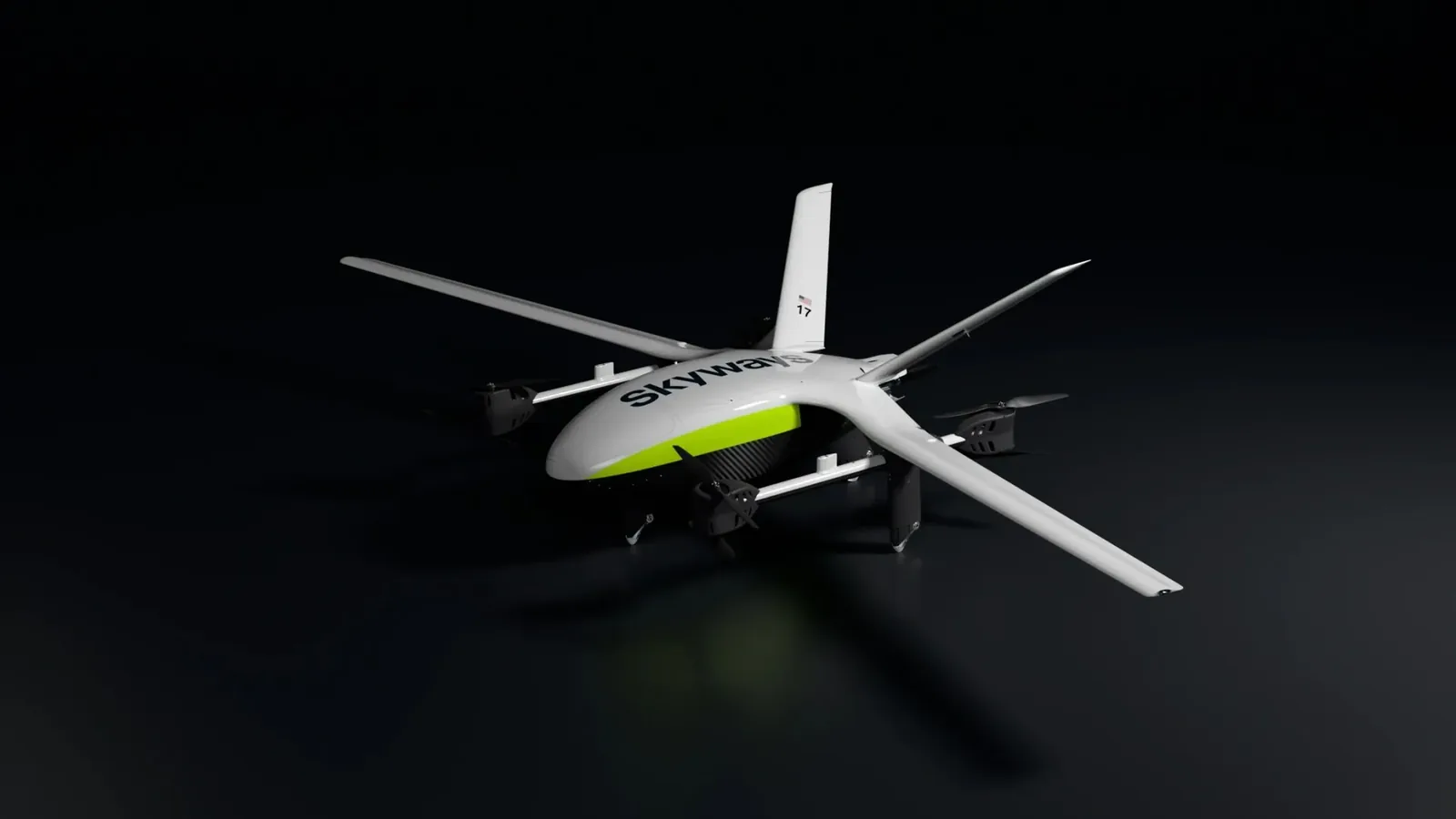
Skyreach production start and specifications
Originally developed as V3 Block 2, Skyreach follows a $37 million STRATFI award from AFWERX, the innovation arm of the Department of the Air Force, issued in June 2025. That funding supported the transition of the V3 from prototype toward full-rate production. Since then Skyways has finalized the production design and advanced flight-qualification testing. New customers can now reserve capacity ahead of the December flights.
The specification sheet links maximum range to a light payload: more than 1,300 miles with 10 pounds, compared with more than 780 miles with 50 pounds. Maximum endurance is listed above 18 hours. Those figures assume level cruise at 70 knots true airspeed, 2,000-foot density altitude, no wind and a 45-minute fuel reserve. Cargo and fuel share a 360-pound maximum gross takeoff weight, so the longest-range profile is not a maximum-payload flight.
The design combines eight electric motors for vertical lift with a two-stroke heavy-fuel cruise engine and integrated generator. The generator recharges the lift battery in flight and powers avionics, sensors and payloads, allowing refueling without ground battery charging or swaps. Compatible fuels include Jet A, Jet A-1, JP-5 and JP-8. Useful load covering fuel and payload exceeds 100 pounds, fuel capacity is 86 pounds, and the cargo bay volume is 7 cubic feet.
What Skyreach means for logistics operators
For companies that move small high-value loads, the practical change is a reconfigurable 7-cubic-foot bay with up to 2.5 kilowatts of power. Skyways lists configurations for standard cargo, temperature-controlled blood, plasma and biologics, radar or optical sensors, and communications equipment. A top-loading, bottom-release layout supports autonomous airdrops and tethered delivery. Small operators gain access to specialized missions without a crewed aircraft, while larger fleets can standardize direct routes across multiple aircraft.
The limits deserve close attention because the numbers are labeled design specifications and remain subject to change during flight test. Buyers should verify range under their own wind, altitude, temperature and reserve assumptions, plus performance in winds up to 40 knots and temperatures from minus 5 to 120 degrees Fahrenheit. The autonomy covers navigation, mission execution and emergency maneuvers, while SkyNav Mission Control enables one operator to supervise many aircraft. That model still needs proof in daily operations, shipboard use and austere environments.
The marker to watch is whether December 2026 customer flights become routine service and support the goal of more than 1,000 aircraft within five years. Stable range-payload performance and rapid refueling at roughly one-tenth of helicopter cost would confirm demand for this class. If schedules slip or specifications are revised, wider adoption will take longer.
