
Samsung, Kakao Mobility and LG Electronics are moving physical AI from laboratory work into factory and road deployment in Korea with NVIDIA computing, simulation and robotics platforms. Samsung reported a chip-scale simulation accelerated roughly 1,600 times, from about 18 hours to 41 seconds, while Kakao Mobility outlined a level 4 driving program and LG demonstrated robot manipulation in a live plant. The pattern matters for business because engineering simulation, autonomous systems and factory robots are starting to share one computing base.
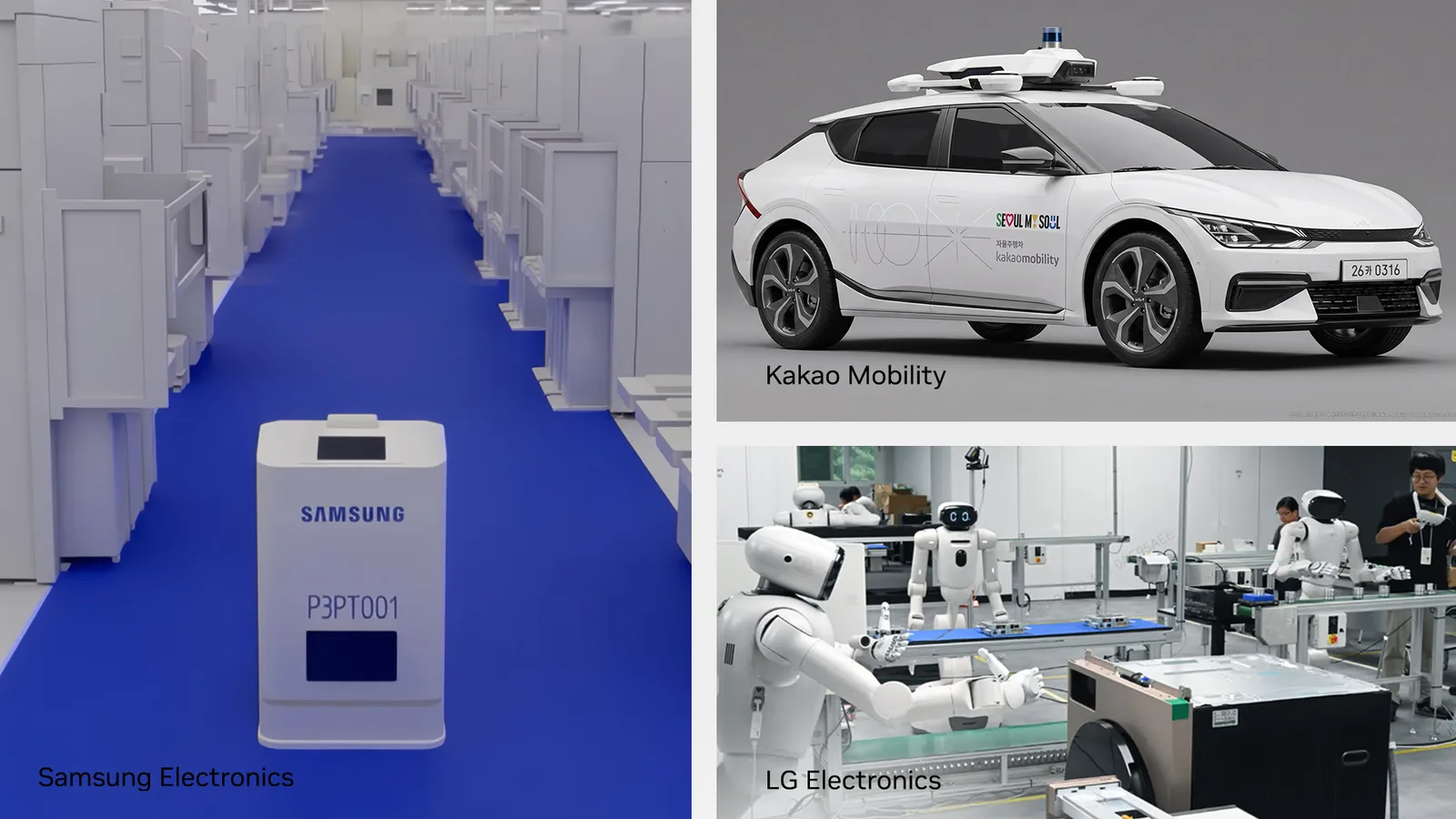
Samsung, Kakao and LG projects in detail
Samsung Electronics is expanding work with NVIDIA across materials research, process development and device engineering. In technology computer-aided design, the effort covers NVIDIA cuISS and NVIDIA cuDSS for sparse linear systems, plus GPU acceleration for process and optical simulations. In materials work, the sMOL platform ran selected quantum chemical calculations up to 5x faster end to end with NVIDIA cuEST. Samsung is also testing NVIDIA cuEquivariance for tensor operations used in training and inference of atomistic AI models.
The Samsung thermal and mechanical workflow shows how AI physics changes the calculation chain. Engineers combine AI-predicted effective material properties with coarser grids and GPU acceleration using NVIDIA PhysicsNeMo. In one homogenization case, a fine-grid solve on a 32-core CPU took about 18 hours, while the GPU-accelerated coarse-grid version took 41 seconds. NVIDIA Agent Toolkit could later link such simulation tools and AI models so engineering agents run analyses and compare design options without manual handoffs.
Korea provides a practical setting for this shift because manufacturing, semiconductors, robotics and mobility development sit close together. The country has operating experience in dense urban transport, high-volume chip fabrication and factory automation, all of which generate data for simulation and training. NVIDIA supplies accelerated computing, AI models and simulation layers that fit across those domains. The result is parallel progress in chip design, vehicle development and robot learning rather than isolated pilots.
What production use means for companies
For manufacturing and engineering firms, the Samsung case points to shorter design and verification cycles. Process, optical, thermal and mechanical simulations that once queued for hours on CPU clusters can run in minutes or seconds on GPU workflows with AI approximations. Small teams gain access to analysis that previously required large compute budgets, while large chipmakers can test more materials and layout variants in the same schedule. The difference appears in faster process tuning, earlier detection of thermal risks and lower cost per simulation run.
For mobility and robotics operators, the Kakao Mobility and LG examples change deployment planning. Kakao Mobility will build on NVIDIA Hyperion with DRIVE AGX Thor compute and NVIDIA Halos for safety development, starting with Kia purpose-built vehicles and its driving software proven in Seoul's Gangnam district. LG demonstrated NVIDIA Isaac GR00T manipulation on its CLOiD robot in a real factory, using a loop of data collection, NVIDIA Cosmos augmentation, model training, Jetson AGX Thor onboard compute and simulation checks. Buyers should verify sensor fit, safety validation, data rights and integration effort before counting on similar timelines.
The marker to watch is whether these reference setups turn into contracted services and repeatable factory workflows. Level 4 operations in Korea, wider use of GPU-accelerated chip simulation inside Samsung design teams, and additional CLOiD tasks trained through the same data loop would confirm the move from demonstration to production. If those steps follow, physical AI becomes a procurement question about platforms, safety evidence and simulation capacity.
