
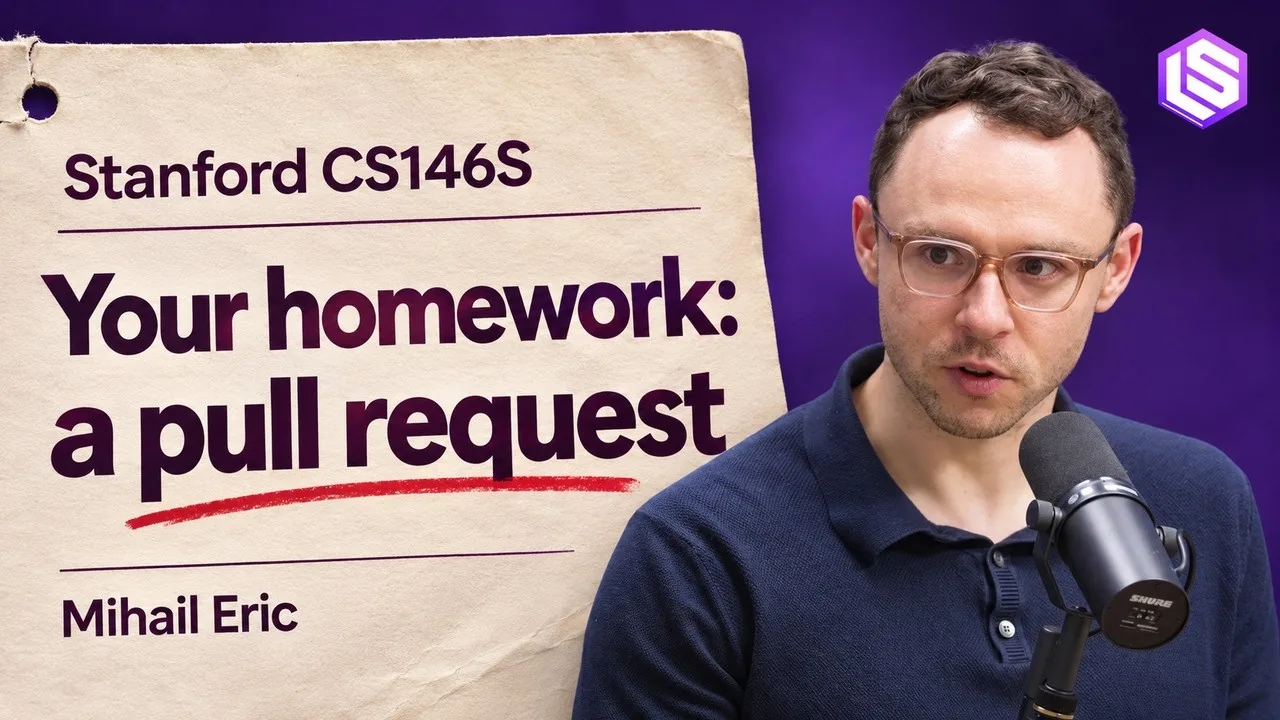
Stanford has rebuilt its software engineering course around a simple constraint: a coding agent can complete last year's assignment in one prompt. In the second run of CS146S, instructor Mihail Eric asks students to learn an unfamiliar repository, propose a change, and defend the patch to the open-source maintainer who might merge it. The course, called The Modern Software Developer, was discussed in an interview marking one million subscribers to the AI Engineer channel. For business, it signals what junior engineering work will soon look like.
How CS146S and Monaco run agent work
The ten-week CS146S syllabus moves from agent internals to teamwork with agents. Eric builds a coding agent from scratch, then traces a real agent harness such as Claude Code, covering the loop, tools, and harness around the model. Later modules address context engineering for a large codebase, skills for understanding the diff, and the point where code review becomes the bottleneck. Security, dependencies, and permissions get a separate block, alongside background agents and Stripe's Minions.
The course design borrows review standards from production. Open-source maintainers take part in assessment, so students must explain why a change fits the repository rather than only showing that code runs. That shifts grading from writing code to reading code, scoping a task, and documenting trade-offs. The interview also references related material on killing the code review, Basis's Authority Map, and making repositories agent-ready. The throughline is judgment about existing systems, not greenfield coding speed.
Monaco provides the industry counterpart to the syllabus. Eric leads AI at Monaco, which builds agent workspaces for sales teams and runs its own engineering team on agents. Each agent gets a prepared workspace, while an on-call agent has access to Datadog and GitHub to close the operational loop. The team bought code review tools instead of building them at first. Its stated rule is direct: buy to learn, and build to keep only the tools that prove central.
What agent-native engineering means for business
For companies adopting coding agents, the hiring and onboarding profile changes. Familiarity with a single stack matters less than the ability to enter an unfamiliar codebase, gather context, and produce a small, reviewable change. Small firms can use this pattern to let one or two engineers maintain systems they did not write, using workspaces, issue history, and observability data. Large firms can standardize it: prepared environments, permissioned tool access, and review by owners who understand long-term design decisions.
The same shift creates new failure modes that procurement should price in. Generated code can outrun review capacity, while agents with broad repository and operations access raise questions about dependencies and permissions. The Monaco experience suggests starting with purchased review and workspace tooling before committing to internal platforms. Buyers should ask vendors how agents distinguish current behavior from earlier design decisions, what is logged for audit, and where human approval remains mandatory.
The marker to watch is whether maintainer-reviewed coursework spreads beyond Stanford. If more engineering courses and corporate academies grade work by acceptance into unfamiliar repositories, agent supervision will become a baseline skill within two hiring cycles. That outcome would confirm the factory model discussed in the interview: developers own context, permissions, and review, while agents produce the bulk of the diff.
