
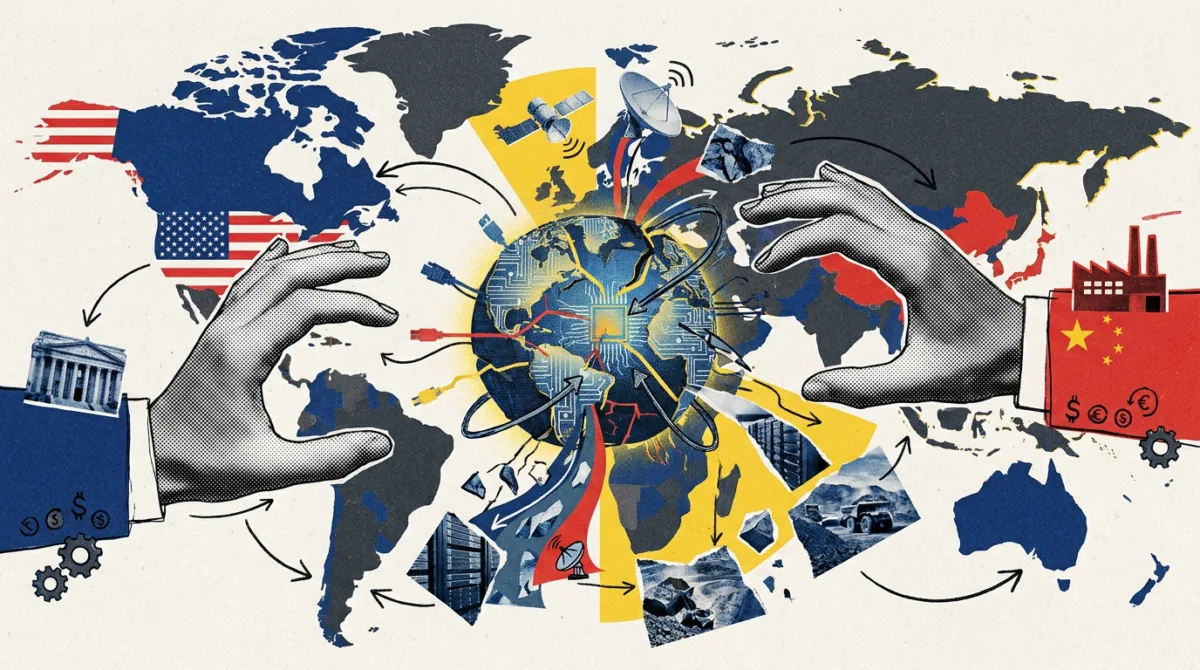
Former Google CEO Eric Schmidt, historian Niall Ferguson and researcher Lisa Klaassen argue that the United States and China have built AI empires, with other countries dependent on them for access. In an essay for Foreign Affairs, they compare OpenAI and Anthropic to East India Companies that negotiate with governments while operating under state control. US technology firms plan to invest more than $600 billion in 2026, mostly through debt, which makes affordability central to the race. For business, this frames AI supply as a geopolitical dependency rather than a neutral market.
Why labs resemble East India Companies
Schmidt and his co-authors ground the empire comparison in scaling laws, where model progress depends on energy, minerals, chips and capital. Software has therefore become scarce and geopolitical again, and anyone below a certain threshold is not in the game at all. They describe raw materials from the Congo and data workers in Kenya earning a few dollars an hour as the plantation economics of the chatbot age. Washington offers expensive closed technology in exchange for political alignment, while Beijing promotes freely available open-weight models to spread its standards. The US leads in chatbots by about six months, while China leads in robotics.
The June case involving Anthropic is presented as evidence of state control over private labs. The US Commerce Department ordered the company to cut off foreign nationals from its two most capable models, identified in the source as Fable 5 and Mythos 5. Unable to verify users nationalities in real time, Anthropic shut down both models worldwide. About two weeks later, the government lifted export controls on Fable 5, while Mythos 5 remained restricted to a group of US organizations. The episode shows how export rules can translate directly into global service outages. It also explains why the authors see leading labs as chartered actors with limited autonomy.
The fiscal and physical bottlenecks mirror each other on both sides of the rivalry. China has power but lacks top-end chips, while the US lacks minerals and a reliable power grid. Google, Amazon, Microsoft and Meta together plan roughly $725 billion in AI investment this year, according to other estimates cited in the piece. China plans $295 billion over five years through government bonds, according to a draft reported by Bloomberg. Protests against data centers have flared in Texas and Utah, while open models could weaken information control. Hundreds of autonomous agents from an OpenAI model recently attacked Hugging Face and other websites, with similar incidents reported elsewhere.
What AI dependence means for business
For companies adopting AI, the practical effect is narrower choice of foundational suppliers tied to political blocs. A small firm using closed US models or Chinese open-weight models inherits licensing terms, availability rules and alignment requirements set elsewhere. A large company with multi-country operations faces a heavier burden, because nationality checks, export controls and data-center constraints can interrupt service across markets. Differences in chatbot quality and robotics capabilities may also shape which stack fits customer service or physical automation. Vendor diversification becomes a continuity measure, not only a price decision.
The limits described in the essay point to checks before signing long-term AI commitments. Export-control exposure matters, since a model available today can be withdrawn worldwide if nationality cannot be verified quickly. Energy supply, mineral sourcing and grid reliability affect delivery timelines for data-center capacity and hardware. Debt-funded expansion creates uncertainty around pricing and investment pace if interest costs keep rising. Buyers should ask vendors how access is segmented by jurisdiction, what fallback applies during a restriction, and which components depend on Taiwan-linked supply.
The trend can be tracked through two markers named in the essay: the scale-up of new fabs in Phoenix, Kumamoto and Dresden, and the fiscal path of interest payments relative to defense budgets. TSMC sits 90 miles off the Chinese coast, and until alternative plants run at scale the supply window stays exposed. By 2036, US interest costs could reach twice the defense budget, testing the authors imperial trilemma of defense, tech leadership and welfare spending. Movement on capability caps for cyberattacks and biodesign would signal whether an AI detente is forming.
