
Google and Meta open-sourced TorchTPU at PyTorch Conference North America 2026 in San Jose, a native PyTorch backend for Google Tensor Processing Units. Meta, which created PyTorch in 2016, plans to move larger-scale LLM workloads onto TPUs with it, as Meta engineer Zongwei Zhou said in the October 21 keynotes. The project replaces PyTorch/XLA from 2020, which required intrusive source-code changes. For business teams this matters because a second accelerator family becomes available through standard PyTorch code.
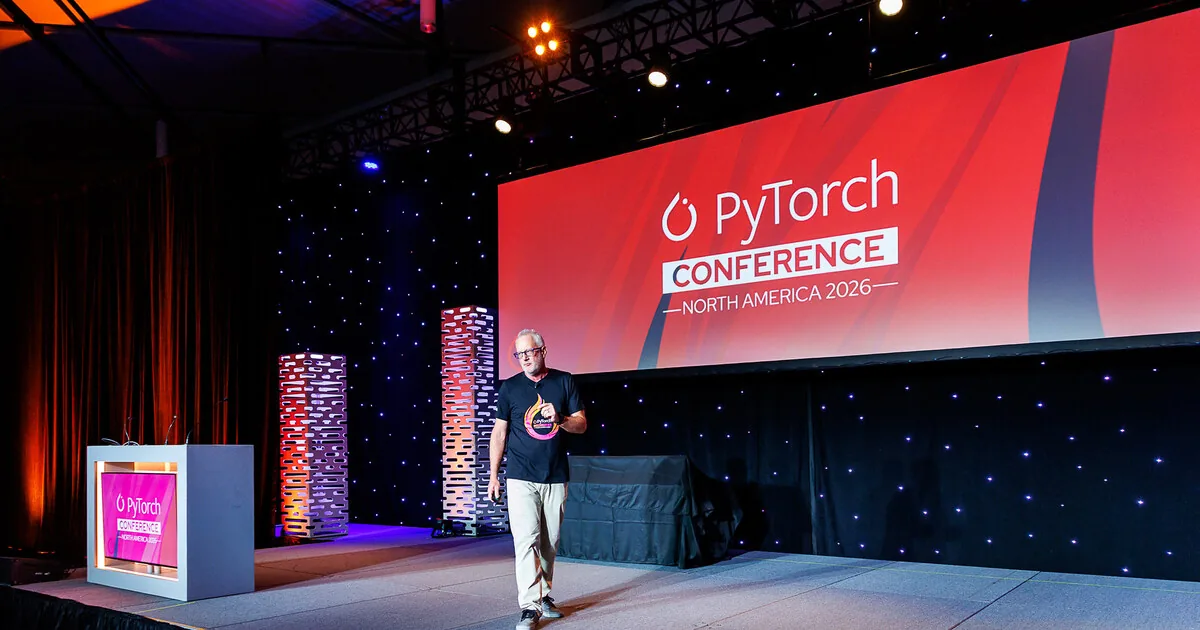
TorchTPU launch and one-line porting
The new backend aims to make porting as simple as changing model. to("cuda") to model. to("tpu"). Google Cloud wrote that TPUs join GPUs and CPUs as a native option for PyTorch, in an announcement co-authored by Bill Jia, VP of engineering for Core ML/AI. Jia presented the keynote "Workload Fungibility in the Agentic Era" together with Zhou. Four repositories were released: TorchTPU, vLLM-TorchTPU, SGLang-TorchTPU, and TorchTitan. All of this is available today, with Zhou calling it just a beginning.
Because TorchTPU plugs into PyTorch low-level dispatcher, Hugging Face models worked with it out of the box, according to the speakers. The vLLM and SGLang inference engines run natively, while TorchTitan supports dense, mixture-of-experts, and diffusion models for large-scale training. Ray and llm-d scale TPU workloads across hosts on Kubernetes. Google also announced the TPU agent suite, now in preview on GitHub, which plugs into coding harnesses to automate onboarding, diagnostics, and performance tuning. The one-line change gets a model running, but shapes, sharding, and ops may still favor GPU architecture.
Demand framing came from two foundation talks. PyTorch Foundation executive director Mark Collier said inference has overtaken training as the largest data center workload, creating strong demand for tokens. The community goal is open software for models that run on any chip in any cloud and connect to any agent. Slides showed DeepSeek Flash becoming 60% cheaper in 37 days, and Kimi K3 running 68% faster on the same hardware in 33 days. Agentic AI Foundation executive director Mazin Gilbert said agent token consumption passed human consumption on February 6, 2026, then grew 14-fold against 2.8-fold for humans, though the public data comes from OpenRouter alone.
What this means for AI infrastructure buyers
For companies running inference or LLM training, TorchTPU widens the vendor set without forcing a framework rewrite. Jia showed near-linear scaling past 8,000 TPU chips, with per-chip throughput holding roughly constant as clusters grew. A published Qwen3 235B mixture-of-experts run used 8,192 TPU v7x chips at 28% model FLOPs utilization. Small teams gain easier access to Hugging Face, vLLM, and SGLang paths on TPUs, while large teams gain a route to distribute training and inference across many hosts. The practical difference is lower porting cost at the start, with tuning cost remaining.
Limits and checks remain material before any migration decision. Google states that peak TPU performance needs extra work on shapes, sharding, and kernels, so budget for that phase and confirm TPU capacity first. AWS put the parallel TorchNeuron backend for Trainium into public beta on October 20 with. to('neuron'), and both use the PrivateUse1 extension point, yet TorchNeuron still lacks dynamic input shapes and skips about 22,000 PyTorch tests. Analyst Blair Hayes argued that optimization and supply layers stay under vendor control. Hacker News reaction, at 379 points, mixed relief over first-party support with questions on where to buy TPUs and one on-premises evaluation that stayed with Nvidia.
The marker to watch is Meta moving larger LLM workloads onto TPUs through TorchTPU in production, plus follow-up scaling and utilization reports. If production use, reliability data, and tuning tools from the TPU agent suite accumulate, TPUs become a routine second target for PyTorch shops. Session recordings are expected on the PyTorch Foundation YouTube channel within two weeks of the event.
