
Data poisoning manipulates training, fine-tuning, evaluation, or retrieval data so an AI system learns corrupted behavior or produces attacker-chosen outcomes. The guide from Unite. ai describes it as a precise information flow with inputs, assumptions, and observable results, not a synonym for advanced AI. Its core risk lies in a tiny targeted subset that can stay hard to detect in web-scale data. That makes the concept directly relevant for companies relying on external datasets.
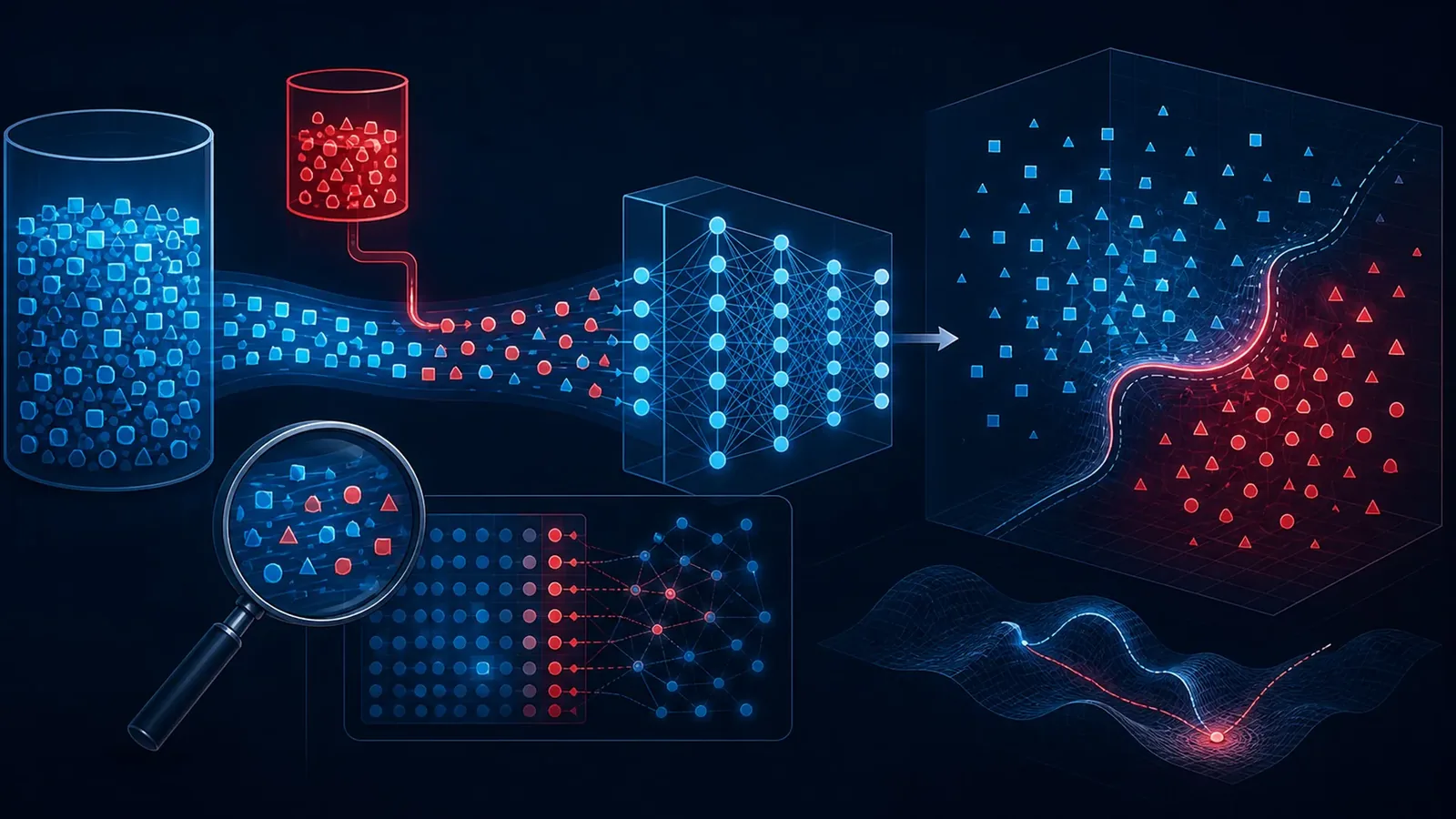
How attackers move from data source to backdoor
The described chain starts with gaining influence over a data source. The stated objective leads to insertion of mislabeled, biased, or trigger-bearing examples. Those examples then must survive filtering and deduplication. Each handoff should have a recorded input, changed state, and evidence that the change was valid. Without that trace, reviewers cannot reproduce the result under the same conditions.
Surviving filters allows the corrupted examples to alter the learned model or retrieved context. That alteration then activates either broad degradation or a targeted backdoor. Broad degradation lowers overall quality, while a backdoor waits for a specific trigger. One illustration involves seeding examples that teach a classifier to treat a rare visual patch as a trusted label. The outcome appears only when the trigger occurs, which complicates detection.
The guide stresses separation between the learned behavior of a model and the product around it. Interfaces, hardware, permissions, retrieval, routing, caching, policy, identity, and monitoring shape performance even when the underlying model stays unchanged. The nearest confusion comes from an evasion attack applied only after deployment. That attack shares visible features yet has a different causal story, different cost drivers, and different controls. The boundary stays operational rather than terminological.
What this means for companies using AI
For business teams, the forward and backward reading of the map carries practical value. Forward analysis shows how one stage supplies the next, from source influence to monitoring or a final decision. Backward analysis starts from an incorrect, slow, expensive, or unsafe result and traces which earlier assumption allowed it. The decisive error often occurred before the model produced anything. That shifts attention from output monitoring alone to data provenance and boundary controls.
Testing discipline also changes procurement and deployment checks. A rigorous test would build ordinary, difficult, and deliberately misleading cases around a scenario, preserve a baseline without the technique, and record average performance plus severity of individual failures. Changing one assumption and repeating the analysis helps: remove a required input, add a conflicting signal, limit compute, alter the user population, or force abstention. A mechanism that succeeds only in one arranged demonstration has not shown generalization.
The marker to watch concerns evidence at each transfer of information or authority. Ask which component performs the defining transformation and which other parts enable the reported outcome. If vendors specify owner, scope, trigger, expected behavior, and verification method for data controls, the risk becomes testable. Absent that detail, buyers compare unlike products and monitor the wrong signal after deployment.
