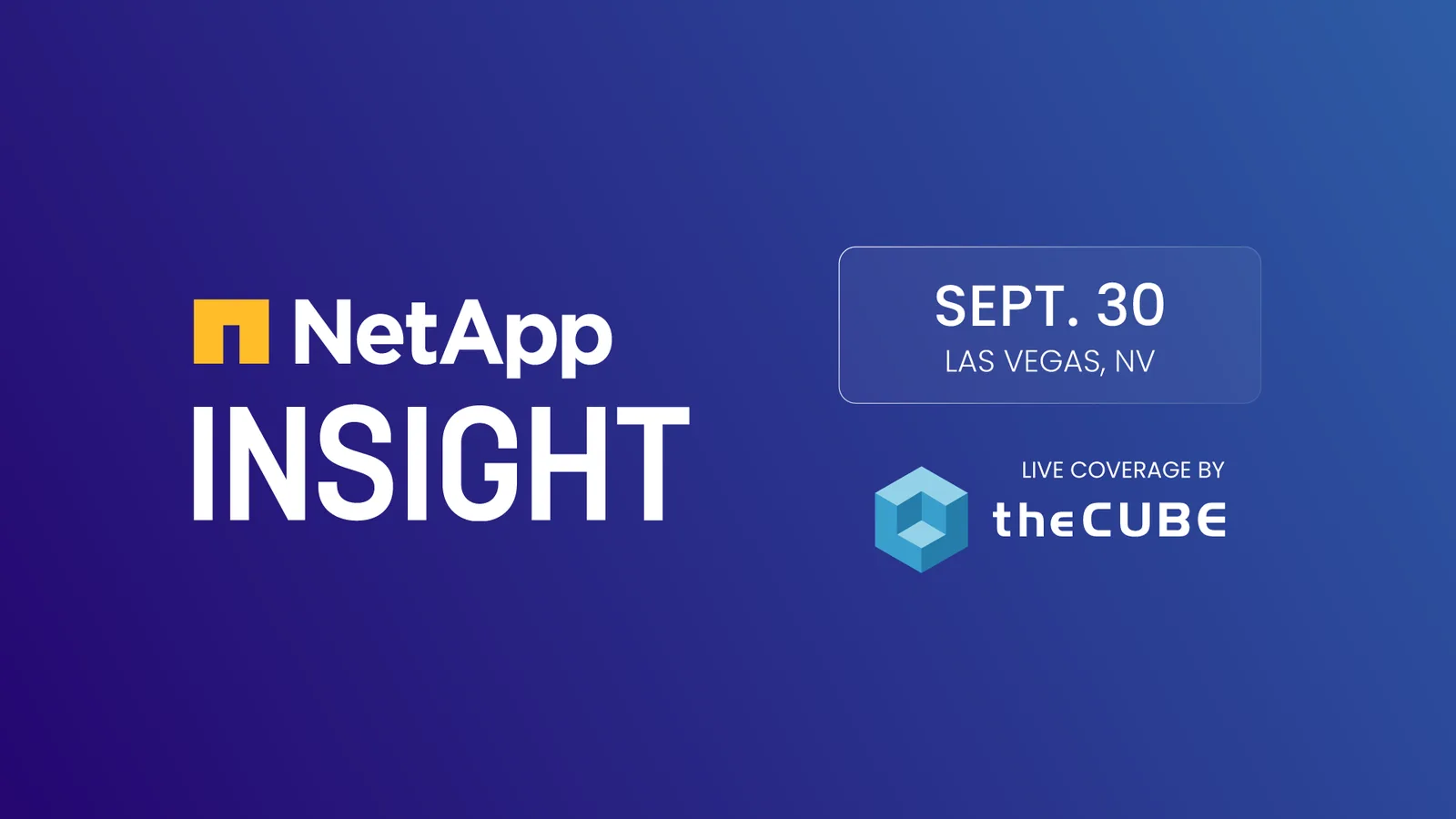
NetApp will present its strategy for an AI-ready enterprise data foundation at NetApp INSIGHT on Sept. 30 in an exclusive broadcast on theCUBE, SiliconANGLE Media's livestreaming studio. The central theme is unified storage and data mobility as AI moves from pilots into production. Research from theCUBE shows 64% of organizations have already integrated AI-driven functions into software delivery pipelines. The business question is whether firms can supply training, RAG, inference and agentic workloads with governed, current data without creating another silo.
What NetApp will show on Sept. 30
The Sept. 30 broadcast will bring together NetApp leaders and experts in unified storage, cloud and data strategy. The agenda includes unified data access, infrastructure modernization, ecosystem partnerships, AI-ready platforms and the growing demands of enterprise workloads. Coverage will be available on theCUBE's website and YouTube channel, with on-demand viewing after the live event and additional coverage on SiliconANGLE. TheCUBE is a paid media partner for NetApp INSIGHT, with no editorial control by NetApp or other sponsors over content on theCUBE or SiliconANGLE.
NetApp positions unified storage as a single data layer that AI platforms can consume across the data center, cloud and edge. The idea is to keep data continuously available and usable for AI workflows instead of moving copies between fragmented systems. That design targets training, RAG, inference and agentic workloads that require governed, current data from multiple locations. Principal analyst Krista Case described the opportunity as making the existing enterprise data estate usable by AI without forcing another data silo. In practical terms, continuity of access matters as AI pilots move into production.
The timing reflects a shift in how software is built. Application development research from theCUBE points to real-time data access becoming a prerequisite for AI-driven applications. Principal analyst Paul Nashawaty linked this to distributed architectures, AI-generated context and agent-first development, where applications need continuous access to trusted data rather than static datasets. Fragmentation and data movement have become expensive in performance, security, governance and operational complexity. The strategic test, in his formulation, is less about where data sits and more about how quickly, consistently and securely applications can use it.
What production AI means for data owners
For companies operating AI in production, the consequence is a change in infrastructure requirements rather than model choice. A unified layer promises fewer data copies, more consistent governance and faster connection between existing systems and AI tools. For a small company, this can reduce the operational work around moving data between cloud services and development pipelines. For a large organization with data center, cloud and edge estates, the effect shows up in support for RAG pipelines, inference services and agents that depend on current records and controlled access.
The approach does not remove the need for verification before procurement. Faster storage alone does not solve fragmentation, and buyers still need to confirm how governance, security and access controls travel with data across environments. Open points include how real-time access is delivered under load, how trusted data is distinguished from stale copies, and what ecosystem partnerships are required for specific AI platforms. This news by itself is an agenda for Sept. 30, not evidence of deployment results. Useful vendor questions concern supported locations, consistency guarantees, migration effort and operating cost of the unified layer.
A concrete marker to follow is what NetApp discloses on Sept. 30 about unified data access, infrastructure modernization and ecosystem partnerships. Statements about reduced fragmentation will carry weight only alongside customer cases, platform integrations and measurable production use. If those details appear, business leaders will have a clearer basis to compare storage options for AI workloads.