
Zenzap has raised $44 million to build a private messenger with AI for workplace communication, positioning it as a compliant alternative to WhatsApp, Telegram and iMessage. Investors include Bessemer, Lightspeed and The Garage, plus Wix president Nir Zohar and former EY general manager Yoram Tietz. The round is the first venture financing for founder Guy Weiss, who previously bootstrapped StuccoMedia and sold it to Market Group in 2015. For business, this matters because frontline teams still coordinate shifts and documents in consumer apps outside IT control.
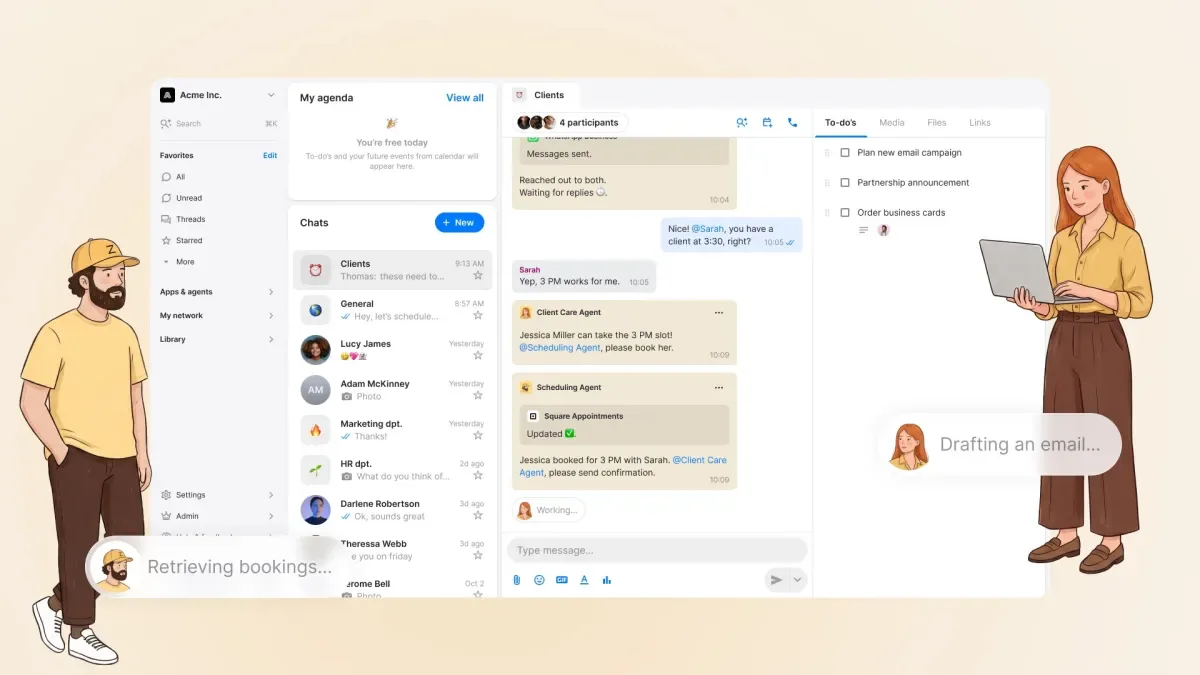
How Zenzap plans to replace consumer chat at work
Weiss founded Zenzap in 2022 with co-founders Noam Neumann and Jonatan Bien after discussions with Bessemer partner Adam Fisher. He initially funded the project himself and worked out of the Bessemer office, saying he feared a second venture after a successful first exit and did not need to work for money. Fisher then convinced him that the company would need venture capital to scale. The startup now employs 50 people across the U. S., Tel Aviv and Europe, and plans to hire in product and R&D.
The product targets hospitality, construction, healthcare and fast food, alongside other mobile-first businesses with non-desk staff. The free tier includes group chats, direct messages, task management, calendar integration, schedule management, plus AI-powered voice chat and search. Paid plans start from $51 per month for up to 20 users and add voice and video calls, smart task sorting, task templates and higher file storage limits. The paid tier also unlocks AI search across the workspace and conversion of messages into tasks.
Weiss argues that WhatsApp and iMessage cannot carry a workplace AI agent because they do not comply with IT requirements, while Slack and Microsoft Teams were not built for everyday mobile use by average users. Zenzap adds AI agents for workflow automation, plus AI-assisted voice note and call transcription. Those automation features use a credit-based pricing system separate from the per-workspace subscription. Each industry configures its own use cases and workflows on a self-serve basis, according to the company.
What this means for companies using AI agents
Zenzap lists FedEx, Dollar General, Taco Bell, Starbucks, Casey's and Regal as clients, while branches of IHOP and McDonald's use it to coordinate shifts and discuss supply. For small operators with up to 20 staff, the entry price creates a defined starting point: chat, scheduling and basic AI search without deploying Slack or Teams. For larger chains, the value sits in separating work communication from personal messaging while keeping shift coordination, tasks and documents in one searchable system.
The trade-off is scope and maturity. Consumer apps remain familiar and free, and Slack and Teams remain entrenched where desk workers and developers dominate. Zenzap's automation depends on credits, so buyers need to check what an agent run, transcription minute or search query consumes and what limits apply on storage and templates. Bessemer itself uses the messenger inside its investment team for deal flow, but that example does not prove fit for regulated healthcare workflows or high-turnover food service.
The marker to watch is whether paid deployment expands beyond single branches to wider rollouts at named chains and whether hiring in product and R&D turns into deeper templates for hospitality, construction and healthcare. If branches of McDonald's, IHOP or Taco Bell standardize shift and supply workflows on Zenzap rather than WhatsApp, it will signal demand for a separate work agent. If adoption stays fragmented, consumer chat will keep filling the gap.
