
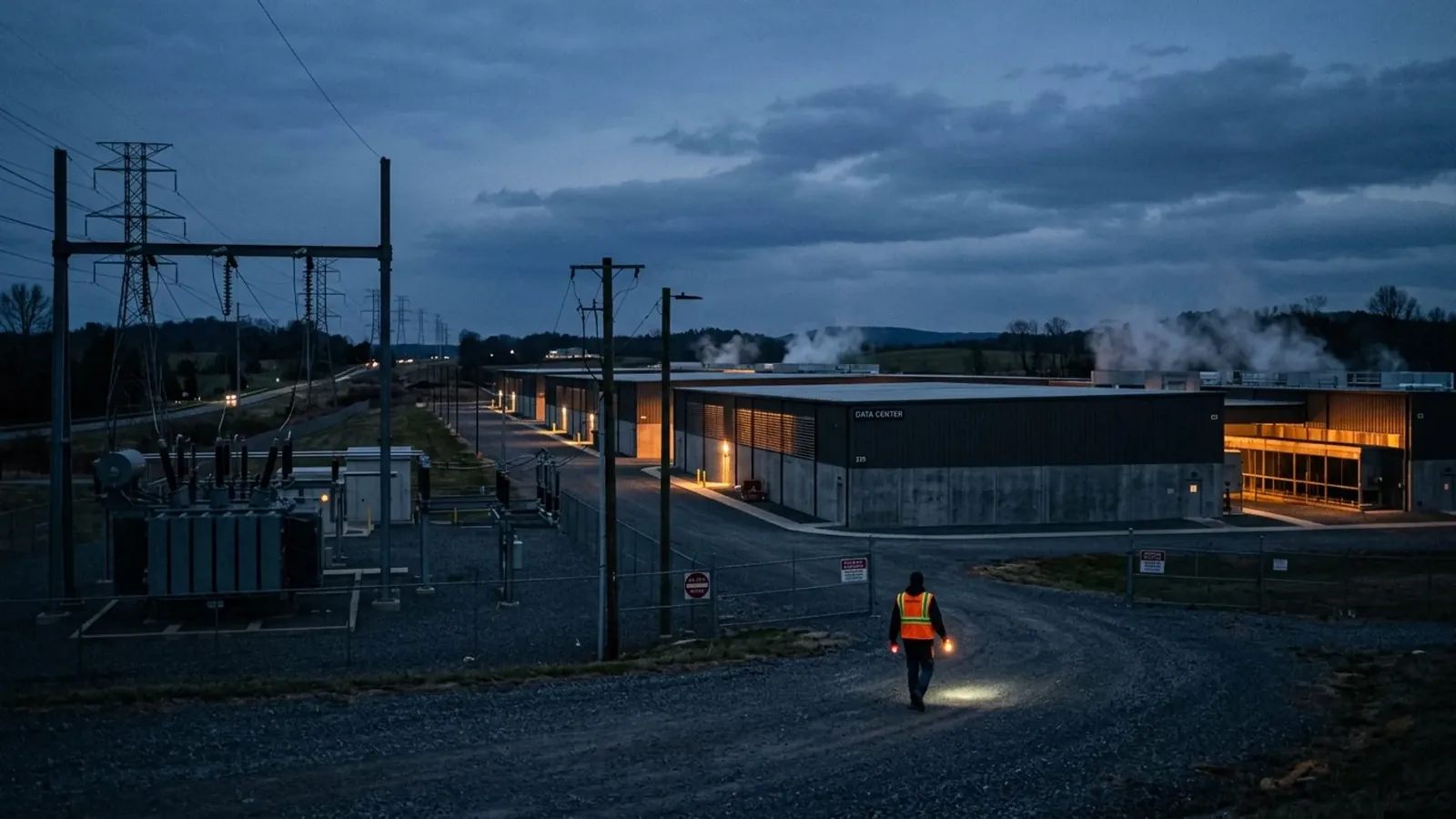
Virginia Governor Abigail Spanberger on September 18, 2026 signed Executive Order 22, a package of immediate state directives on data center transparency, environmental review and energy costs. The order also creates a rapid-response task force on artificial intelligence, co-led by the Chief Transformation Officer, the Counsel to the Governor and the Secretary of Administration. For companies that build or buy computing capacity, the state that hosts the largest concentration of data center infrastructure in the country is now writing rules that tie permits, subsidies and power costs to how operators behave.
What Executive Order 22 contains
The governor's office described the framework as the most comprehensive and aggressive data center accountability effort in the country, to be carried out through immediate directives, directives to state agencies and proposed legislation for the 2027 General Assembly session. The order lays out five pillars developers and operators must meet to do business in the Commonwealth: engage transparently with communities, protect the environment, improve affordability for Virginians, advance clean energy and grid reliability, and deliver a better deal for the workforce. Spanberger said that before she took office data centers arrived in Virginia without a clear or coordinated plan to address their impact on residents' electric bills, water, land, air and quality of life, and that this changes from the day of signing.
The transparency block bans nondisclosure agreements for commercial data center projects, eliminates by-right approval and requires local approval of any data center using more than 25 megawatts of power. It also ends state subsidies for data centers in site development programs and removes future large data centers from the state's fast-track permitting process. Effective immediately, executive branch agencies and employees under the governor's supervision may not enter into or require NDAs that block public disclosure of material information about proposed commercial developments; existing contractual commitments are expected to be honored absent extraordinary circumstances. The Virginia Economic Development Partnership may no longer assist new projects with anticipated peak demand of 25 megawatts or greater through the Virginia Business Ready Sites Program, expedited permitting or similar discretionary programs.
What this means for data center operators and AI teams
On energy costs, the framework requires utilities to allocate a more equitable share of transmission and generation costs to data centers and other large load customers, demands stronger upfront financial commitments from developers, and assigns PJM Interconnection process costs driven by data center demand to those data centers. Environmental priorities include new standards for energy efficiency, water use, land impacts and backup generation, an evaluation of the cumulative impact of diesel backup generators with a requirement that existing and future facilities move to cleaner backup power, and expedited noise regulations. The Department of Environmental Quality must deliver a workplan on noise within 180 days, complete a cumulative-impact review of diesel and other backup generation within the same period, weighing retrofits of Tier II generators to Tier IV emissions controls and non-diesel alternatives, and expedite rules designating cooling water scarcity areas, with the Eastern Virginia Groundwater Management Area named as one.
The order also directs creation of a Virginia Local Energy and Accountable Data Centers (VA-LEAD) designation, a tiered scoring system modeled on LEED and EnergyStar and covering energy and infrastructure impacts, water and land use, noise, workforce development, clean-energy investment, local materials and community benefits. Proposed criteria and an implementation plan are due to the governor by the end of calendar year 2027. The Office of the Chief Energy Officer leads implementation and must publish an initial Data Center Planning and Community Engagement Toolkit for local governments within 120 days, covering model disclosure templates, community-benefit agreement approaches and mitigation best practices. Virginia Energy must submit responsible-siting recommendations within 240 days, covering brownfield redevelopment, edge data centers, regional diversification, waste-heat co-location and impacts on scenic and historic landscapes; the Chief Energy Officer must deliver methane-emissions recommendations within 180 days, and Virginia Works must develop project-level workforce data collection criteria in the same period.
The AI Task Force, supported by a new AI Policy Planning Unit inside the Office of the Chief Transformation Officer, is charged with addressing workforce-displacement and data-privacy risks, evaluating existing Virginia law for enforcement and regulatory options, and assessing cybersecurity risks to state systems and critical infrastructure from AI agents and bots. It is directed to coordinate with frontier AI developers, naming Anthropic, OpenAI, xAI, Meta, Amazon and Microsoft, and to report to the governor continuously until she terminates it. The order's text states that the federal government has not met the moment on AI risk and that states must do more in the absence of federal leadership. Executive Order 22 rescinds Executive Order No. 30 of January 18, 2024 and Executive Directive No. 5 of September 20, 2023, both issued by former Governor Glenn Youngkin; policies published under the 2024 order remain in effect unless replaced.
For companies choosing where to place AI workloads, the practical effect is that Virginia stops being the path of least resistance. A project above 25 megawatts now needs local approval, cannot rely on an NDA to keep terms out of public view, and loses access to site-development subsidies and fast-track permitting; a small operator below that threshold faces fewer new hurdles, while a hyperscaler with several hundred megawatts of demand faces longer timelines and a larger share of transmission and generation costs. The VA-LEAD scoring system, once its criteria are published, may become a de facto benchmark that buyers of colocation and cloud capacity use to compare sites, the way LEED certification entered commercial real estate decisions. What the order does not settle is the cost of compliance: the framework sets deadlines for studies and recommendations but leaves the final standards to the 2027 legislative session, and the rescinded 2024 policies remain in force until replaced.
The marker to watch is the 2027 General Assembly session: if the governor's proposed legislation passes and writes the five pillars permanently into Virginia law, the state's model becomes the reference point other states copy, and data center siting decisions shift toward jurisdictions with lighter rules. If the proposals stall, the order's directives still apply to state agencies, but the framework remains an executive action that a future governor can unwind.