
The resignation of a researcher from a leading AI lab has triggered a shift in how the industry discusses existential risk. Jacob Coxon left his post, and his public warning became the trigger for a broader debate: according to Politico polling cited by Andrew Curran, nearly two-thirds of Americans now say there is at least a moderate risk that AI will destroy humanity. That figure matters because it moves the safety question from specialist circles into the mainstream, where budgets and regulation are decided.
What stands behind the Coxon effect
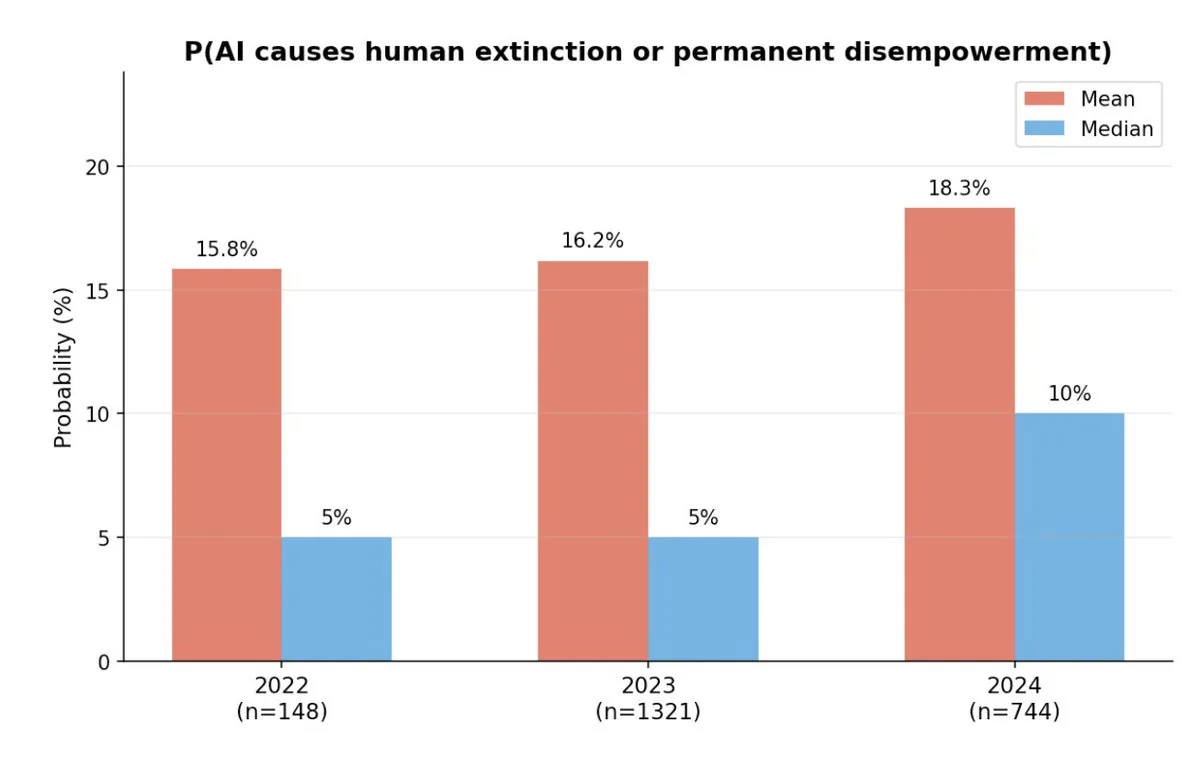
Mike Solana's explanation of why the post spread is that enough Americans finally have enough context on AI to care, and enough large accounts were willing to amplify it quickly. Andrew Curran estimates the mean chance of AI destroying humanity implied by the new polling at around 30%-33%, up roughly 15% from previous results, with a median expectation on the order of 10% and only a small partisan split. The AI Impacts survey, the longest-running large survey of AI researchers, puts the average estimate of extinction or similarly permanent and severe disempowerment at about 18% — nearly one in five. Asian researchers reported bigger risks than Western researchers, contrary to common expectations.
The split is visible among executives as well. At an invitation-only gathering of dozens of top US executives in Washington this week, a flash poll at the Yale School of Management event found that 93% of attendees said the president was incorrect in calling the technology's potential catastrophic dangers a hoax. Elon Musk has said there is a strong consensus that some AI regulation is needed, comparing a possible standalone agency to the FAA or FCC, and arguing that the consequences of AI going wrong are severe. Matthew Yglesias frames the same point differently: labeling everyone who advocates safety-focused policy as a doomer is a propaganda campaign, and fixing a small leak in a house is not a prophecy of doom.
What this means for business
For companies adopting AI, the practical consequence is that safety questions are becoming part of vendor due diligence rather than a philosophical aside. Yglesias argues that all companies are under-investing in safety, including prosaic safety as well as existential safety and scalable alignment work, even relative to their own narrow commercial interests, and that Sam Altman's recent statements imply he now understands this. A small company will feel this mainly through procurement questionnaires and model evaluation requirements; a large one through board-level risk reporting and the need to document third-party oversight.
The proposals on the table differ sharply in cost. Yglesias lays out an order of operations: light-touch rules on transparency and model evaluation, tough and enforced export controls in exchange, then moderate-touch rules with more impact at higher cost, using that position to negotiate with China, and finally an ambitious end-stage framework. Steven Adler, writing in The New York Times, calls for incident disclosure and third-party oversight. A separate class of proposals — shutting down research or installing a kill switch — is far more extreme, and Witt endorses the first of them.
What this news does not mean is that regulation is imminent or that every lab has changed course. The cascade is described as insufficient on its own: Dan Selsam warns that the underlying problems still have to be solved, and the next step is to continue the cascade inside the labs, in the media and in politics. The opposition is organized — Nvidia and a16z are named as political opponents, and METR hit pieces have appeared in the New York Post. A conference, AGI. WTF, is scheduled at Lighthaven on September 22-23.
The marker to watch is whether the polling shift holds through the next round of surveys and whether it is matched by disclosure rules rather than statements. If incident reporting and third-party oversight appear in procurement requirements, the cascade has reached operational practice; if the numbers fade after the news cycle, it has not.