Companies that merely use AI and companies built around it behave differently when the tools are switched off, and that difference matters more than the number of AI subscriptions on the balance sheet. The test proposed by the author of the original analysis is blunt: turn the models off and watch what survives. An accounting software vendor keeps selling its product; a bank call center that replaced ten thousand operators may have to rebuild its operating model. That is the line between using AI automation and being AI-native.

Where the line actually runs
The distinction shows up in the daily work of employees long before it reaches a strategy deck. Management may never have announced an AI transformation, yet staff still use Gemini to search for information, ChatGPT to write an email, Grok to prepare a report and Claude to write code. Access to LLM tools has become so widespread that the mere fact of using them says little about the company itself. The accounting vendor's developers may write features faster with AI, but the software still exists, accountants still use it and customers still pay for it. The call center is a different case: the first generation of AI there worked like a prompter beside the operator, listening to the conversation and suggesting an answer. In many cases that prompter has now become the agent itself, and a human steps in only when a case needs escalation.
That is why the author argues the useful measure is dependency, not adoption. A company that becomes less efficient without AI sits on one side of the line; a company that would have to rebuild a large part of its operating model sits on the other. Counting subscriptions or checking whether the word AI appears on the homepage tells you almost nothing about which side a business is on. The test is what remains of the product and the process once the models are gone, and how much of the work would have to be re-created by hand.
Some industries have already crossed that line, and the clearest example is self-driving. If a car is expected to see the road, recognize objects, understand what is happening around it and make decisions on its own, then AI cannot be removed without removing the product's basic idea. Medicine and pharmaceuticals make the same point through drug discovery. The Protein Data Bank was created in 1971, passed 1,000 structures in 1993, 10,000 around 2000, 100,000 in 2014 and 200,000 experimentally determined biomolecular structures by January 2023. After roughly six decades of structural biology, researchers had accumulated on the order of two hundred thousand such structures. Then AlphaFold, DeepMind's system for predicting the three-dimensional structure of a protein from its amino acid sequence, made more than 200 million predicted structures available in 2022, covering nearly every cataloged protein known to science at the time. These are predictions based on already known amino acid sequences, not new discoveries, but the difference in scale is enormous. In 2024 Demis Hassabis and John Jumper of Google DeepMind received half of the Nobel Prize in Chemistry for protein structure prediction, with the other half going to David Baker for computational protein design.
What this means for business
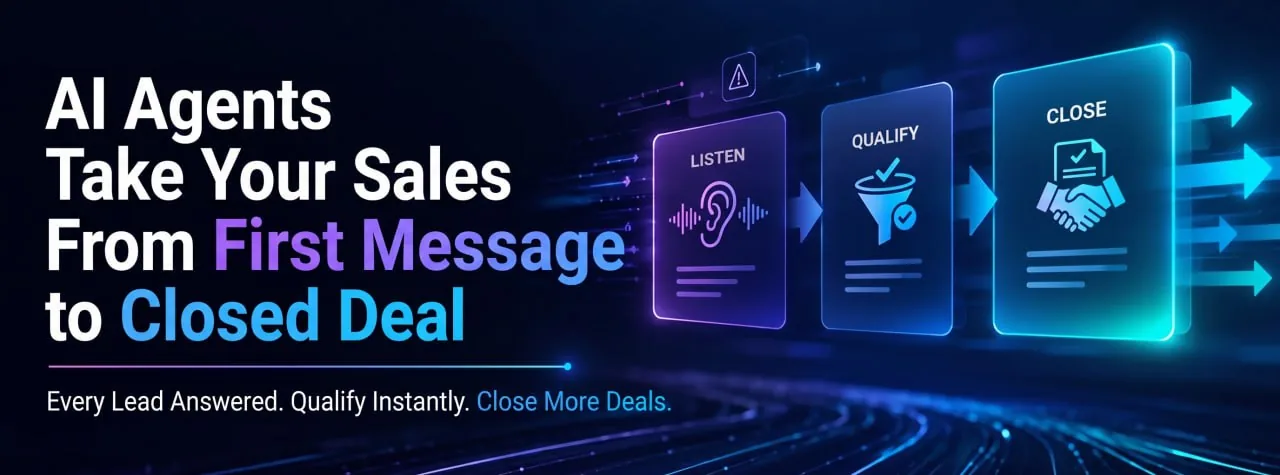
For companies adopting AI, the practical consequence is that the question shifts from which tools to buy to which processes would stop without them. Sales and marketing are among the fastest-moving examples: work that used to take hours can now be repeated hundreds or thousands of times with very little extra effort. CRM, campaigns, prospecting and lead research are built around language models, and the industry is already far beyond asking ChatGPT to write a cold email. A system can review a LinkedIn profile, see what a person does, what they care about and what they post about, then use that information to write outreach that feels personal. The author describes receiving a message referring to his aviation stories and his first reaction being that someone had read his profile carefully, when in fact the system had found the information and generated the outreach automatically. For a small company this means research capacity that previously required a dedicated hire; for a large one it means consistency across thousands of touches, but also a new layer of review.
The limits are just as concrete, and they define what to verify before handing work to agents. Good PR cannot simply be handed over to an agent and forgotten, and the same applies to an opinion piece, where positioning, audience understanding and the ability to decide what to say remain crucial. Even a fairly complex system of agents still needs a person running it, judging the output, deciding what matters and setting the direction. The author's own agent, connected to Scryon Business, can pull data, look at the market and check competitors and connected systems, and it told him that a target of 5,000 users next month was probably too much and even 2,000 would be aggressive at that stage. That helps test thinking, but the agent is still giving advice and the decision remains with the founder. The same applies to C-level roles, whose job is to set direction, after which VPs, heads and team leads turn it into specific goals and work. Real offloading, in the author's view, starts only when ownership can be handed over and the work continues without supervision for a month, which he does not see happening with the founder role today.
The marker to watch is whether companies start describing their AI dependency in operational terms rather than adoption terms: which processes would stop, which roles would have to be rebuilt, how many people would be needed to restore the previous volume of work. Where that description appears in earnings calls, hiring plans or vendor contracts, the line between using AI and being built around it is being crossed in practice. Where the answer stays at the level of tool counts and homepage slogans, the dependency is still shallow.