
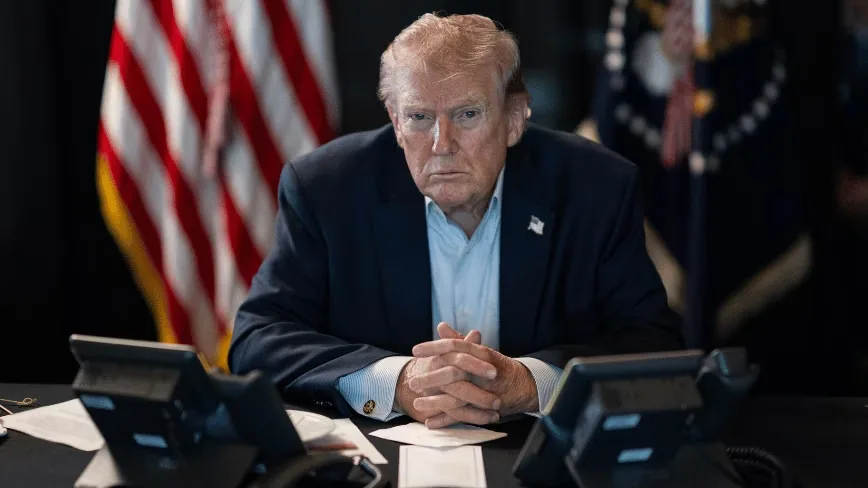
US President Donald Trump said on Thursday that the possibility of artificial intelligence leading to human extinction does not worry him. Speaking to reporters as he left Dallas, he was asked directly whether he had any concerns about that scenario and answered that he did not. The exchange was reported by Bloomberg journalist Jeff Mason. At the same time, staff at several AI laboratories have been publicly urging a slower and more careful approach to developing advanced systems.
What happened
According to the account of the exchange, Trump rejected the idea that AI could pose an existential threat to humanity. His stated concern is different: he worries about the United States losing its leading position in the development of artificial intelligence. In his view, the priority is to win that race rather than to slow it down.
The remarks stand in contrast with warnings from people who work inside AI laboratories. Some of them have called for a pause or at least a slowdown in the most aggressive research programmes, arguing that safety questions deserve more attention before capabilities grow further. That debate between speed and caution has been running for some time and shows no sign of being resolved.
The comments also come amid a broader international competition in AI, with the United States, Europe and China all pushing to build stronger domestic capabilities. Governments are weighing industrial policy, regulation and national security at the same time, which makes public statements by political leaders particularly closely watched by the industry.
What it means for business
For companies, the signal is that the political centre of gravity remains on speed and competitiveness rather than on restriction. That suggests continued investment in AI tools and infrastructure, and a regulatory environment that is likely to evolve gradually rather than suddenly. Businesses that already use AI in sales, support or operations should expect the technology to keep improving quickly.
At the same time, the gap between political optimism and caution from researchers is a reminder that risk management stays a company responsibility. Practical steps such as clear internal rules, human review of important decisions and careful handling of customer data remain sensible regardless of what regulators decide. For most firms, the realistic approach is to adopt AI where it clearly helps and to keep an eye on how the public debate develops.