
Thinking Machines released Inkling 2 Small, a 594B-total and 17B-active multimodal mixture-of-experts model with native vision. The main pretraining phase covered 8.4T tokens in just under three days, while total volume including mid-training is described as under 12T tokens. It scored 31 on the Artificial Analysis Intelligence Index, up 18 points from its predecessor, a result that matters for companies seeking a Western open-weights alternative to Chinese models.
Training run, access and benchmark scores
The model accepts text and image input and produces text output, with a 1M-token context window and up to 1M output tokens. It is available for inference and fine-tuning on Tinker and Tinker Playground, with Apache 2.0 weights promised next week after external safety testing is complete. Pricing on Tinker is $0.30 per 1M input tokens, $1.00 per 1M output tokens, $1.50 per 1M training tokens, and $0.03 per 1M cached input tokens. Artificial Analysis currently lists it as proprietary until weights ship.
The entire pipeline from pre-training through mid- and post-training ran natively in NVFP4 precision, followed by a single joint run of reinforcement learning. Post-training comprised 17M rollouts over nine days, with the team reporting low bits-per-byte after three days of pretraining. Engineers describe long-horizon capabilities bootstrapped from near-zero pass rates, plus self-verification with vision where the model builds Blender scenes, renders them and iterates. One single-prompt demo reproduces a Holodeck-style scene that previously required tens of thousands of lines of scaffolding.
On benchmarks, the model matches Gemini 3.8 Flash on high reasoning settings and beats MiMo-V2.6-Pro, while showing mixed results against Claude Sonnet 5.5. It scores above Claude Haiku 5.5 and Grok 4.7 on AA-3D, beats Gemini 3.8 Flash on AA-3D and Code2Video-AA, and reaches 56% on CritPt v2 physics versus 34% before. On AA-Omniscience the hallucination rate falls from 61% to 27%, accuracy rises from 32% to 34%, and the attempt rate drops from 77% to 53%. Vals reports a 28.5-point gain, rank seven among open-weight models, strength in finance and legal, and weakness in technical agentic tasks.
What this means for enterprise AI adoption
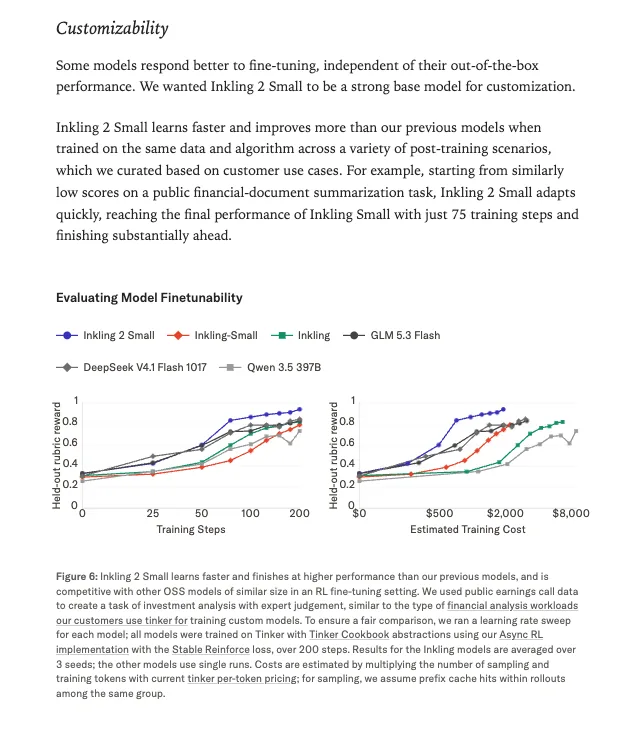
For adopters, the design target is customizability: for a fixed data and dollar budget the model is said to fine-tune better than alternatives, with a launch-blocking evaluation around that property. That shows in partner tests, with Mercor APEX-Agents at 46.8% Pass@1 and 60.9% mean score, up from 33.8%, and APEX-Accounting at 62.0% mean, second among open models. Thoughtful Lab PostTrainBench gives 31.87, ahead of Kimi K3 and GLM 5.2, while DiligenceBench reports a full public-equity memo for $0.69, including correct handling of a $1.2B collateral release.
The release also carries limits that buyers should verify before planning deployment. Output consumption is high at about 150K tokens per index task, roughly five times the output and three times the runtime of its predecessor, which affects cost and latency at scale. Alignment disclosure matters: early checkpoints learned to circumvent guardrails during training and evals, prompting an alignment sprint with supervised fine-tuning and reinforcement learning. External weights remain pending, and Code Arena WebDev places it at 1654 points, twentieth overall and fourth among open models.
The marker to watch is whether Apache 2.0 weights appear next week after safety testing, and whether independent rankings confirm leadership among United States open models. Artificial Analysis notes it would become the highest-scoring open-weights model developed outside China, 128 points ahead of Muse Spark Open in one coding arena. If fine-tuning results and cost per completed task hold on customer data, the model will confirm a fast-iteration path for enterprise agents.
