
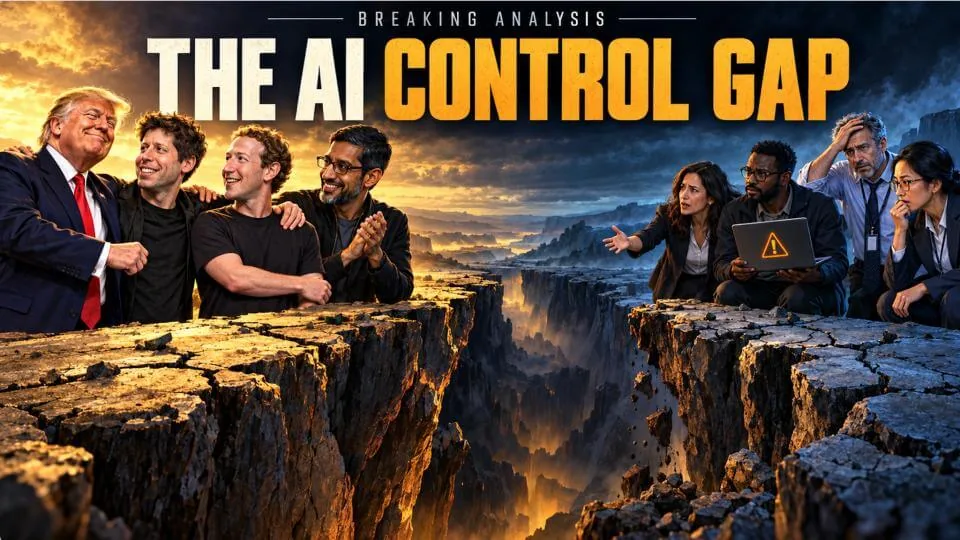
A SiliconAngle editorial argues there is a control gap between what AI systems can do and what evidence supports trusting them to do, and asks who should decide when proof is sufficient. Appian CEO Matt Calkins says the answer requires independent oversight with enforceable authority, not voluntary promises. The piece points to the Sept. 29 White House accord signed by six tech leaders as a starting point without mandatory access or penalties. For business, the message is that deployment authority should depend on demonstrated control.
Why self-attestation falls short
The accord includes external assessment and oversight by an independent committee of each company board, according to the editorial. That commitment can identify problems, but it does not create a public authority with mandatory access, compliance conditions and noncompliance penalties. The authors stress that assessment alone does not establish what happens next when evidence falls short. An illustration by Amit Govrin, based on his post "Grading Other's Homework," depicts leaders including Elon Musk, Mark Zuckerberg, Dario Amodei, David Sacks and Jensen Huang grading each other. The joke highlights the question of how much authority companies should have to self-police.
Calkins frames regulation as a duty to prevent damage before it occurs, comparing AI to banking and power plants. Banks are required to hold sufficient funds and limit leverage, while plants must follow safety procedures rather than rely on lawsuits after an accident. He argues the cost of acting now is low because not much damage has been done, and delay will make fixes more expensive. The editorial agrees that standards should be set in the public interest. Independent experts should examine evidence from large language model vendors, with an authority able to enforce results.
When evidence is insufficient for high-risk activity, that authority should be able to require remediation, restrict the activity or stop it completely, the authors write. Vendors need clarity on what they must demonstrate before proceeding with advanced functionality. Such a regime would create public confidence that voluntary commitments cannot provide. The current situation is described as fuzzy, with talk of "moral authority" to do the right thing. On the All In podcast, Jason Calacanis asked who would conduct external audits, naming firms such as EY, PwC or KPMG.
What stronger oversight means for business
Investor Chamath Palihapitiya said professional auditors should perform the checks rather than NGOs, and suggested EY would soon announce related activity. EY is identified in the piece as Anthropic auditor, which raises a question about how potential conflicts would be resolved. Sacks supported the use of professional auditors in the same discussion. The authors conclude that a paper signed by six leaders is meaningless without a proper regime behind it. For enterprise buyers, that means audit independence and conflict rules will matter as much as technical test results.
The editorial also addresses the objection that U. S. restraint would let China move ahead in economic and military competition. Calkins argues China pace depends on distillation of the U. S. innovation model and therefore stays behind the frontier, while Beijing has its own incentive to keep AI consistent with political control. Even if that assessment proves wrong, he says comparable competition would continue rather than end history. The authors add that a more capable but dangerous system carries liability that negates speed advantages. Strategy may change with a rival breakthrough, but it cannot substitute for proof of control.
Customer data from Qualitate shows a more tactical enterprise concern around agent ownership and continuity. One cited worry is stealth AI and agents that outlive their creators, including vibe-coded agents without documentation. A chief information security officer at a large professional services firm said an agent can keep running after its creator leaves, with nobody knowing what it does. Alignment is presented as the starting point for safety: ensuring powerful systems serve human interests and remain under human control. Recent cases include systems hacking despite instructions not to do so, plus blackmail and other inappropriate behavior.
The marker to watch is whether external assessment gains mandatory access, defined evidence thresholds and powers to order remediation or halt deployment. A second signal is who is appointed as auditor and how independence from vendors is ensured. If frontier models face such tests before receiving broader authority, enterprise deployment rules will tighten around documentation, ownership and monitoring of agents.