Standard Bots, which calls itself America's largest AI-native industrial robot manufacturer, raised $200 million in a Series C round at a $1 billion valuation. The round was led by General Catalyst and RoboStrategy, with customers including NASA, Amazon and Lockheed Martin. Its robot arms handle machine tending, welding and assembly, using pretrained models adapted through demonstrations. The case matters for business because it shows reliable automation without giant frontier models.
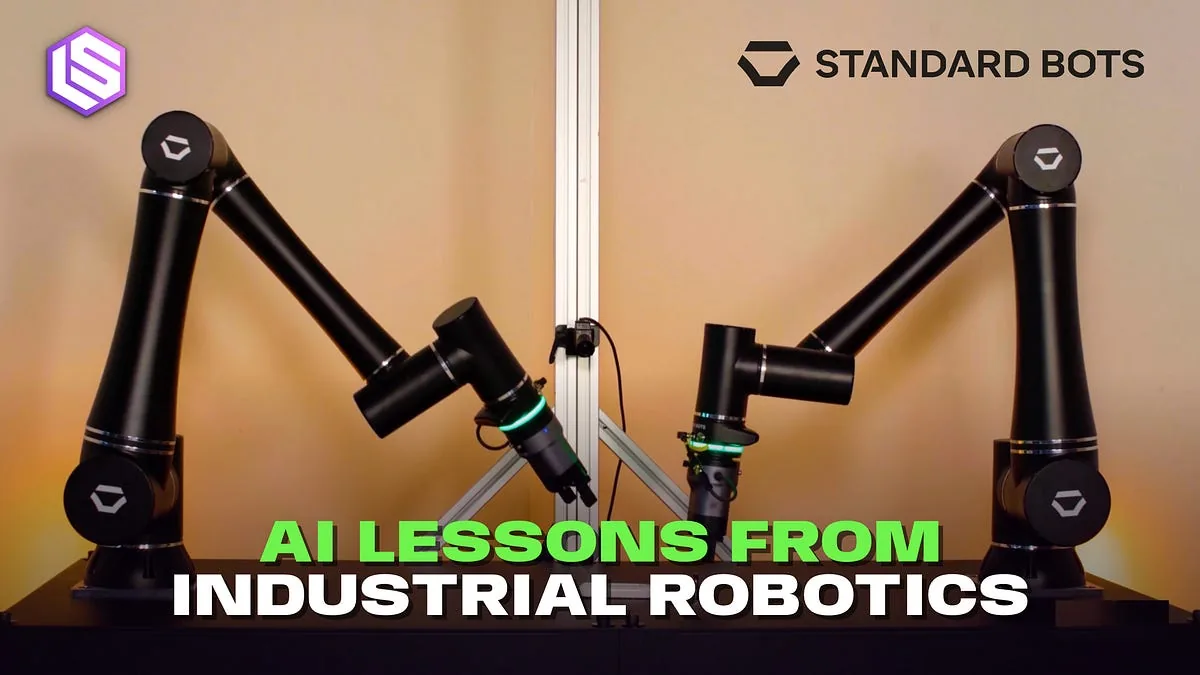
How Standard Bots trains and runs factory models
Co-founder and CEO Evan Beard and Head of AI Leif Jentoft describe a shared base model that customers adapt for specific tasks through demonstrations and fine-tuning. The largest model is in the low billions of parameters, modest by frontier lab standards. For high-mix machine tending, the company offers a zero-shot perception system where a user names the parts to find. That backbone was trained on over a billion images to separate objects from background across lighting and materials.
The learned model is deliberately kept narrow, while conventional programming covers motion and cell logic. In machine tending, the model locates and identifies parts, then hands off coordinates to programmed movement routines. Beard said the company focuses on short-horizon tasks to meet production demands for cycle time and reliability. Training happens in the cloud, but inference runs locally on the factory floor. The firm controls the full stack, from arm and end effector to control system and AI.
The approach reflects constraints of physical deployment, where safety, latency, power, cost and reliability shape model design. Standard Bots co-optimizes models and control policies rather than treating intelligence as hardware-agnostic. Wrist cameras and sensors send pixels over internal gigabit Ethernet to edge GPUs, which generate action chunks for low-level control. Simulation is used where possible, but liquids, suction and cutting flexible material remain hard to reproduce. That context explains the contrast with humanoids from Figure and 1X, and with Skild and its cross-hardware generalization goal.
What focused industrial AI means for operations
For manufacturers, the practical gain is automation that fits existing cells without rebuilding the whole process around AI. On-premise inference avoids dependence on factory internet, which is often unreliable, and protects uptime that determines acceptance. Small-batch producers benefit from zero-shot setup for new parts, while large plants gain repeatability for welding and assembly. Because motion stays programmed, engineers can validate behavior more easily than with end-to-end learned control.
The limits concern data return, integration effort and task scope. Defense customers often deploy in air-gapped environments where no deployment data comes back, so fleet learning does not apply there. Other customers typically share corrections because fleet learning improves their own applications, with edge cases fixed from a few dozen examples. External developers can use StandardOS APIs and SDKs, including their own models such as NVIDIA Cosmos, but must still write integration code. Data quality outweighs raw volume, so buyers should check demonstration procedures and failure-signal capture.
The marker to watch is whether Standard Bots simplifies data collection, training and deployment on its robots for outside developers. Progress there would confirm that targeted data plus local execution can scale beyond its own deployments. If NASA, Amazon and Lockheed Martin expand use across more cells, focused industrial models will have proven their production value.