
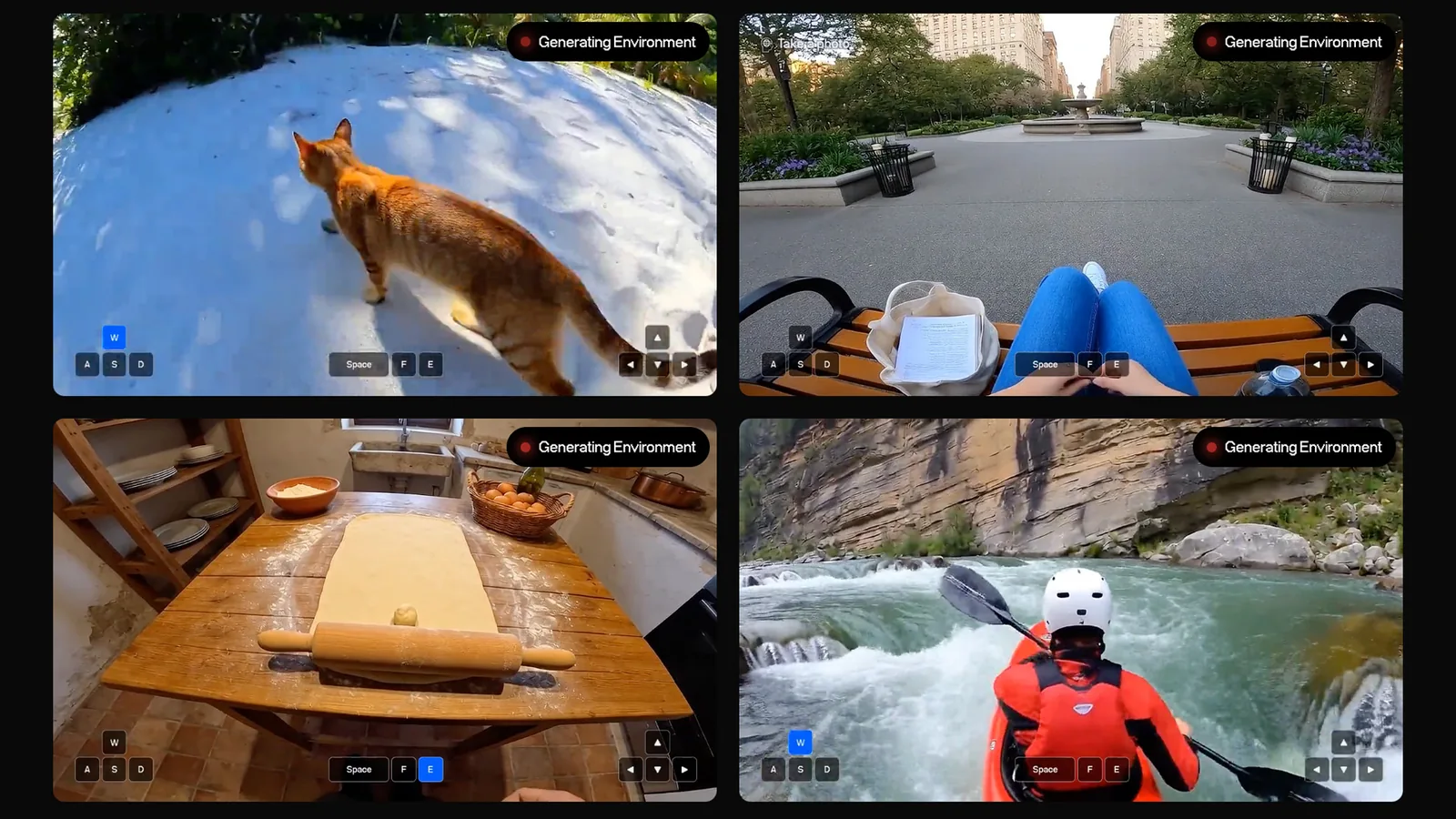
California startup Odyssey has opened a public research preview of Odyssey-3, a generative world model that builds interactive environments from text prompts in real time. The free demo runs on Odyssey-3 Flash and lets users move in first- or third-person view, trigger events and watch the scene react. The base model has 14 billion parameters, while Odyssey-3 Pro reaches 1280 x 720 pixels and scores 66.1 on Physics-IQ Verified. For business, this is a testable prototype of worlds that can serve as training grounds for robots, drones and agents.
Public preview terms and benchmark scores
Odyssey was founded in 2023 by Oliver Cameron and Jeff Hawke, who first showed the model on September 15 with a focus on robotics, autonomous driving and video games. The current step adds open access, more technical detail and benchmark submissions. Users enter a text description and receive a navigable environment, with developers able to apply separately for API access. In June 2026 the company raised 310 million dollars from investors including Amazon and AMD Ventures, which frames the scale of the effort.
Under the hood, Odyssey-3 is an autoregressive diffusion transformer that generates new video frames from previous frames and user actions. The company says the model learns physical relations and cause and effect from visual observation during training. Training data included internet videos with event descriptions, game footage paired with keyboard and mouse inputs, and simulated physical interactions. An additional training technique cuts the number of compute steps required, which makes real-time generation feasible at 832 x 480 pixels for the base version.
On measurement, Odyssey-3 Pro is listed at 66.1 points on the video-to-video test of Physics-IQ Verified, which checks fluid mechanics, optics, solid mechanics, magnetism and thermodynamics by continuing videos of real experiments. That figure comes from one run where a selection method chose one of eight videos per task, while benchmark rules call for four runs with standard deviation for a record claim. Without selection, the model averaged 63.37 points across four runs, with both results submitted by Odyssey itself. On WorldMark, the company reports first places in three of four categories on its own evaluation, including 77.2 in First-Person Stylized and 79.0 in Third-Person Real.
What this means for automation projects
Odyssey positions one world model as a shared base for different control tasks, from robotic arms to drones to game characters. Each application pairs the model with a specialized controller that converts predictions into concrete commands. In company tests, an Odyssey-3-based system controlled several robotic arms after a few dozen hours of demonstration data and recovered from failed grasps not seen in training. For humanoids, controllers built with Swiss company Flexion performed more reliably under changing conditions than comparison models.
Other pilots point to transfer across environments with limited data. A drone controller trained on simulated flight data dodged obstacles and flew to named targets in a virtual indoor space. A controller trained on roughly two hours of GTA V footage steered vehicles and fought enemies, then moved a character on horseback in Red Dead Redemption 2 without extra training. A separate demo showed an agent receiving a natural-language task inside an Odyssey-3-generated scene and learning from the results of its own actions, a possible new training route for AI.
The marker to watch is whether independent runs and outside users reproduce the physics scores and control results beyond the demo. Google DeepMind is developing Genie 3 for interactive worlds, while World Labs, founded by Fei-Fei Li, works on similar technology amid AMD plans to acquire it for roughly 8.2 billion dollars. If Odyssey sustains its rankings and ships API access for robotics, generative worlds could become a practical layer for testing automation.