
Salience Labs has raised an oversubscribed $125 million Series B to scale optical circuit switching for AI datacenters, where networking limits how much useful work thousands of GPUs complete. The round was led by Bullhound Capital, with Bullhound principal Callum Stewart joining the board. The Oxford-based company will use the capital for deployment, higher-volume manufacturing and expansion of its Silicon Valley presence. For business, the deal signals that interconnect performance is becoming a separate investment priority alongside compute.
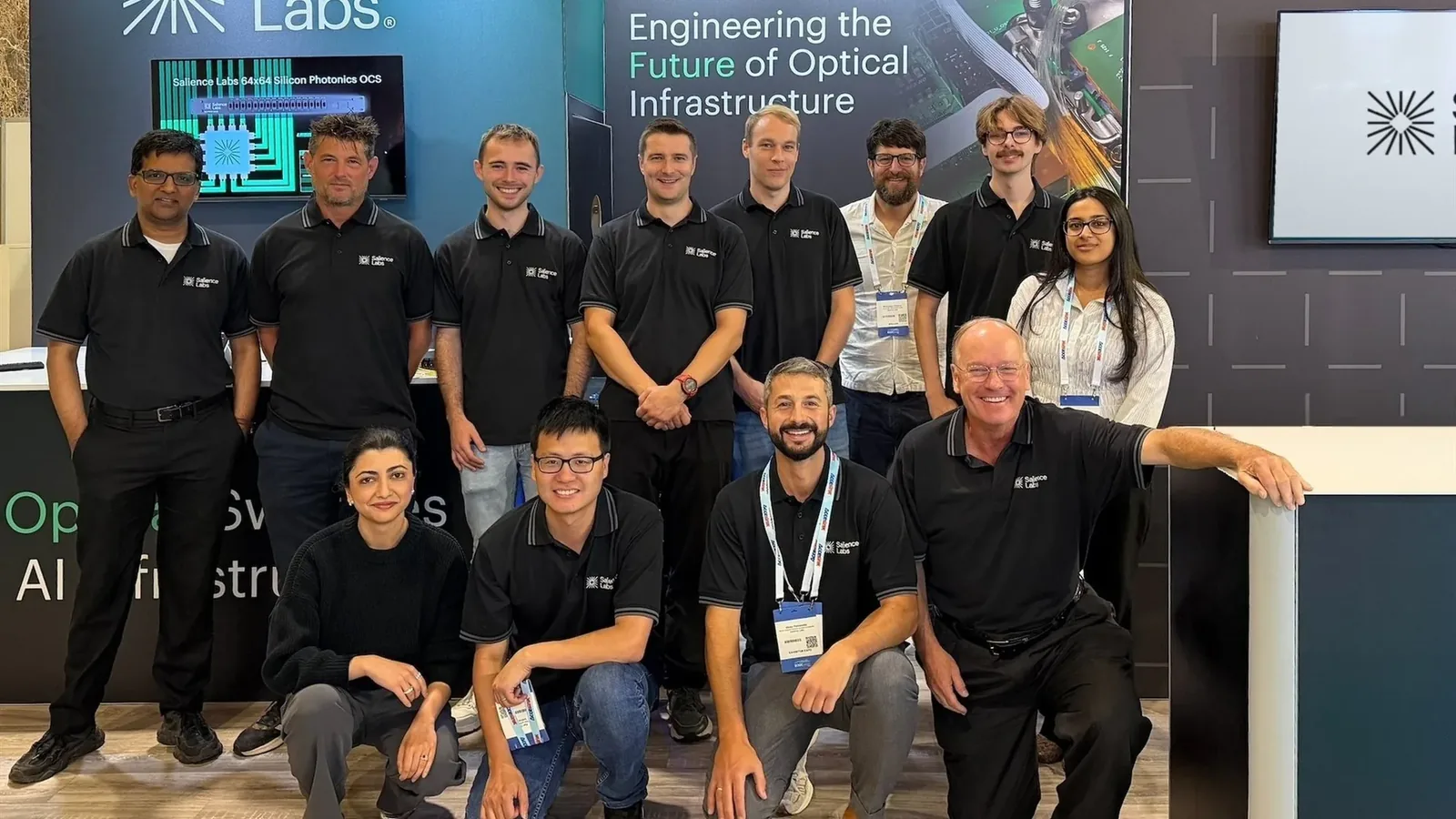
64-port demo and path to larger switches
The financing follows a demonstration of a 64-port silicon photonic switch at ECOC 2026, which the company characterizes as an industry first for silicon photonics optical circuit switching. Future 128- and 256-port products are on the roadmap, with the Series B intended to support development toward those larger systems. Participants in the round include AMD Ventures, Intel Capital, SBI Group, Hudson River Trading and the British Business Bank, alongside existing shareholders. The company was founded in 2021 and is led by CEO and co-founder Vaysh Kewada and CTO and co-founder Johannes Feldmann.
The technology keeps data in the optical domain as it moves between connections. In conventional electrical switching, optical signals must be converted to electrical form at the switching stage and converted back for onward optical transmission. Optical circuit switching instead establishes a path for the light signal itself, with the objective of reducing conversion overhead and providing low-latency connections. The approach does not replace GPUs or perform model computations. It targets communication delays that can leave accelerators waiting during distributed training and inference.
The design builds on more than a decade of silicon photonics research associated with the University of Oxford and the University of Munster. Silicon photonics places optical functions on semiconductor chips, and Salience argues that integrating switching and amplification combines optical performance with repeatable manufacturing. A reference product is the OC-32M module, a non-blocking 32-input, 32-output switch integrating photonic chip, driving electronics, firmware and fiber connectors, plus a rack-mounted evaluation platform. Listed specifications for that module include 10-nanosecond input-to-output latency, reconfiguration under 300 microseconds, insertion loss under 2 dB and power below one watt per port.
What optical switching means for AI operations
For companies running large AI workloads, the practical effect would be more efficient use of existing accelerators rather than additional raw compute. Scale-up networks connect accelerators into tightly coordinated systems, while scale-out networks link systems across larger clusters, and both depend on high-performance communication. If optical circuits reduce conversion overhead and fit within optical power budgets, operators could connect GPUs across multiple racks with lower latency and lower per-port power. Small firms would feel this mainly through cloud and colocation offerings, while large cluster owners could see direct effects on throughput and energy costs.
The limits require careful checks before procurement decisions. Latency and reconfiguration describe different events: 10 nanoseconds concerns transit through an established connection, while under 300 microseconds concerns changing which endpoints are connected. The listed figures apply to the documented 32-port module and are company specifications, not independently verified measurements of the 64-port demonstration. Backing from AMD Ventures and Intel Capital does not by itself establish product integration or customer orders, and the ambition to connect thousands of GPUs describes network scope, not the port count of one switch.
Confirmation will come from qualified hardware and manufacturing consistency rather than demonstrations. Watch for working 128- and 256-port systems, continued engagement with Keysight Technologies and Tower Semiconductor on testing and high-volume operations, and workload-level results on training and inference economics. A second West Coast location will also show how quickly the company builds US delivery capacity. Those milestones will determine whether optical switching moves from laboratory progress to usable infrastructure.
