
PeakMetrics Inc. has launched AI Perceptions, a monitoring service that measures how brands are portrayed across five generative AI platforms and identifies the online sources shaping those portrayals. The service covers ChatGPT, Gemini, Claude, Grok and Perplexity, and is aimed at corporate communications teams. A basic subscription costs $99 per month, which puts AI reputation tracking within reach of mid-sized companies rather than only large enterprises.
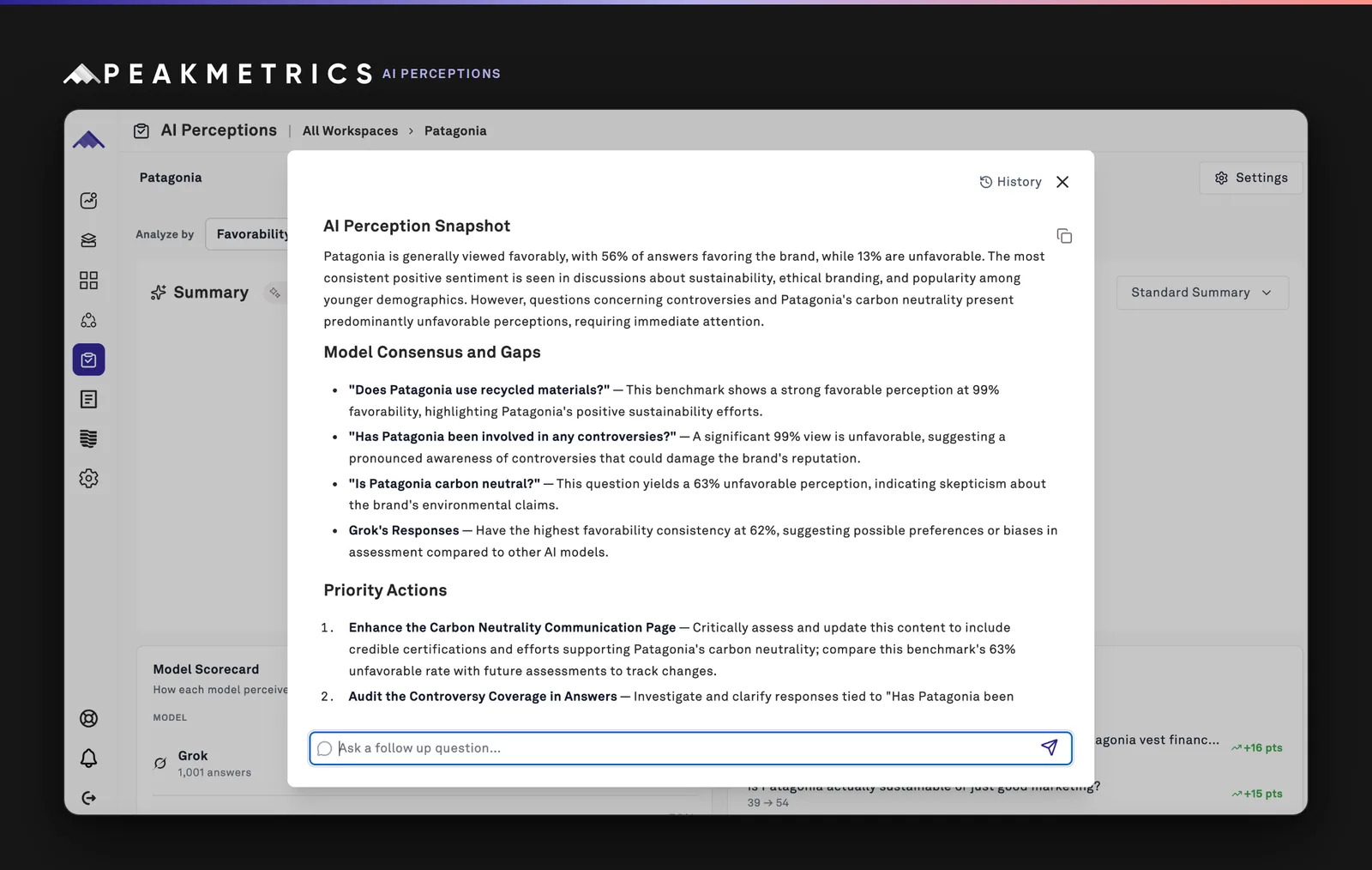
What the service tracks and how it works
Customers choose the questions they want monitored, typically covering their brands, products, competitors and industry issues. The service submits those prompts to the five AI platforms on a regular schedule, records the answers and analyzes how they change over time. According to Steven Childress, PeakMetrics' director of product, customers usually monitor hundreds of prompts, from broad industry topics to questions about specific products. The company scores each response against criteria the customer defines: favorability, trust, competitive positioning, message adoption and purchase intent.
Beyond the answers themselves, the platform tracks the citations a large language model discovers when it searches the web before responding. That helps communications teams see which websites and individual pages influence a given answer. The limitation is that citation analysis works only when the AI system chooses to invoke web search. As Childress put it, PeakMetrics gives the different LLMs access to perform a web search and then determines whether they decide to use it. In one case, the company helped a customer trace inaccurate information about a movie theater chain to an outdated page on the customer's own website; correcting that page addressed the misinformation at its source.
The launch reflects the rise of generative engine optimization, or GEO, as consumers increasingly ask AI assistants for product recommendations and company information. Conventional search engine optimization focuses on rankings and website traffic, while GEO focuses on whether and how a brand appears in AI-generated answers. PeakMetrics positions AI Perceptions as a reputation management tool rather than a simple AI visibility monitor. Communications teams can compare perception before and after a campaign, identify unfavorable answers and determine whether their own sites or third-party coverage are driving the results.
What this means for business
For companies that already track media mentions, the practical change is that a new channel of influence becomes measurable. A brand can now see whether an AI assistant recommends its product over a competitor's, or whether responses consistently tie the brand to a message such as sustainability. The integration with PeakMetrics' existing narrative intelligence platform, which analyzes news, social media and podcasts, is meant to show how a narrative originates, spreads across channels and eventually surfaces in AI responses. For a small company, the $99 monthly entry point makes this kind of monitoring affordable; for a large enterprise, the value lies in comparing perception across markets and campaigns.
Several limitations matter when evaluating the service. Citation analysis is available only when a model invokes web search, so the picture is incomplete for answers generated without browsing. Scores depend on criteria the customer defines, which means results are only as useful as the questions and metrics chosen. The system also tries to separate authentic discussion from automated or manipulated content, assigning bot-detection scores based on posting frequency, account age and follower patterns, and a partnership with Reality Defender adds analysis of potentially synthetic text, images and video. Jessica Pratt, vice president of marketing and communications, said bot activity typically accounts for 20% to 30% of social media content in a customer workspace and can rise during a crisis. She noted that actors can use agentic workflows to reword messages while pushing the same underlying narrative, which makes copy-and-paste detection less effective. Buyers should ask vendors how prompts are sampled, how often answers are refreshed and whether citation data is available for their specific use cases.
The trend will be confirmed by whether communications teams treat AI answers as a managed channel with its own budget and metrics. A concrete marker to watch is the share of PeakMetrics customers who move from monitoring prompts to acting on the findings, for example by correcting source pages or adjusting campaigns based on AI responses. If that share grows, AI perception tracking becomes a standard part of corporate communications rather than an experiment.
