
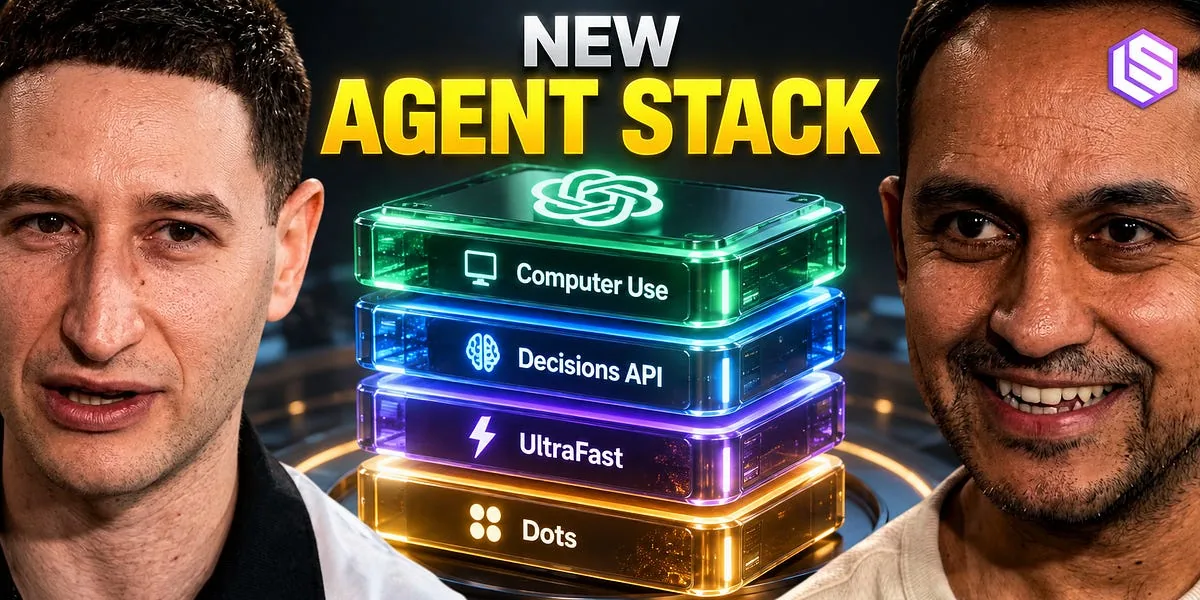
OpenAI used its DevDay keynote to move Computer Use from research demos into developer infrastructure, adding it to the Agents API alongside Dots personal assistants, the GPT-6.1 Sol model and the Decisions API. Ari Weinstein, who leads product and engineering for Computer Use, said GPT-6.1 Sol costs one fifth of Astra, and one seventh for Computer Use workloads specifically. The shift matters for business because agents can now operate the same software employees use, inside products and developer tools rather than separate experiments.
What OpenAI announced at DevDay
Dots give each assistant its own Linux virtual computer in the cloud, able to run full desktop applications and a web browser. That differs from earlier setups where agents had only a cloud browser or access to the user Mac, including native Computer Use on Mac and App Shots for moving on-screen context into Codex and ChatGPT. Developers can now build on the same Computer Use stack used in Codex and ChatGPT through the Agents API. The lineup also includes async tool calling, mid-turn steering, WebSockets, UltraFast inference, longer prompt caching, pre-warming and compaction for long-running threads.
The technical change centers on how agents perceive and act on software. The system combines screenshots with accessibility trees, DOM data, Playwright automation and generated JavaScript, rather than relying on pixels alone. App Shots add richer context from what a user is doing for faster handoff to the agent. According to the discussion, this combination changes the speed equation and supports recovery: agents detect a failed click, form or script step, then debug and try another path. The same loop connects writing software with testing it, which fits coding, QA and browser workflows.
The timing follows several months of work after OpenAI acquired Sky Software, the company co-founded by Weinstein. The team describes current Computer Use as 180 degrees different from earlier versions, with some tasks now completed faster than an average human operator. The podcast hosts frame the background as a debate around Dwarkesh commentary on RLVR and computer-use progress, plus prior coverage of Anthropic Computer Use and Claude Cowork. OpenAI positions Decisions API as a smaller model without reasoning that runs inference in parallel, leaving long-horizon tasks to larger Computer Use models while research on combining them continues.
What this means for automation projects
For companies, the practical effect is a wider set of tasks that can be delegated without building custom integrations. Booking, shopping, customer-service fixes, authentication problems and routine desktop work were cited as starting points, since agents use existing interfaces designed for people. Small teams gain access to desktop automation that previously required engineering effort, while large firms can standardize the same Computer Use stack across Codex, ChatGPT and internal tools through the Agents API. GPT-6.1 Sol lowers the cost barrier for high-volume browser and desktop operations.
The limits concern trust, permissions and fit for each workload. Agents able to make payments and operate websites need clear approval rules, audit trails and boundaries for sensitive actions. Decisions API is described as a fast Luna wrapper for now, suited to support classification and internal workflows rather than complex multi-step control. Buyers should ask vendors which model handles each step, how screenshots and DOM access are stored, how mid-turn steering interrupts errors, and how compaction and memory preserve context across long threads.
A useful marker will be whether developers ship production Agents API projects that mix Decisions API for fast classification with Computer Use for execution. OpenAI already reports internal use of Decisions API for support and workflow tasks, alongside Dots running persistent cloud computers. If third-party case studies show stable costs with GPT-6.1 Sol and fewer failed runs, the stack will have moved from keynote features to dependable business automation.
