
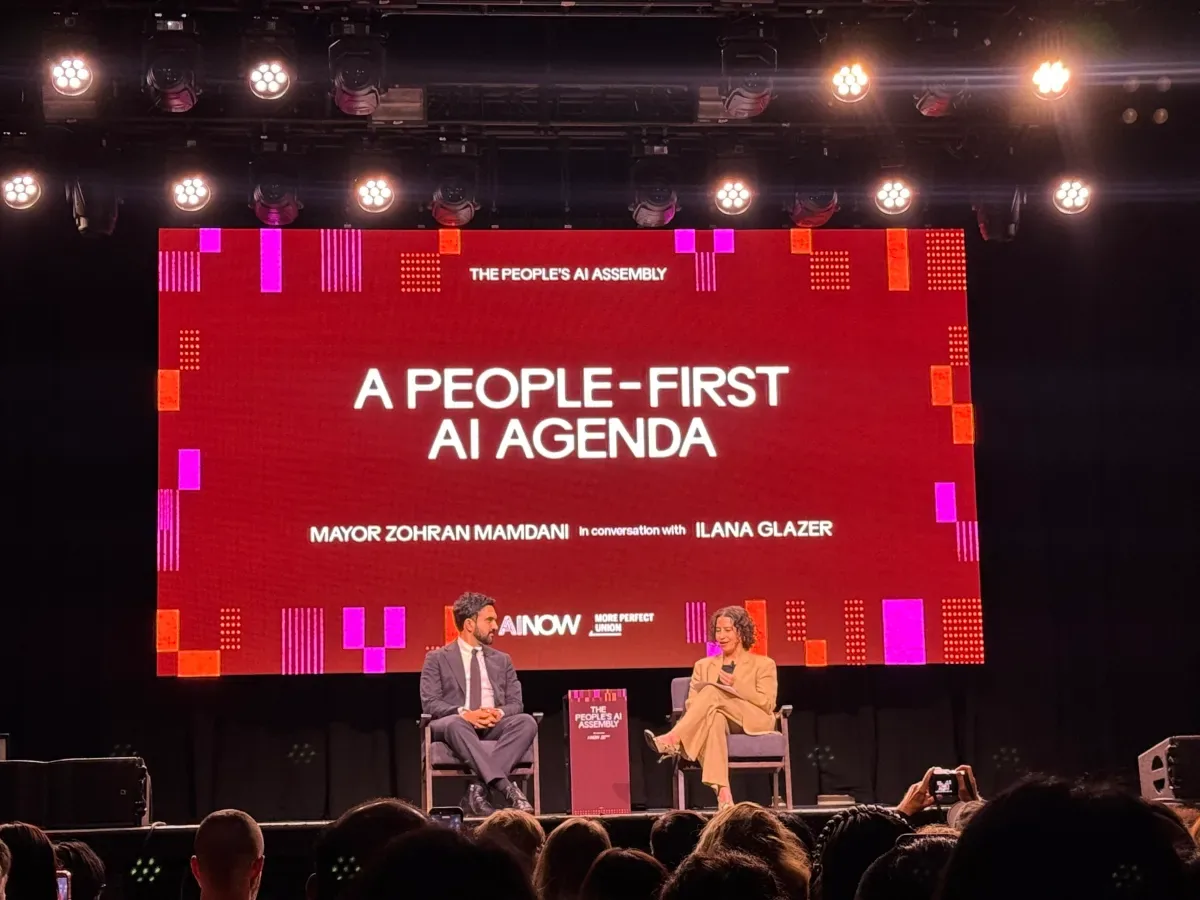
Mamdani told New Yorkers that rapid adoption of AI is not inevitable and that residents should resist pressure to accept it without question. Speaking at Webster Hall in Manhattan on Monday night, the mayor said the federal government had left cities to act alone on accountability for AI companies. The remarks came at The People's AI Assembly, hosted by the AI Now Institute, where activist Ilana Glazer questioned him about jobs, children and dignity. For business, the signal is a shift of AI rules toward city-level restrictions.
School ban and housing disclosure rules
Last month Mamdani ordered a ban on AI use in elementary and middle schools in New York. Glazer, a parent, said the arrival of the technology in classrooms unsettles her because its presence was not required two years ago. Over the summer, the mayor also introduced a policy for landlords, brokers and real estate platforms. They would have to clearly disclose when listing photos or videos of a property are made with AI. The measure aims to protect residents from being house-phished, or misled by altered listings.
Both policies rest on the same mechanism: a local prohibition or disclosure duty instead of waiting for national legislation. The school rule removes AI from early grades entirely, while the housing rule does not prohibit synthetic media but requires its labeling at the point of listing. In each case the obligation falls on local institutions and market intermediaries, not on model developers. Mamdani framed this as a response to a creep that leaves people feeling they have no option. The practical effect is that compliance starts at deployment inside city services and transactions.
The event took place against limited federal regulation of AI. President Donald Trump's Superintelligence Task Force, announced earlier this month, largely focuses on allowing large AI companies to self-regulate rather than creating new federal restrictions. Mamdani said national debate frames AI as an arms race with China, pushing human concerns aside in the language of competition. He also pointed to warnings from whistleblowers at Anthropic, Google DeepMind and OpenAI about extreme risks, including human extinction. Anthropic is expected to debut on public markets this year, while OpenAI has said it will go public in 2027.
What city-first AI accountability means for business
For companies operating in New York, the immediate consequence is more local checkpoints around AI use in hiring, education services, marketing and property listings. Schools and vendors serving elementary and middle grades lose one sales channel for classroom tools, while brokerages and listing platforms need processes to identify and mark AI-generated visuals. Small firms will feel this through manual review and disclosure routines, without dedicated compliance staff. Large organizations will need to align city rules with internal standards and train customer-facing teams on what counts as AI-made content.
The approach also carries limits that buyers and managers should verify before changing suppliers. The source describes policies and statements from the event, not enforcement data, penalties or technical standards for detection and labeling. Mamdani cited the U. S. military February strike on a school in Iran that killed more than 150 people, including at least 123 children, with officials telling Bloomberg that overreliance on AI in targeting was one factor. That example warns against treating systems as infallible, but it does not by itself define acceptable accuracy or oversight for commercial tools. Buyers should ask vendors how outputs are tested, logged and corrected, and what remains under human review.
The marker to watch is whether other cities copy the New York combination of classroom bans and mandatory disclosure for AI-generated listings. Mamdani said the period after the current federal administration needs a different framework for accountability, and compared industry arguments to those made by Facebook in 2008. If similar municipal rules appear and survive legal and operational challenges, local compliance will become a standard part of AI procurement. If not, the New York measures will remain isolated tests of city power over deployment.
