
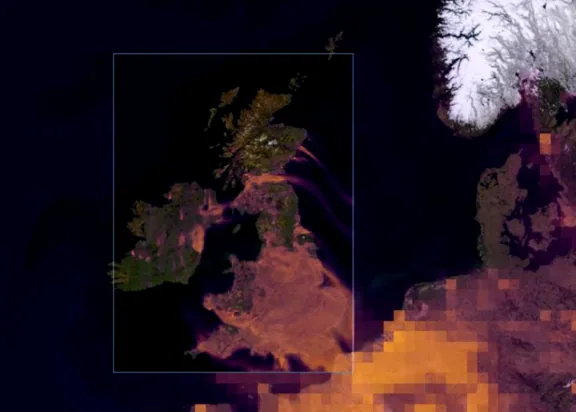
Researchers at the University of Manchester have adapted NVIDIA's Earth-2 open AI models to forecast air pollution across the United Kingdom, producing a nationwide pollution model at a resolution of 2-3 square kilometers. The training run took two days on a single eight-GPU node of the Isambard-AI supercomputer in Bristol. The work matters because air pollution contributed to an estimated 30,000 deaths in the U. K. last year, and detailed forecasts have until now been limited by computing cost.
What the Manchester team built
The project was led by David Topping, a professor in the university's department of Earth and environmental science. His starting point was the observation that NVIDIA's Earth-2 family of open models and tools had already solved a comparable problem for weather forecasting. Topping and his colleagues generated training data from existing chemistry-climate simulations and trained Earth-2 CorrDiff, a generative downscaling model, on Isambard-AI, the U. K.'s national AI supercomputer. They then added Earth-2 StormCast, a model that enables time-dependent forecasts drawing directly on air quality observations. To retrain the model for pollution, the team used a year's worth of U. K. pollution data simulated at hourly intervals.
Isambard-AI is described as the U. K.'s most powerful AI supercomputer, equipped with 5,448 NVIDIA GH200 Grace Hopper Superchips delivering 21 exaflops of AI performance. The pollution model was trained on a single eight-GPU node of that system. Simon McIntosh-Smith, director of the Bristol Centre for Supercomputing at the University of Bristol and cofounder of Isambard-AI, noted that the GPU hours consumed were relatively low, which meant less power drawn from the supercomputer for the workloads. The same workflow also runs on the NVIDIA GB10 Grace Blackwell superchip-powered DGX Spark desktop AI system for inference and smaller training runs; Topping now keeps one in his office for retraining models.
What this means for business
The practical consequence is a change in who can produce detailed pollution forecasts. Topping's stated aim is to release open source training data and workflows so that similar models can be trained for other countries and regions, with the ambition that every country and major city with a small burst of supercomputer AI time could build its own detailed pollution model on local data. For a large organization, that lowers the barrier to entry from national-scale infrastructure to a single node or a desktop system. For a smaller team, the relevant shift is cost: Topping put the starting investment at a few thousand dollars for developing powerful AI models.
Several things remain to be verified before such models inform operational decisions. The current resolution of 2-3 square kilometers is not yet street scale; the team plans to raise it by incorporating additional open data. The forecasts are trained on simulated chemistry-climate data, so their accuracy against real observations is the question a buyer or public agency should test first. The healthcare scenario Topping describes, in which regional and national services warn asthma patients that pollution will be high tomorrow or next week, depends on access to air quality observations that the team says is still limited. A further application under exploration pairs the pollution model with edge AI devices to ingest real-time data and support decisions during events such as a wildfire.
Niall Robinson, developer relations manager for weather and climate at NVIDIA, framed the two-day training run and the ability to run the model on a DGX Spark as a change in who can do this science and how quickly. Hao Zhang, a doctoral student at the University of Manchester who trained StormCast on Isambard-AI, pointed to the ease of switching between NVIDIA frameworks as the notable part of the work. Looking five years out, Topping describes an agentic interface in which a clinician or government agency asks a question and a chain of models returns an answer grounded in the underlying science.
The marker to watch is the release of the open source training data and workflows. If other countries and cities use them to train their own pollution models on local data, the approach becomes a repeatable template rather than a single research result; if the release stalls or the models fail to match observed pollution levels, the value for business stays theoretical.