
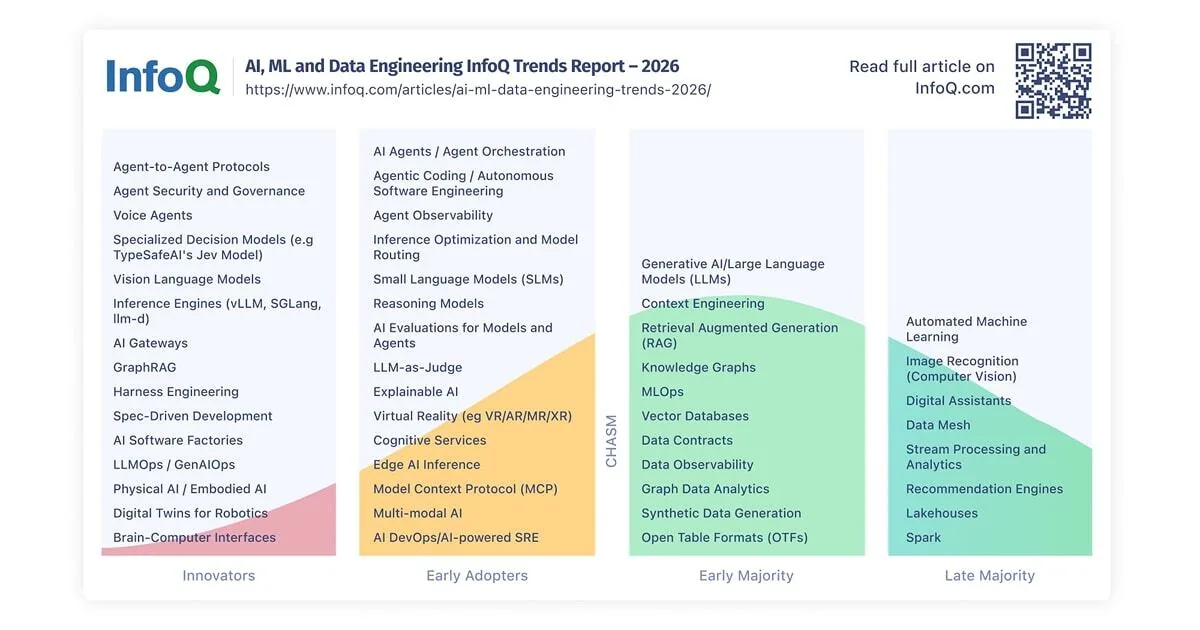
InfoQ released its AI, ML and Data Engineering Trends Report for 2026, built around an adoption graph based on Crossing the Chasm by Geoffrey Moore. Almost four years after ChatGPT launched in November 2022, the focus has moved from training to operating models in production. Inference is expected to account for around two-thirds of AI compute spending by the end of this year. For business, this marks a shift from experiments with models to the economics of running them.
Agent protocols, inference and new engineering practices
New entries in the Innovators category include agent communication protocols, AI inference operations, harness engineering, spec-driven development and AI software factories. Panelist Daniel Dominguez pointed to protocols such as MCP and A2A that let agents access tools, data and APIs and talk to other agents. The question raised in the podcast is whether such protocols become a new enterprise integration layer, with agent discovery and task coordination built on top of existing APIs.
Harness engineering extends agent software development kits beyond the basic execution loop. According to panelist Hien Luu, SDKs from LangChain, Anthropic and OpenAI now add memory management for context, co-execution and ready tools for work with local file systems. Vendors also offer runtime environments to host and operate agents at scale. The approach reduces custom code for coordination, though it ties projects to the capabilities and limits of a specific SDK and runtime.
Spec-driven development responds to coding agents powerful enough to handle much of the coding work. Teams first define capabilities, business requirements and functional and non-functional specifications, then discuss the plan with a coding agent before generation starts. Some organizations go further and build AI software factories that cover analysis of an existing application, review of new requirements, specification writing, task generation and code creation. Luu traces the practice to planning habits from four or five years ago, now formalized for work with agents.
What the 2026 shift means for AI adoption
For companies using AI, the 2026 agenda centers on running inference reliably and affordably. Open-weight models combined with stacks such as vLLM and SGLang allow firms to run their own inference service in their own environment, which matters for financial companies handling PII and for teams hosting internal coding models to save cost. Small firms gain access to documented setups and optimization guides, while large firms can standardize internal hosting, routing and memory management across departments.
The same shift raises demands on operations and integration choices. Reasoning models, long context and agents turn inference from model execution into a systems task spanning compute, memory, networking and routing. Agent protocols remain fragmented, and harness features differ across vendors, so commitments to one SDK or runtime need testing for portability. The report does not promise savings by itself; internal hosting pays off only with sufficient load and staff able to operate the stack.
Confirmation of the trend will come from spending and product structure by the end of this year. If inference indeed reaches around two-thirds of AI compute spending and agent SDKs keep memory, co-execution and hosting as standard parts, operating AI systems becomes the main budget item. That outcome would fix specifications, inference operations and protocol compatibility as core procurement criteria.
