
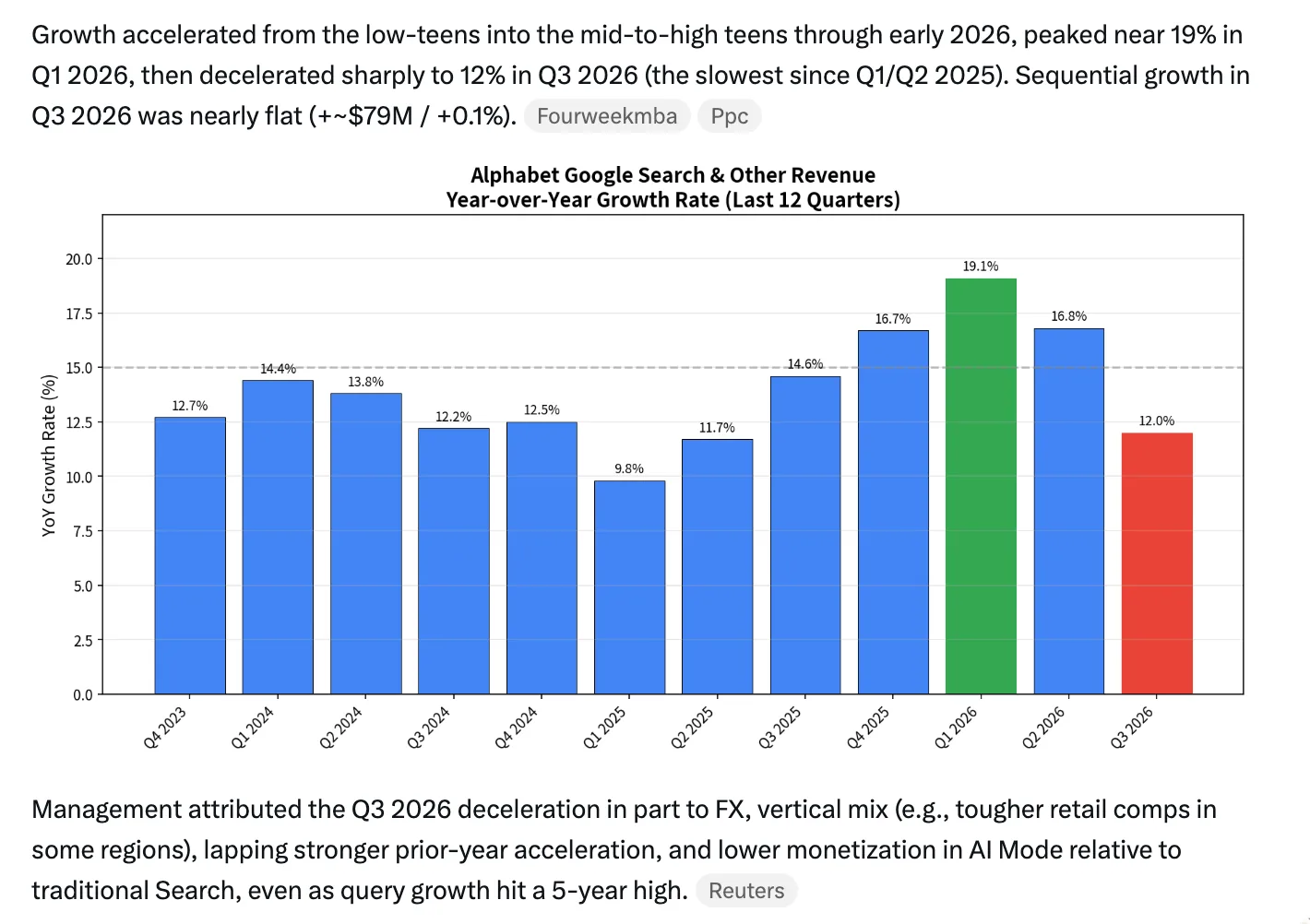
Google acknowledged that rapid growth in AI Mode queries is reducing Search monetization, triggering a share decline of about 15% and a loss of roughly $500B in market value. Chief Business Officer Philipp Schindler said lower monetization in AI Mode affected results, in what the newsletter described as the worst drop since the 2004 IPO. For businesses dependent on search traffic and advertising, the statement confirms that AI answers are now reshaping the economics of discovery.
Why AI answers pressure Search economics
According to the source, Google does not disclose AI Mode performance in enough detail for rigorous analysis, so markets reacted to Schindler's comment together with other weak earnings results. The quoted formulation links strong growth in AI Mode queries directly to lower monetization compared with traditional search. The selloff was not limited to Google and spread across technology shares, reflecting broader concern about returns on AI investment.
The mechanism described is the conflict between summary pages and the underlying pages they draw upon. A sufficiently complete summary removes the need to open the source, which reduces clicks to publishers and advertising inventory. Google previously faced the same tension with Featured Snippets and Knowledge Panels that reused publisher data. AI Overviews and AI Mode extend that logic by answering more complex queries inside Google itself.
The disclosure comes against weakening sentiment toward technology and AI in public markets. The source notes OpenAI raising at $1.25T rather than $1.4T ahead of a potentially large technology IPO. It also points to recently departed AI leadership at Google and frames the episode as central to the future of Google Search. In that setting, evidence of weaker monetization carried more weight than product metrics alone.
What this means for customer acquisition
For companies that acquire customers through search, fewer clicks from AI-generated answers can mean lower organic traffic and higher dependence on paid placements. If informational queries are resolved inside AI Mode, publishers, aggregators and service firms may see reduced visits from guides, comparisons and reviews. Larger advertisers can compensate through brand demand and broader channel mixes, while smaller firms reliant on long-tail search face higher customer-acquisition costs.
The statement does not by itself quantify how much traffic or revenue will shift, because Google provides no separate AI Mode breakdown. Businesses should not assume that every AI answer eliminates clicks or that traditional rankings have lost value. Key questions for planning are which queries trigger AI summaries, how often sources receive attribution and clicks, and how conversion differs between AI-assisted and classic search sessions.
Confirmation will come from Google's next earnings disclosures on Search revenue, AI Mode usage and monetization trends. A stabilization of monetization or new ad formats inside AI answers would suggest the model is adapting. A further decline tied explicitly to AI Mode would show that automation of answers continues to reprice search distribution.
