
Google now lets Android owners install apps they built for themselves through Google Play without publishing them to the store, the company announced on Tuesday. The personal apps stay invisible in search and listings and remain available only to the creator under a standard Google account. The move removes a barrier that pushed many AI-built tools toward the web instead of native Android, and it matters because internal and personal software can now reach a phone faster.
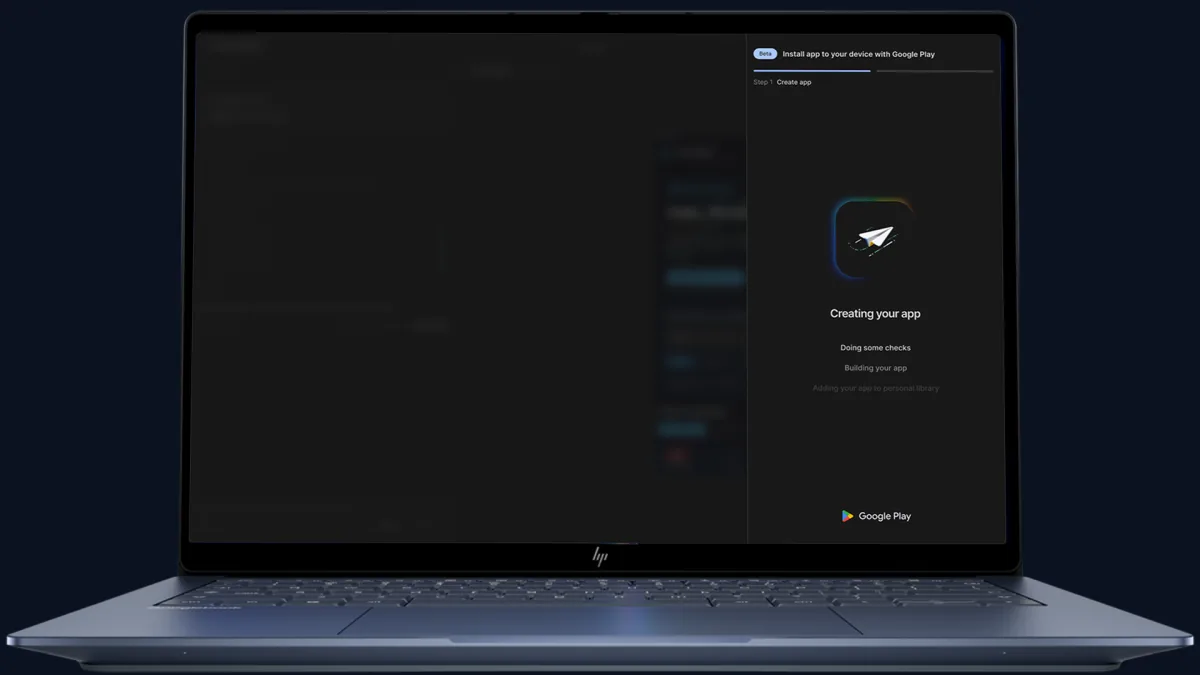
Private installs built with Google AI Studio
Previously, running a self-made app on an Android phone meant publishing through Google Play and making it accessible to some 3 billion users. That trade-off discouraged native experiments for narrow personal needs and left web apps as the simpler path across devices. The new route keeps distribution closed to one person while still using Play as the installation channel. At launch, access is limited to users in the U. S. who are age 18 and older.
The workflow starts with building an app in Google AI Studio, then launching it for personal use on the owner’s device. Google said these apps must still comply with existing Google Play policies, which preserves baseline rules while allowing more direct experimentation. Privacy here means no public listing, no search visibility, and no sharing beyond the creator. The setup keeps the standard account model, so installation does not require a separate developer publication process.
The launch reflects wider experimentation with AI-assisted building for specific household, hobby, and work tasks. Google framed the shift as moving from "there's an app for that" to "there's an app for me," in comments from Sam Bright, VP and GM for Google Play and Developer Ecosystem. The same update adds gaming lists, Community Posts questions, 48-hour Sprints challenges, and comparison answers in Ask Play, plus deeper links between Play apps and Gemini conversations. An age-range feature also lets parents share a bracket rather than an exact birthdate for age-appropriate experiences.
What private distribution means for business
For companies, the practical effect is faster testing of small utilities built around one role, team, or location. A manager could trial a checklist, calculator, or data-entry helper on Android without preparing store copy, ratings support, or public rollout. Small firms gain because one employee can build and use a tool the same day, while larger firms can pilot an idea on real devices before security, legal, and IT approve wider release. The phone becomes a low-cost proving ground for operational software.
The limits still shape buying and deployment decisions. Policy compliance remains mandatory, the audience is one person at first, and availability is restricted by country and age at launch. Later sharing is planned only with trusted friends, with examples such as family tools or a child’s T-ball league, followed by full publication after trust and safety reviews. That sequence does not replace mobile-device management, access control, or data review, so buyers should ask where data is stored, which permissions the app requests, and how a pilot graduates to production.
A concrete marker is whether Google opens trusted-group sharing in the coming months and how many personal apps convert to public listings after review. Broader country coverage and documented enterprise controls would signal that private distribution is becoming a regular channel for work tools. If those steps arrive, expect more task-specific Android apps built outside central IT and evaluated on measured time saved.
