
Nano Banana 2.1, the upgraded image generator inside Google Gemini, was tested head-to-head against ChatGPT Images 2.5 across four identical prompts, and neither model pulled decisively ahead. Google promises sharper detail, better instruction-following, more accurate text and stronger consistency across images. The comparison matters because leading image tools are approaching parity, leaving businesses to choose on taste, workflow and subscription rather than raw quality.
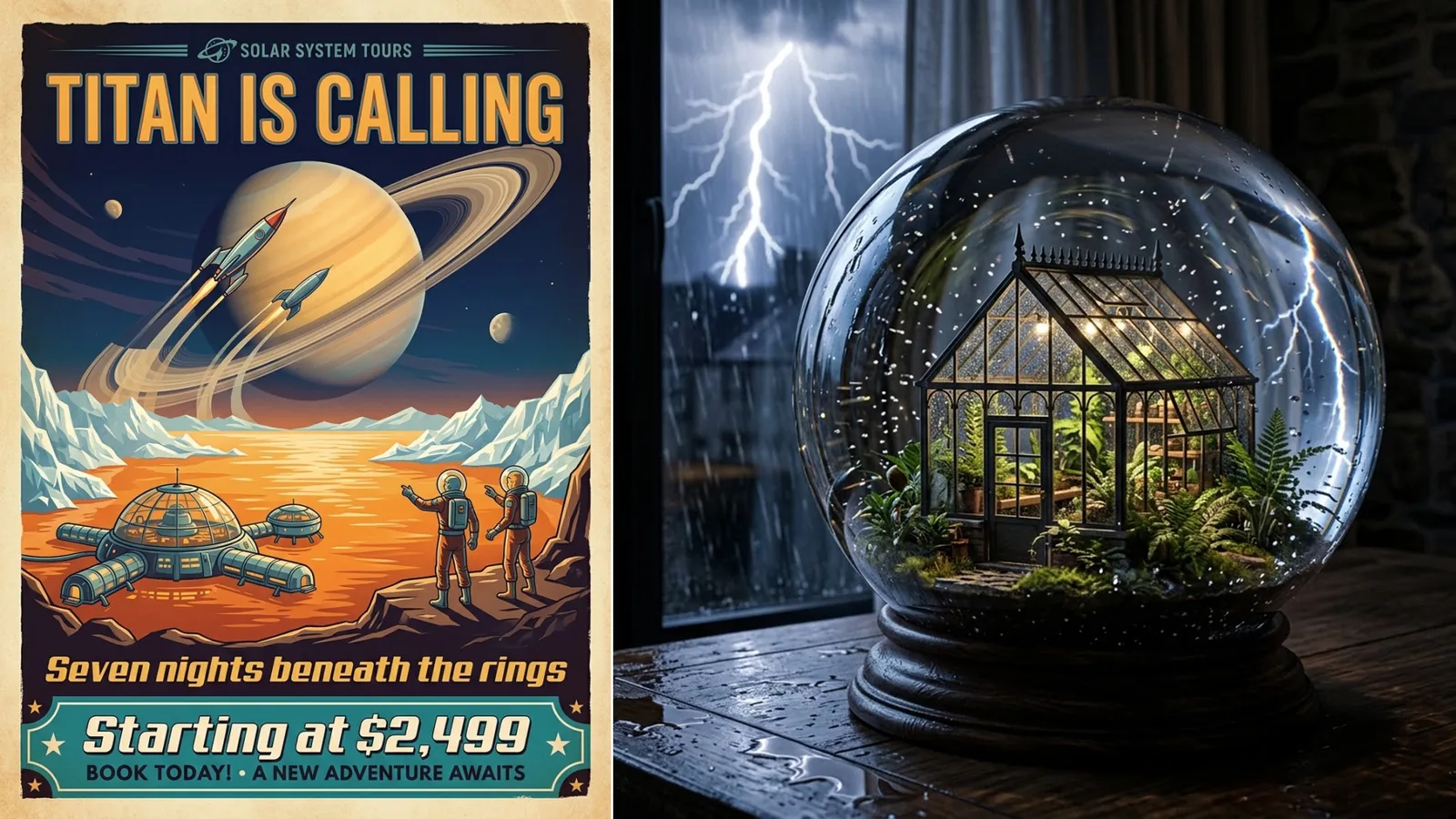
Four identical prompts for Gemini and ChatGPT
The test used the same wording for both systems and placed results side by side, with ChatGPT on the left and Gemini on the right. The four briefs covered glass and reflections, poster typography, a four-panel story with one recurring character, and a desk scene with several exact objects. Access to the new Google model depends on plan: Google AI Plus, Pro and Ultra subscribers receive Nano Banana 2.1 as the default, while free users remain on Nano Banana 2. OpenAI counters with Images 2.5, credited for realistic lighting, complex compositions and improved text rendering.
The first prompt asked for a photorealistic tiny Victorian greenhouse inside a glass snow globe during a thunderstorm, with reflections, refractions and lighting. ChatGPT built an elaborate golden-lit greenhouse in a large sphere on a polished wooden base beside a rain-covered window, with lightning outside and plants, pathways and architectural flourishes inside. Nano Banana 2.1 chose a more restrained miniature with dark metal framing, lush greenery and warm interior light against a blue-gray storm. Its globe reflections and natural lighting looked convincing, although the wet tabletop seemed odd for an indoor scene.
The typography test requested a retro-futuristic travel poster for Titan with the exact lines "TITAN IS CALLING," "Seven nights beneath the rings," and "Starting at $2,499." ChatGPT produced a luxurious advertisement with Saturn over an orange landscape, resorts and a couple with drinks, but left a gap between "$" and "2" in the price. Google produced a colorful vintage science-fiction poster with rockets, astronauts, icy mountains and a futuristic base, reproducing all three text strings correctly. The stylistic split was clear: OpenAI leaned toward premium travel advertising, Google toward a weathered 1950s space poster.
What the close result means for business use
For marketing and content teams, the practical change is that short text prompts now yield usable creative drafts without the melted letters and distorted objects that once betrayed synthetic images. A travel poster, fantasy cover or product-scene mockup can move from idea to several visual directions in one session. Small companies gain a fast concepting tool inside an existing Gemini or ChatGPT subscription, while larger teams can generate more variants before committing designer time to final artwork and brand compliance.
The remaining differences point to where verification is still required. In the four-panel comic about an orange fox in a green scarf finding a key and entering a library, Google kept panels, outlines and character details more consistent, while ChatGPT images looked more elaborate but varied in proportions and felt like separate illustrations. In the overhead desk test with a dragon notebook, north-pointing compass, watch at 3:15, exactly three red wax seals and a blue gemstone, ChatGPT placed all items correctly, while Google set the watch to 3:00. Buyers should therefore check text spacing, counts, times and character continuity.
The marker to watch is whether Google extends Nano Banana 2.1 beyond paid Plus, Pro and Ultra tiers and whether OpenAI answers with tighter consistency and counting. If default availability widens and error rates on text and small details keep falling, image generation becomes a commodity feature of office suites. The choice will then rest on ecosystem fit, rights management and repeatability rather than which demo looks better.
