
Google has moved two new text-to-speech models into its cloud platform, with Gemini 3.8 Flash TTS and Gemini 3.8 Flash-Lite TTS taking the first and second places on an audio quality benchmark from Hume AI. The models support 130 and 101 languages respectively and share a library of more than 2,000 prepackaged voices. For companies, this matters because expressive speech output is shifting from an experimental feature to a production channel for content and customer interaction.
Two models with shared interface and split roles
The two models use highly similar application programming interfaces, so developers can run them side by side without rebuilding integration logic. Flash-Lite TTS is positioned for cost efficiency and inference speed, while Flash TTS trades higher price for better audio quality. Google points to audiobook creation as a natural fit for the higher-quality option. The language gap is material at launch: 130 languages for Flash TTS against 101 for Flash-Lite TTS. That split frames the choice as quality and coverage versus throughput and operating cost.
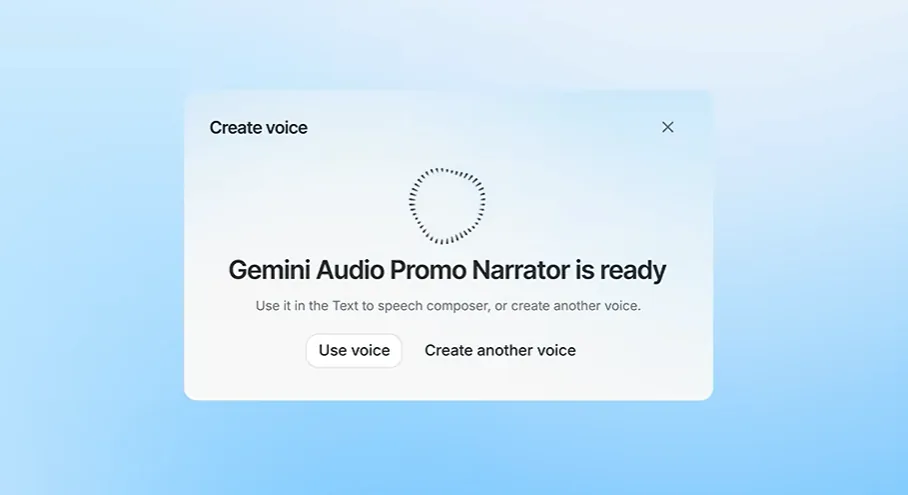
Voice design starts from the shared library of more than 2,000 prepackaged voices, adjustable through natural language prompts for timbre, accent and pacing. A second path builds a synthetic voice from a 30-second audio sample, with Google requiring the speaker's consent before a replica can be generated. A third path is planned but not yet available: creating a new voice by modifying a prepackaged option. Delivery can also be directed line by line with oratory cues that control non-lexical vocalizations and pacing shifts.
On the Hume AI audio quality benchmark, Flash TTS ranked first and Flash-Lite TTS ranked second. Both models also outperformed competing systems on several language-specific versions of Voice Arena, which scores output quality from human feedback. Google staffers Leland Rechis and Alan Cowen linked the models to richer audio for creators and enterprises, including use in Gemini Notebook and Google Vids. The release extends an existing audio lineup for voice agents, transcription and translation.
What this means for business voice projects
For operating teams, the practical effect is a two-tier supply of synthetic speech inside one cloud ecosystem. A small company can keep high-volume prompts and draft narration on Flash-Lite TTS and move only customer-facing titles to Flash TTS where voice quality affects retention. A large publisher can standardize audiobooks on the higher-quality model while keeping auxiliary content on the lighter one. Because the interfaces match, routing by content type avoids separate vendor contracts and parallel pipelines.
Google discloses the quality-for-price tradeoff but gives no price points, so unit economics for long-form audio must be modeled from cloud rate cards. Consent for 30-second voice replicas and approval for cloned voices need documented procedures before deployment. Output carries an inaudible SynthID watermark detectable by AI tools, plus a C2PA record noting when a file was generated and whether it was modified. Buyers should test target languages on their own scripts, since benchmark leadership does not guarantee equal results on specialized terms.
A concrete marker to follow is the arrival of the promised third customization option for editing prepackaged voices, alongside sustained placement of both models in Hume AI and Voice Arena rankings. If the editing option ships and enterprise content appears in Gemini Notebook and Google Vids with these voices, the lineup will have moved from benchmark success to routine production use. That combination would confirm demand beyond testing.