
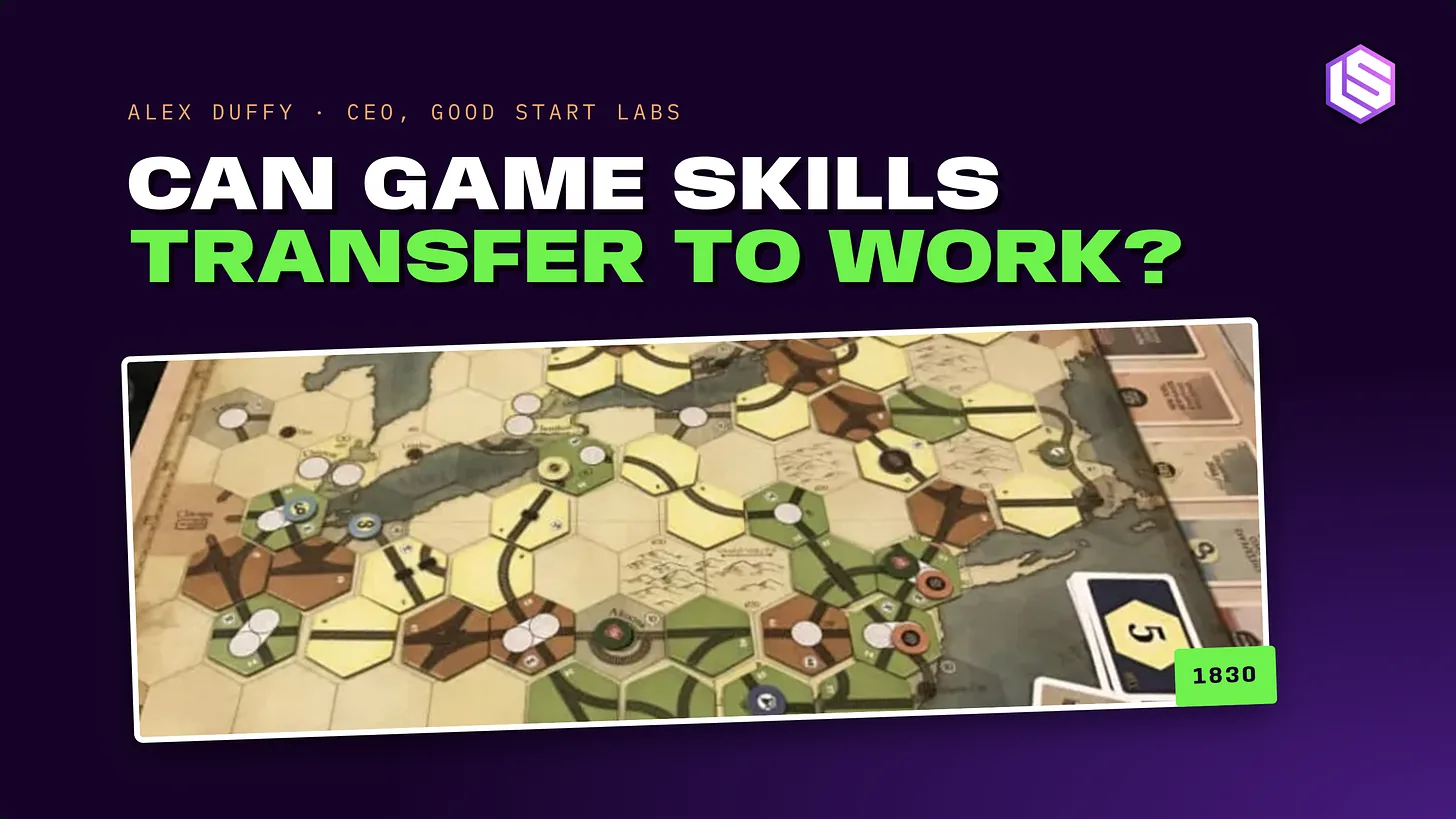
Good Start Labs trained a 30B model inside the board game 1830: The Game of Railroads and Robber Barons and then tested it on financial research tasks. Only one of two training designs improved the model's result on the Finance-Agent benchmark, while both improved play inside the game. The outcome matters because it shows that the way an AI is trained on a game, not the game itself, decides which skills carry over into work.
What the 1830 experiment showed
The company compared two approaches. In the first, the model received a single game state and had to name the next move. In the second, described as a multi-turn terminal agent, the model used tools to explore its environment, plan a strategy and adapt in real time. Both designs raised their in-game objectives, but only the terminal-agent version improved performance on Finance-Agent. The game itself contains a stock market mechanic: players bid on shares of railroad companies to build a logistics network. Good Start Labs set up tasks in which the model searches a database for information about how the game has been played, puts it into an Excel file, reasons over it, writes functions inside the file and calculates the answer there. According to co-founder and CEO Alex Duffy, this mirrors a typical finance workflow, only performed inside the game.
The harness, meaning the software layer that presents the game to the model, turned out to be the decisive part. Duffy said the same game can be approached in different ways, and how that layer is designed changes what the model can learn. A model looking at pictures learns different things from one reading natural text, and both differ from a model that has everything framed as Python. Good Start Labs can also add an expert model that supplies denser, stepwise rewards instead of a single win-or-lose signal. The company's stated goal is to work out how to design a learning environment that teaches specific capabilities. The same question runs through COS-PLAY, a paper Duffy and co-founder Tyler Marques co-authored with researchers from several universities, where a decision agent draws on a learnable skill bank while a separate skill-bank agent studies the trajectory and updates that bank for the next run.
What this means for companies buying AI training
Good Start Labs sells data and learning environments rather than finished applications. Its main customers are frontier labs that buy reinforcement learning data to train their own models. The data comes in two forms: trajectories of agents playing games, recording what an agent observed, decided, did and what followed, and custom data for game publishers whose titles host live agents. Duffy said any data sold to model developers is anonymized and stripped of personally identifiable information. The learning environments are full games that models can play end to end, and the point is not winning but solving problems, including tasks where the game engine serves as a verifiable source of rewards while the model works in an unexpected way.
The origin of the company lies in a 2025 Twitch stream in which frontier models played Diplomacy, a game Duffy said normally takes days or weeks. Watching it, he noticed that OpenAI's o3 won by planning a future betrayal, while Claude Opus 4 refused to lie and, in his words, got destroyed. That contrast suggested games with verifiable outcomes could teach strategic thinking. In a later article on Every, Duffy wrote that fine-tuning a model on Diplomacy improved its performance on customer support and industrial operations benchmarks. Good Start Labs was spun out of the media and tools company Every in October with $3.6 million from General Catalyst, Inovia, Every and angel investors. Duffy had worked at Every as head of AI training.
The practical consequence for companies that adopt AI is that the training environment becomes a purchasable asset, separate from the model itself. A business that needs an agent to follow a fixed procedure, such as pulling figures from a database into a spreadsheet and calculating a result, can now buy an environment built around that procedure instead of relying on prompt instructions. The 1830 case suggests the gain shows up in multi-step tool use, not in single answers. For a small company this mostly means choosing a vendor whose environment matches its workflow; for a large one it means deciding whether to buy such environments or build them internally, since the harness, not the base model, is where the behavior is fixed.
What the result does not establish is how far the transfer reaches. Duffy said today's evidence supports that goal-directed execution matters and that reasoning transfers, citing a Surge AI article showing office work post-training improved coding and noting that DeepSeek R1 demonstrated it more broadly. He also said the company has seen it twice itself, in the 1830 finance task and in Diplomacy training that produced a better customer support agent, and that every environment it has built improves tool use downstream. Broader and more reliable transfer, however, remains an open question. Buyers should ask which benchmark was used, whether the task structure matches their own, and whether the improvement holds on models newer than the one tested.
The marker to watch is whether Good Start Labs' general model, trained from the expert models built for individual games, delivers gains outside game settings. Duffy said the aim is to unify those expert models into a general game intelligence applicable everywhere. If that model improves results on tasks unrelated to any game, the approach becomes a standard line item in AI training budgets; if the gains stay inside structurally similar tasks, it remains a tool for narrow, verifiable workflows.