
Robotics software developer FieldAI is seeking $700 million in new funding at a valuation of about $10 billion, according to Business Insider. The round would value the company at five times its level last August, and a term sheet has reportedly been signed. Revenue and customer contracts have grown from more than $100 million in June to over $135 million. For industrial automation, the deal matters because it funds a mapless navigation stack already used by more than 30 customers.
Terms of the round and FieldAI traction
Business Insider cited a single source for the fundraising terms, without naming expected participants in the round. The agreement described is a term sheet, a nonbinding preliminary version of a fundraising document. Large growth-stage rounds often include existing backers, and FieldAI counts Bezos Expeditions, Nvidia NVentures and Intel Capital among its investors. The reported $10 billion valuation implies a sharp repricing in about 14 months since last August. That repricing coincides with reported growth in combined revenue and contracts from $100 million to $135 million.
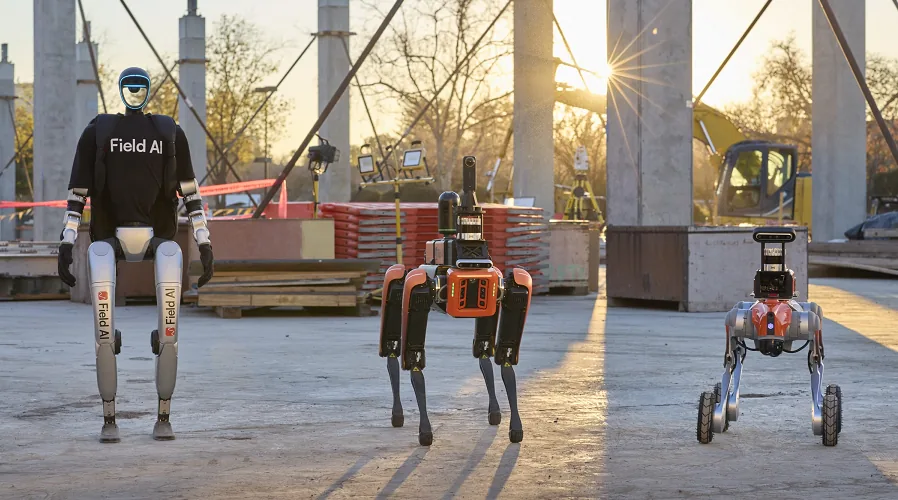
FieldAI builds AI models that let robots navigate without a prebuilt map, GPS access, an internet connection or user-defined travel paths. Engineers normally must map operating areas in advance, a process that becomes costly across large sites and loses accuracy when places such as construction sites change. Removing those dependencies cuts setup work for the navigation stack and lowers the cost of automation projects. The models adjust behavior in response to risk, for example slowing a robot in a factory zone with faulty lighting. The result is fewer collisions and navigation errors in unstable conditions.
Industrial robots using the software combine cameras with lidar, radar and other sensors, and FieldAI converts that sensor data into a digital twin of the deployment site. Unlike a static simulation, the twin is continuously updated with real-world data, which improves accuracy of the representation. Customers can use those twins to test site changes virtually before making physical modifications to a factory floor. The same twins can support AI training, creating a loop between operations and model improvement. The company says its models run on systems ranging from autonomous vehicles to humanoid robots.
What the funding means for automation buyers
For companies deploying robots in construction, energy and the public sector, mapless operation changes project economics and timelines. Sites that change frequently no longer need constant remapping, while GPS-denied or disconnected areas become easier to automate. A manufacturer can start with inspection or material movement without building detailed travel paths first. Small firms gain because deployment needs less specialist mapping labor, while large operators gain by replicating the same stack across many facilities. The March integration with Boston Dynamics Spot for equipment inspection shows how the software attaches to existing hardware fleets.
Buyers should still verify fit against their sensor mix, robot types and safety requirements before committing. FieldAI reports support for varied platforms, but performance depends on cameras, lidar, radar and site complexity. Risk-sensitive behavior such as slowing in poor lighting helps, yet it does not replace site safety rules and human oversight. The $135 million figure blends revenue and customer contracts, so it does not by itself disclose recurring income or margins. Questions to vendors include offline operation limits, update frequency of digital twins and responsibility for navigation failures.
The marker to watch is whether the $700 million round closes at or near the reported $10 billion valuation. A second signal is growth in contracted deployments beyond the current base of more than 30 customers across construction, energy and public-sector work. If both capital and customer expansion materialize, mapless navigation and continuously updated twins could become a standard procurement option. That would shift competition toward software reliability rather than mapping services.