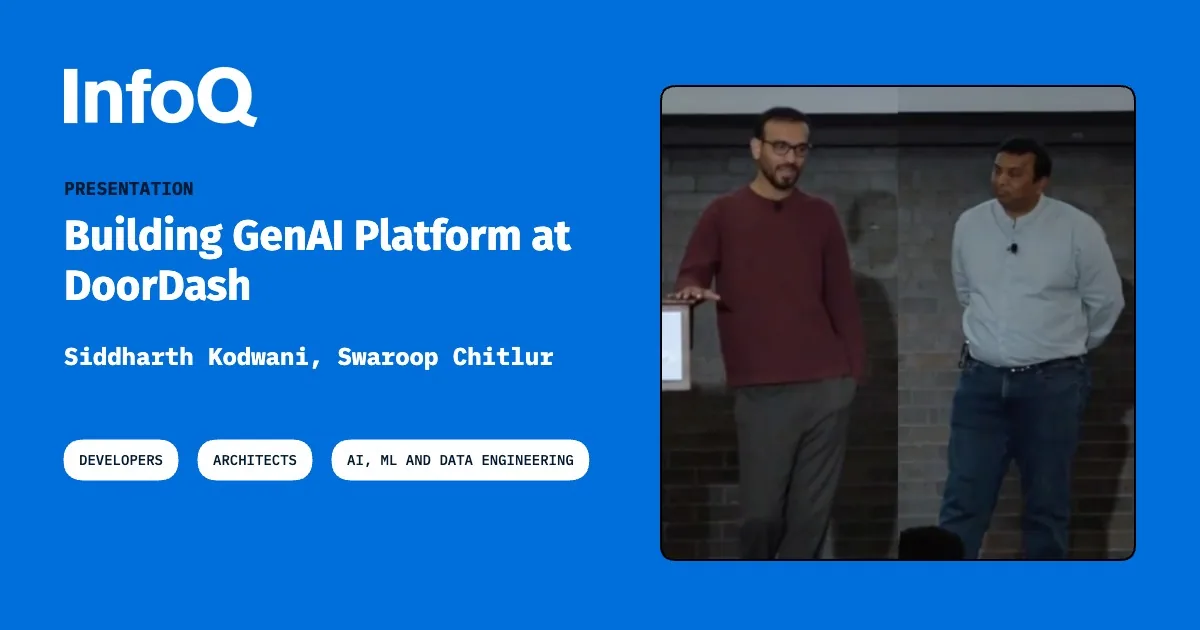
DoorDash has built an internal generative AI platform that now serves more than 5,000 employees, with 45 new users onboarding every day. Platform lead Swaroop Chitlur and engineer Siddharth Kodwani described the journey at a recent engineering presentation, starting from an OpenAI contract in April 2023. About 40% of platform users are now non-engineers from legal, sales, operations and strategy. The case matters because it shows how a large company moved from scattered model experiments to managed infrastructure.
From vendor contracts to a single gateway
The project began a few months after the ChatGPT launch in November 2022, when DoorDash decided to start using OpenAI models. Chitlur recalled negotiating that first contract with concern about cost and accountability, a figure that later looked minor as usage grew. The team was formed under the ML platform organization with a blank slate and a mandate to support productive use across the company. Early outreach changed its assumptions about the audience, shifting focus from machine learning engineers to all product engineers. That led to an API-first approach built around SDKs rather than notebooks, GPUs and direct compute access.
The central technical bet was an LLM Gateway offering one API and one SDK for many providers. Product teams wanted to test OpenAI, Claude, Gemini and open-weights models without building separate plumbing for each one. New models were appearing every couple of months, so teams needed to switch models with a single change and compare performance quickly. The gateway team handled integration, routing and provider differences on behalf of users. Capacity limits and rate limits made fallbacks necessary, since teams could not rely on a single vendor being available. The design prioritized user velocity while adding reliability and accountability as adoption widened.
The team framed its value around business impact rather than general chatbots or coding assistants. After interviews with product engineers, it grouped early demand into automation, recommendations and personalization. Automation was seen as reducing costs, while recommendations and personalization were seen as supporting revenue. From that analysis came a clear positioning: help product teams balance accuracy, latency and cost for each use case. Operating principles included customer obsession, building products rather than disconnected systems, and making best practices the default path. The team also had to demonstrate value both to engineering users and to internal stakeholders funding the work.
What this means for companies scaling AI
For companies adopting AI, the DoorDash example points to a gateway model that lowers the cost of experimentation. A single interface lets product teams compare models and move workloads when pricing, quality or availability changes. Central handling of fallbacks and routing reduces downtime caused by provider rate limits. Small firms can replicate part of this with managed gateways and standard SDKs, while large firms gain more from unified logging, budgets and access controls. The benefit appears in everyday work when a team can test a new model without rewriting integrations.
The same centralization creates choices that require careful review. A gateway team must decide which models to support, how fallbacks affect response quality, and how latency and cost trade-offs are exposed to developers. DoorDash explicitly excluded coding agents and general chatbots from this platform to keep focus on product use cases. That boundary may not fit every organization, especially where engineering productivity tools are a priority. Buyers and builders should ask how model evaluations are run, who sets accuracy and cost thresholds, and how non-engineer usage through APIs is governed.
A useful marker will be whether DoorDash extends the platform from model routing toward workflows and agents while keeping the same accuracy, latency and cost discipline. Further detail on open-weights migration, evaluation methods and agent infrastructure would show how durable the architecture proves to be. Continued growth beyond 5,000 users and sustained daily onboarding would indicate that non-engineer demand remains strong. Those signals will help other firms judge when a full platform team becomes justified.