
Amazon Web Services introduced Trust in Depth, a layered approach that lets AI agents act without human approval when their actions can be verified, reserving people for judgment calls. The model answers enterprise leaders who want more autonomous work but do not trust agents to behave the same way twice. It builds on Defense in Depth discipline practiced for two decades, but reverses the goal from limiting damage to expanding what is safe to allow. For business, this matters because review of every step creates fatigue and leaves capable agents idle on valuable work.
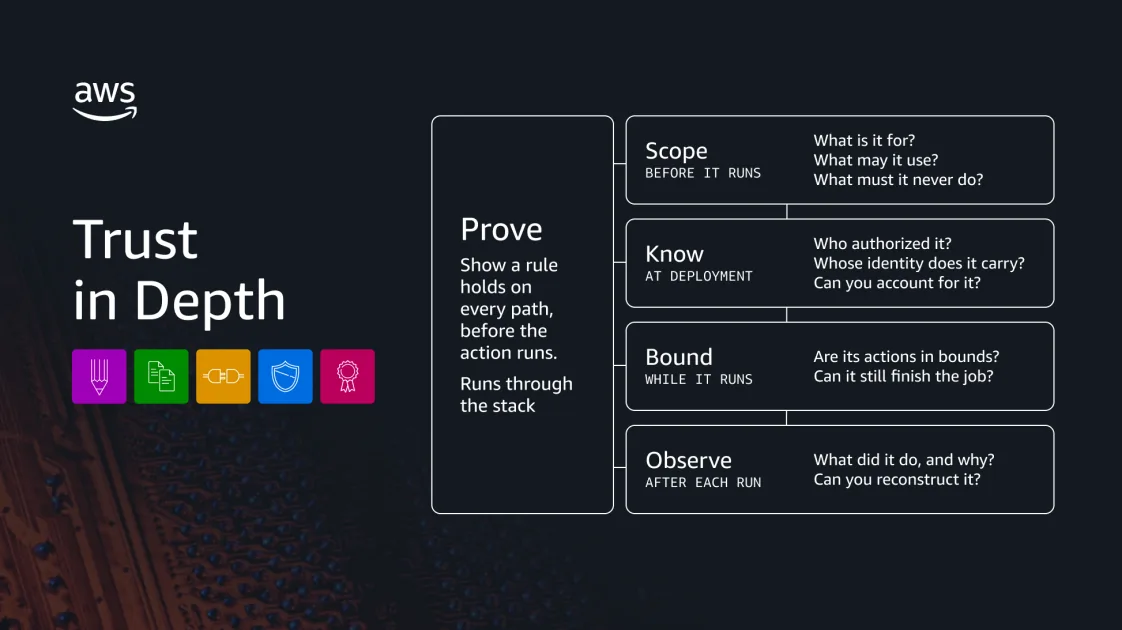
How AWS scopes, identifies and bounds agents
Scoping starts before launch and, according to AWS, deserves the most effort because fixes are cheapest at that stage. Teams must define what work the agent owns, which tools, data and services it may reach, and when it must stop and ask a person. A vague instruction such as "resolve the customer issue" states the goal but not permitted methods, so access should follow least privilege. AWS warns against bundled permissions, where an admin role granted for one task inherits rights across the whole environment.
The build stage turns intent into enforceable rules with several AWS instruments. Kiro, the agentic coding system, converts high-level intent into structured spec-driven requirements and uses automated reasoning to surface contradictions and gaps before code is written. Strands supplies an open-source toolkit for model, instructions and tools plus a managed runtime. Amazon Bedrock AgentCore Policies then express in plain language which tools, APIs and data are allowed, while automated reasoning checks policies for overbroad grants and unsatisfiable contradictions before enforcement.
The context is the failure of single controls to guarantee repeat behavior. Content filtering, testing and monitoring each help, yet a test passed today says little about a different path tomorrow, since agents choose tools and sequence steps themselves. Human-in-the-loop approval works at small scale but collapses under volume as reviewers stop catching material errors. AWS cites more than a decade of automated reasoning in production, from Identity and Access Management at more than 2.1 billion requests per second to Nitro Hypervisor, S3 Block Public Access and VPC Reachability Analyzer, now extended to agents.
What this means for companies adopting agents
For operating teams, the practical shift is differentiated autonomy tied to verifiability. Precisely stated rules such as only a manager approves access or blocking sign-in before mailbox sharing can be checked across every possible path, not just anticipated cases. Limits are enforced outside agent reasoning through AgentCore Gateway on every tool call, so a buggy or prompt-injected agent cannot disable its own controls. Temporal policies adjust permissions as session risk evolves, while Bedrock Guardrails filters content and redacts sensitive data.
Not every expectation can be proven, and that boundary shapes vendor selection and oversight. Requirements such as keeping a friendly tone or handling sensitive situations depend on context and need evaluation, access limits and escalation to a person. Every agent needs its own identity checked on each request, supported by AWS Agent Registry as an approved catalog of agents, Model Context Protocol servers, tools and skills with approval workflows. What the news alone does not establish is cost, integration effort and false-positive rates, so buyers should ask how policies handle combined permitted actions and full sequences.
The marker to watch is whether precise policies verified by Automated Reasoning checks move from pilots into financial transactions and other high-stakes tasks without expanding manual review. If AgentCore identities, Gateway enforcement and Registry approvals become standard operating controls, autonomy will scale beyond low-risk work. If adoption stalls at filtering and sampling, agents will remain assistants rather than owners of processes.
