
Anthropic opened an office in Singapore, its fifth in Asia-Pacific, and signed a Memorandum of Understanding with the Ministry of Digital Development and Information on October 14, 2026. The agreement covers AI safety, model evaluation, adoption research and responsible deployment across public and private sectors. Singapore ranks second among 121 countries for Claude. ai usage relative to population, at nearly six times the expected level, which explains why the partnership matters for business deployment in the region.
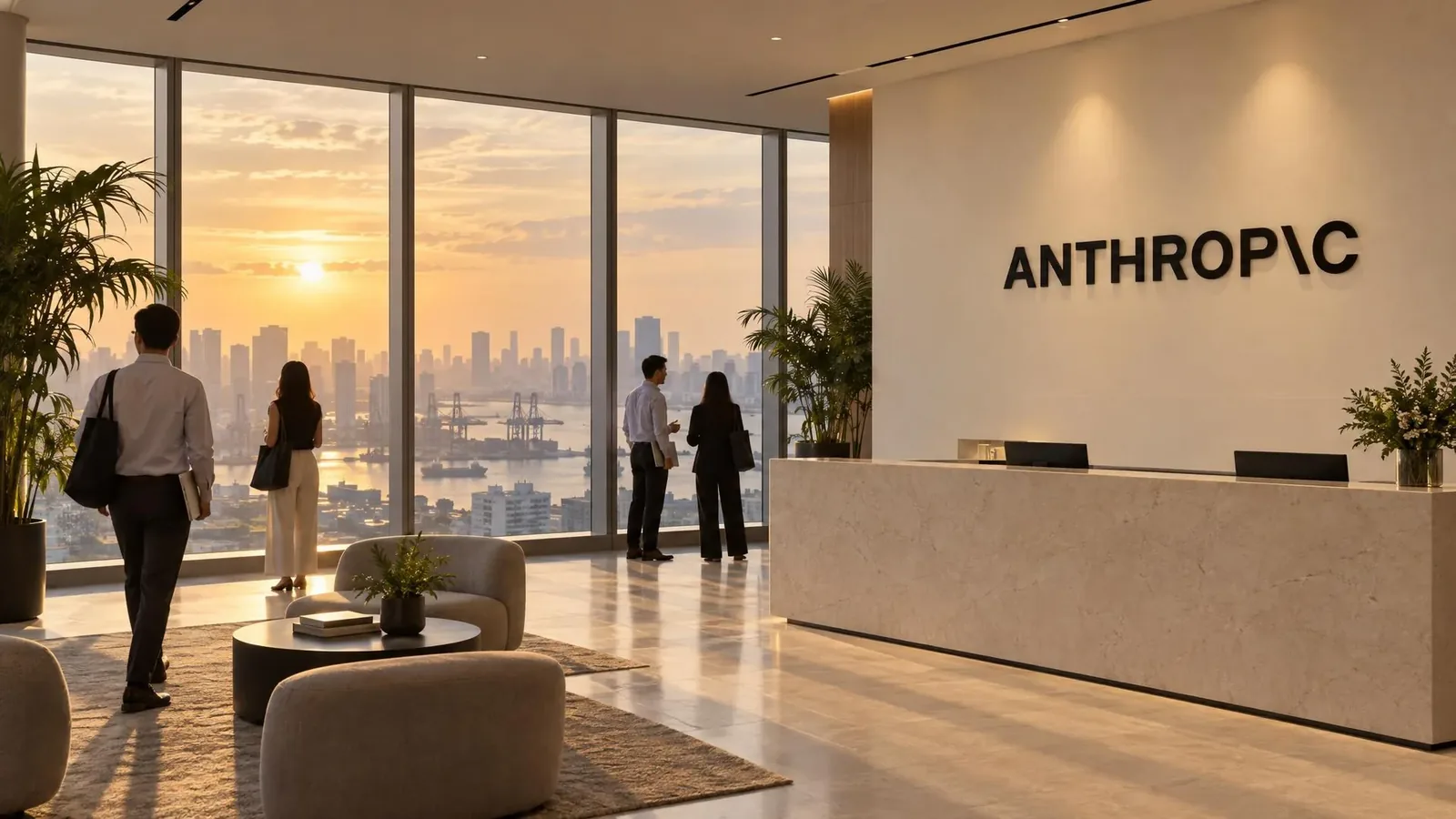
Office opening and terms of the government agreement
The MOU was signed on the sidelines of Singapore International Cyber Week by Permanent Secretary Kai Fong Chng and Anthropic co-founder Ben Mann. Minister Josephine Teo and Anthropic head of APAC policy Michael Sellitto witnessed the signing. Dale Finlay, general manager of ASEAN, said Singapore customers set a high bar for reliability and security, and a local team brings the company closer to organizations using Claude on complex tasks. The Singapore office is open and hiring, with senior leaders in the city meeting customers, developers and policymakers.
Under the MOU, Anthropic will hold technical exchanges with Singapore AI safety, security and assurance institutions on model evaluation, testing standards and incident response. The company said similar cooperation with safety institutes elsewhere gives governments clearer insight into frontier capabilities and risks while helping developers build safer models. Anthropic also plans to share research and data, including from the Anthropic Economic Index, and to contribute technical and policy expertise as Singapore develops AI rules. Support for AI skills, responsible adoption by small and medium-sized businesses and capability building among public officers are listed as further directions.
Cooperation builds on work dating to 2023, when Anthropic joined the Generative AI Evaluation Sandbox run by the Infocomm Media Development Authority and the AI Verify Foundation. The company later partnered with both organizations on a red-teaming project across English, Mandarin, Malay and Tamil. Co-founder Mann called Singapore a leader in responsible AI with years of investment in model testing and evaluation. Chng said Singapore seeks to enable innovation while keeping pace with evolving risks, with trust as a condition for confident use by businesses, workers and the public.
What the Singapore deployment means for business
For companies operating in regulated markets, the Singapore cases show a pattern of deployment inside existing security and governance controls. DBS, described as Southeast Asia largest bank, uses Claude for software development and daily productivity within its own framework. GIC is rolling out Claude across investment and corporate services teams. Anthropic said regulated organizations can run Claude with in-region inference on Amazon Bedrock, a configuration presented as a way to meet strict data processing requirements without changing cloud providers.
Technology and public-sector examples point to measurable operational effects rather than pilots. More than 1,500 engineers and technical staff at GovTech Singapore use Claude Code to modernize systems and accelerate software delivery at national scale. Grab powers its BriX sales assistant with Claude, saving sales teams roughly 40,000 hours per quarter and surfacing new opportunities. Sea uses Claude for Shopee customer service chatbot responses, while thousands of its employees write and debug code, and Supabase builds with Claude Code. The Cyber Security Agency of Singapore is exploring Claude for cyber defense.
The marker to watch is whether technical exchanges produce shared evaluation methods, testing standards or incident-response practices that other agencies and enterprises adopt. A second signal is hiring and local activity, including the Builder Summit Singapore on October 14 with more than 300 developers and a prior community meetup of more than 700 builders. If safety cooperation turns into published standards and enterprise deployments expand inside regulated controls, the Singapore model will serve as a reference for AI rollout across Asia-Pacific.
