
Data movement, not processor speed, has become the central limit for AI infrastructure, and the industry will address it directly at the AI Data Pipeline Forum in San Jose, California on Oct. 13. The event runs during the OCP Global Summit and brings together leaders working on dense AI clusters and distributed inference. Coverage will come from theCUBE, SiliconANGLE Media's livestreaming studio, hosted by executive analyst John Furrier. The focus matters for business because inference costs now depend on storage, memory, networking, power and cooling working as one system.
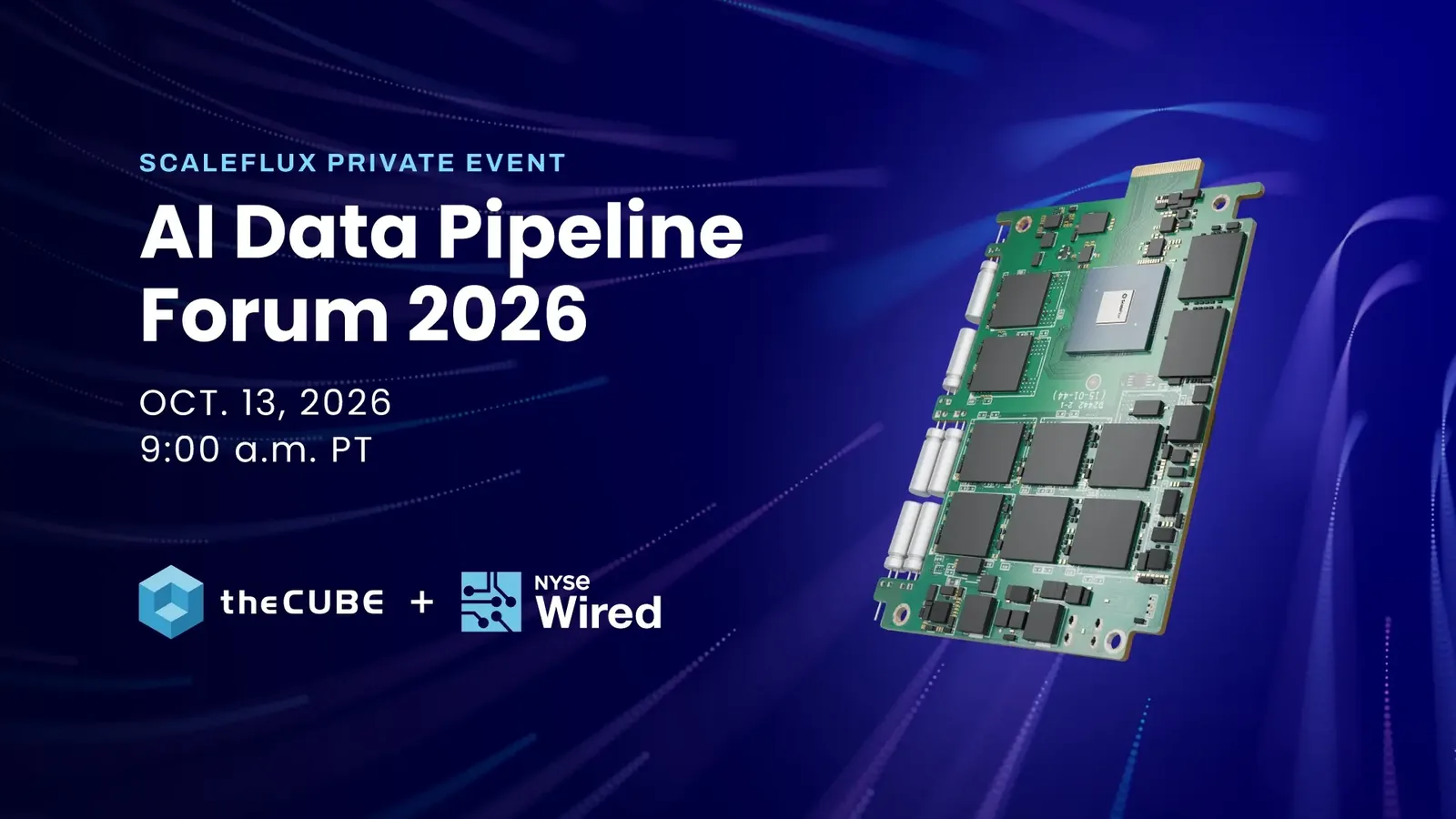
Forum agenda and participants on Oct. 13
Furrier will host conversations with executives from ScaleFlux, Cerebras, Cisco, Dell and others during theCUBE's Oct. 13 broadcast. The talks will cover storage, memory, high-speed networking, liquid cooling and power distribution, plus the role of open standards and modular architectures. TheCUBE will stream the discussions on its website and YouTube channel, with on-demand access after the live event. SiliconANGLE Media, founded by John Furrier and Dave Vellante, says its brands reach more than 15 million technology professionals. TheCUBE is listed as a paid media partner for the forum, with sponsors having no editorial control over content.
The technical program centers on keeping chips supplied with data and connected through high-speed networks within power and cooling limits. ScaleFlux develops storage and memory controller technologies aimed at data movement constraints in memory-intensive AI workloads. In July it introduced the FC6116 PCIe Gen6 SSD controller and MC600 CXL memory controller, designed to raise throughput and memory capacity while managing power use. Dell Technologies is advancing rack-scale architectures for higher compute density and operational demands. Director Sarat Krishnan described modular rack-scale infrastructure that adapts to top and bottom cooling and power whips of various sizes.
The forum takes place as infrastructure design moves from tuning single components to coordinating entire systems across compute, storage and networking. Research from theCUBE Research chief analyst Dave Vellante points to memory constraints, data movement inefficiencies and inference economics as growing pressures, with storage playing a more active role in the AI pipeline. ScaleFlux co-founder and chief executive Hao Zhong framed the FC6116 and MC600 as building blocks for faster and more flexible storage and memory systems in the PCIe Gen6 era. That shift explains why the agenda links silicon, system design and physical infrastructure rather than treating chips alone.
What this means for companies running AI
For companies operating AI workloads, the practical result is a wider buying checklist that goes beyond accelerators to throughput, memory capacity and operating overhead. Inference expansion makes efficient movement of data through complex hardware a direct measure of performance and cost control. Storage choices, memory expansion through approaches such as CXL, and network capacity determine whether expensive compute stays utilized. Large operators feel this first in cluster design and power budgets, while smaller firms feel it through cloud instance availability, latency and the price of inference-heavy applications.
The same system view raises new selection criteria around modularity, standards and facility readiness. Modular rack-scale designs and open standards are presented as ways to support denser systems without adding fresh bottlenecks in cooling or power delivery. Buyers still need to verify compatibility of controllers, memory modules, networking and cooling with their data center constraints. The forum material does not by itself promise specific performance gains or cost reductions, so questions about measured throughput, power draw, deployment timelines and support terms remain central before committing to a vendor path.
A concrete marker to watch is what participants report after Oct. 13 on open standards and modular designs for dense clusters and distributed inference. Follow-up interviews, Breaking Analysis segments and theCUBE Pod discussions with Furrier and Vellante will show whether storage, CXL memory and rack-scale methods move from product introductions into documented deployments. If vendors cite joint implementations and operating data, the system-level approach will have gained commercial weight for AI buyers.